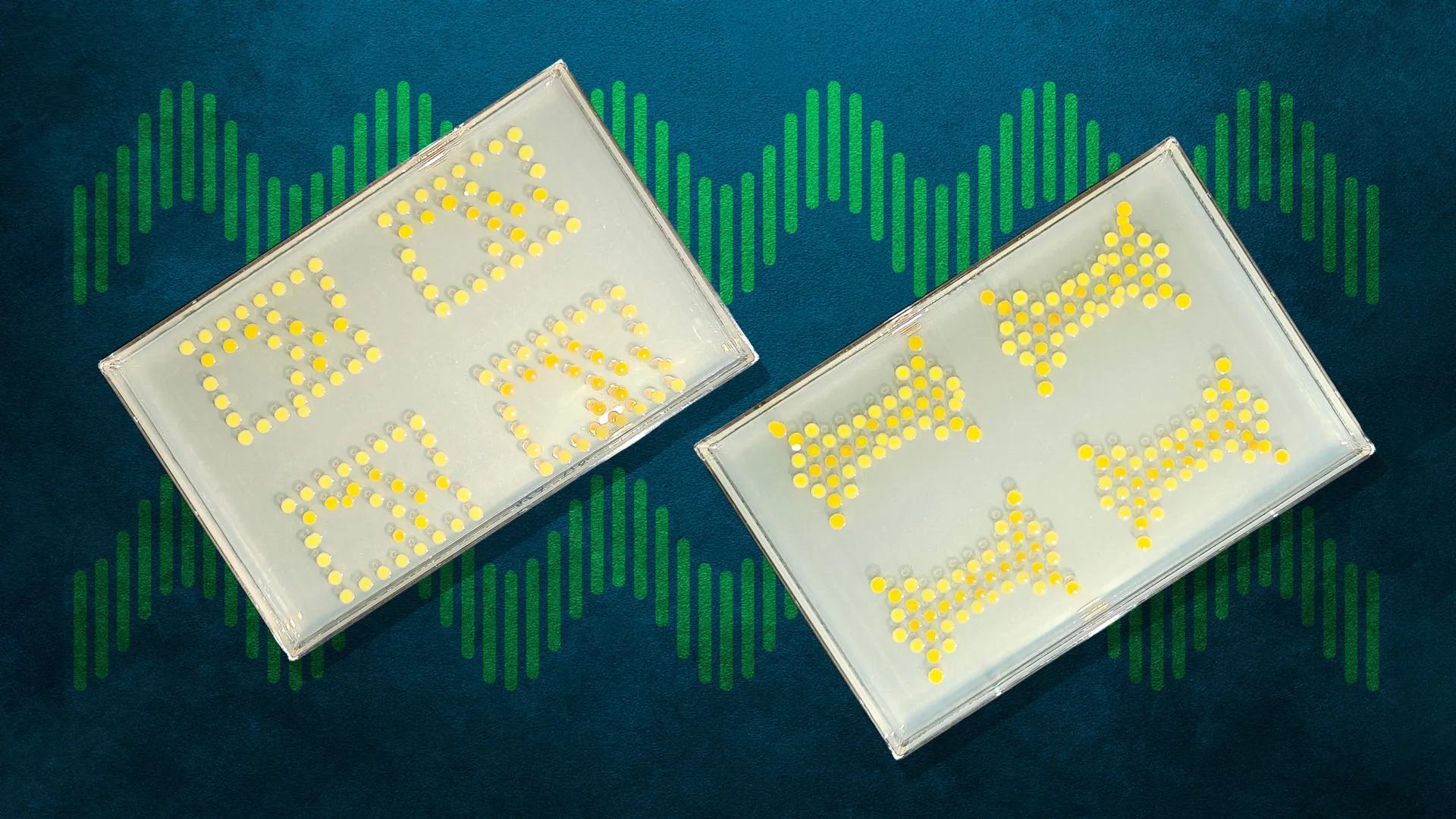
Эрдэмтэд бактерийн эсийг ашиглан дохио дамжуулах болон боловсруулах чадвартай биологийн хэлхээг амжилттай туршиж, хөдөө аж ахуйн салбарт ашиглах боломжийг нээлээ.
MIT-ийн Биологийн инженерчлэлийн тэнхимийн судлаачид Pantoea agglomerans хэмээх бактерийг ашиглан электрон транзистортой ижил үүрэг гүйцэтгэх амьд эсийн системийг бүтээжээ. Эдгээр бактериуд нь дохионы молекулуудыг зохицуулах замаар мэдээллийг дамжуулж, уламжлалт цахилгаан хэлхээний нэгэн адил логик үйлдлүүдийг гүйцэтгэдэг. Судлаачид нийт таван төрлийн бактерийн омгийг ашиглан хоёр болон гурван оролттой дохиог нэгтгэх, чиглүүлэх чадвартай 24 колони бүхий нарийн хэлхээг угсарчээ.
Энэхүү судалгаа нь нэг эсэд хэт их ачаалал өгөхөөс сэргийлж, тус бүрдээ өөр өөр үүрэгтэй бактерийн колониудыг хооронд нь холбох модулийн аргыг ашигласан байна. Агарын тэжээлт орчин дээр байрлуулсан бактериудын хоорондын 5 мм-ийн зай нь химийн дохиог зөвхөн дараагийн колони руу нэг чиглэлд дамжуулах боломжийг олгожээ. Nature Chemical Biology сэтгүүлд нийтлэгдсэн уг бүтээл нь биологийн эсүүд дэх тооцооллын удирдлагыг сайжруулах шинэлэг шийдэл юм.
Энэхүү технологийн гол давуу тал нь ургамлын үндэс эсвэл навчин дээр суулгаснаар хүрээлэн буй орчны нөхцөл байдлыг тандах боломжтойд оршино. Бактериуд ган гачиг эсвэл хортон шавьжийн халдлага зэрэг стрессийн үед тодорхой дохиог хүлээн авч, шаардлагатай хариу үйлдэл үзүүлэх буюу мөөгөнцрийн эсрэг бодис ялгаруулах зэргээр ургамлыг хамгаалах чадвартай. Гэсэн хэдий ч биологийн хэлхээний тооцоолол хийх хурд нь электрон компьютерийг бодвол удаан буюу найман цаг орчим үргэлжилдэг нь хязгаарлалт болж байна.
Судлаачдын үзэж буйгаар энэхүү хурд нь ургамлын ургалтын улиралтай харьцуулахад хангалттай бөгөөд уг системийг компьютерийг орлуулах бус, харин биологийн процесст тооцооллын удирдлага нэвтрүүлэх зорилгоор ашиглах юм. Уг төслийг АНУ-ын Батлан хамгаалахын дэвшилтэт судалгааны төсөл (DARPA) болон Тагнуулын дэвшилтэт судалгааны төсөл (IARPA) санхүүжүүлжээ.
Дэлгэрэнгүйг эх сурвалжаас харах
↓Эх сурвалжийг нээх ↓
MIT researchers have engineered bacteria to work like transistors, creating living “circuit boards” that can be printed onto growth material inside a Petri dish.
In conventional electronics, transistors act as switches that control whether electrical current can pass through a circuit. In the MIT system, engineered bacterial cells perform a similar role by regulating the movement of small signaling molecules. Those molecules then carry information to other components in the biological circuit.
The researchers created two types of bacterial transistors and three additional bacterial strains that act as relays between them. Together, these five strains provide a modular set of components that can be arranged to build nearly any kind of circuit. In the new study, the team demonstrated circuits capable of adding two or three inputs and directing a single input toward a selected destination.
“We’ve built some initial computer architecture components that are commonly used, but any operation can be built with these five strains,” says Hamid Doosthosseini PhD ’25, an MIT postdoc and the lead author of the new study.
One potential use is to place these living circuits on plant leaves or roots. There, the bacteria could process information about environmental conditions, helping plants detect and respond to stresses such as drought or pest attacks.
Christopher Voigt, head of MIT’s Department of Biological Engineering, is the senior author of the paper, which was recently published in Nature Chemical Biology. Former MIT postdoc Haorong Chen is also an author of the paper.
Turning Bacterial Cells Into Transistors
Synthetic biology circuits are usually built by engineering cells to produce proteins and transcription factors that interact with one another. These systems can be programmed to carry out tasks such as detecting a particular molecule and then producing a specific response.
Such circuits can perform different logic functions, but their complexity is limited. Researchers generally need distinct transcription factors for separate operations so that signals do not interfere with one another. Because only a limited number of suitable transcription factors are available, there is a practical ceiling on how complicated a circuit can become inside a single cell. Packing too many circuits into one cell can also overwhelm its protein production machinery.
The MIT team approached the problem differently. Rather than placing an entire circuit inside one cell, they engineered individual cells to serve as transistor-like components that could be connected in different arrangements.
For these components, the researchers used Pantoea agglomerans, a bacterium that commonly grows on surfaces, including plants. They engineered two versions of bacterial transistors that respond to a molecule called OC 6. One type switches on when it encounters the molecule, while the other switches off.
Each transistor also senses a second target molecule, OC 12. Depending on whether OC 12 is present and whether the transistor has been activated, the bacterial cell produces an output molecule called OHC 14.
Wiring Living Cells Together
The team then engineered three strains of Pantoea agglomerans to function as relays. These cells convert the OHC 14 signal into another output that can serve as the input for the next transistor. In this way, individual bacterial components can be “wired” together much like parts on an electronic circuit board.
For instance, the researchers built a bidirectional switch using two transistors that detect OC 12. Depending on a separate switch input, the system sends that information through different relay strains before passing it to additional transistors for further processing.
To assemble the circuits, the researchers printed bacterial colonies onto plates containing agar, which serves as a growth medium. Each colony was positioned about 5 millimeters from its nearest neighbor. This spacing helps ensure that chemical signals reach only the next colony in the sequence, allowing information to move through the circuit in a single direction.
Building More Complex Biological Circuits
The researchers showed that the same bacterial transistor could perform several logic operations depending on where it was positioned within a circuit. These included “multi-input,” “or,” and “imply” gates.
By connecting multiple transistors, the team also created more sophisticated systems. The circuits could add two signals, process several signals at the same time, or operate as a demultiplexer, which receives one incoming signal and routes it to one of several possible destinations based on a separate control signal.
The largest circuit demonstrated in the study contained 24 interconnected bacterial colonies and was designed to add two inputs together.
“This work shows that we can get toward more complicated functions by linking up simpler functions in individual cells,” Voigt says. “Computationally, there’s nothing that your iPhone can do that these circuits couldn’t do.”
There is, however, a major difference in speed. Each calculation performed by the bacterial circuits takes about eight hours, far longer than an electronic computer would require. For biological applications, though, the researchers say that pace can still be practical.
“We’re not trying to replace computers, but rather put computational control into biology. If you have bacteria on the root of a plant, or the plant itself is doing the computing, running a simple calculation overnight is fast enough relative to a growth season,” Voigt says.
Living Computers for Agriculture
One possible application is agriculture. If these circuits can eventually be placed on plant roots, they could be programmed to detect different forms of stress. When the system recognizes a particular signal, it could trigger a corresponding response, such as producing a fungicide.
The research was funded, in part, by the U.S. Defense Advanced Research Projects Agency and by the U.S. Intelligence Advanced Research Projects Activity.


Бактери ашиглан транзистор бүтээх санаа үнэхээр сонирхол татам байна. Энэ технологи ямар салбарт хамгийн их ашигтай болохыг та бодож байна вэ? Мөн биологийн хэлхээний хурд цахилгаан хэлхээнээс арай удаан болох нь хийгдэж буй зүйлд хэр нөлөөлөх бол?