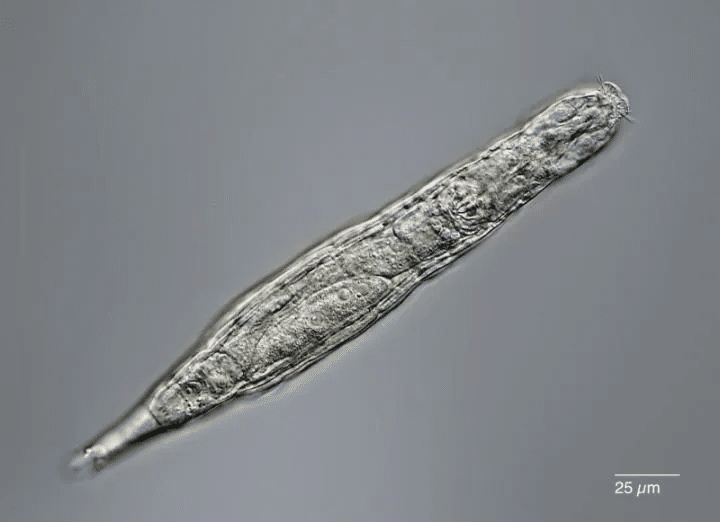
Эрдэмтэд Сибирийн мөнх цэвдгээс олсон бичил биетнийг лабораторийн нөхцөлд амьдруулан, эсгүйгээр үржих чадварыг нь баталлаа.
Оросын эрдэмтдийн баг Сибирийн мөнх цэвдгээс 24,000 жилийн настай гэж тооцоолсон “Adineta” төрлийн бделлоид хорхойг илрүүлжээ. Судлаачид тухайн хорхойг шууд он цагийн аргаар тогтоогоогүй бөгөөд олдвор олдсон геологийн давхаргын органик үлдэгдэлд нүүрстөрөгчийн шинжилгээ хийх замаар насжилтыг нь тогтоосон байна. Мөнх цэвдгийн 3.5 метрийн гүнээс олдсон энэхүү бичил биетнийг орчин үеийн бохирдлоос хамгаалах арга хэмжээ авч, лабораторийн нөхцөлд эсгүйгээр үржүүлэх соёлыг бий болгосон юм.
Энэхүү судалгааны үр дүн 2021 онд “Current Biology” сэтгүүлд нийтлэгдсэн бөгөөд бделлоид хорхой нь хөлдүү нөхцөлд хамгийн удаан хугацаагаар амьд үлдэж чадсан тохиолдол болжээ. Судлаачид тус бичил биетнийг криптобиоз хэмээх бодисын солилцооны идэвхгүй төлөвт шилжих чадвартай болохыг тогтоосон байна. Энэ нь эрс тэс уур амьсгалд эсийн гэмтлийг багасгаж, таатай нөхцөл бүрдэхэд физиологийн үйл ажиллагаагаа дахин сэргээх боломжийг олгодог ажээ.
Туршилтын явцад лабораторид өсгөвөрлөсөн хорхойнуудыг -20 хэм хүртэл хөлдөөж, долоо хоногийн турш байлгахад тэд амьд үлдсэн байна. Гэсэн хэдий ч энэхүү туршилт нь 24,000 жилийн турш мөнх цэвдгийн гүнд хөлдүү байсан бичил биетэн яг ямар биологийн механизм ашиглан амьд үлдсэнийг бүрэн тайлбарлаж чадаагүй юм. Судалгаа нь зөвхөн олдсон хорхой болон түүний үр төл нь хөлдөлтийг тэсвэрлэх чадвартай болохыг баталсан хязгаарлагдмал хүрээний дүгнэлт юм.
Дэлгэрэнгүйг эх сурвалжаас харах
↓Эх сурвалжийг нээх ↓
To find out how life existed beneath the earth in extreme conditions, Russian scientists drilled into the ground near Vostok Station, Antarctica, a place where the ice has been continuously frozen for over 800,000 years. They recovered what looked like “ice” (but was actually frozen water) and brought it back to a lab where they warmed it up and found that there was a creature inside that was still alive.
A bdelloid rotifer.
The scientist studied this microscopic animal to see if it would reproduce. This type of microscopic animal has adapted to survive in extreme environments; the permafrost that surrounded it was radiocarbon-dated to around 24,000 years old.
When thawed, the rotifer produced offspring without mating. Scientists created a clonal laboratory culture using these offspring to continue producing offspring in the laboratory.
Scientists published a paper on the subject in a 2021 issue of Current Biology by Lyubov Shmakova, Stas Malavin, et al. The scientists called it the longest recorded survival in a frozen condition for a rotifer.
Surviving being frozen was nothing new. Bdelloid rotifers have been shown to be able to survive extremely low temperatures. In fact, prior research referenced in the study demonstrated that rotifers were able to survive for six to ten years in temperatures ranging from -20°C to +0°C.
The permafrost containing this specimen is tens of thousands of years old.
Buried in Ice for 24,000 Years
That needed clarification: The scientists did not date the rotifer directly. Instead, they dated organic matter surrounding the rotifer within the Siberian permafrost to approximately 24,000 years before present. Therefore, the age of the rotifer is inferred based upon the geologic layer in which it was discovered rather than through the direct dating of its tissues.
In addition to this indirect method of dating, the researchers also implemented methods to prevent contamination from modern organisms. The frozen core was taken from approximately 3.5 m below the surface, and the sedimentary environment surrounding the core remained frozen since those sediments were deposited.
Another line of evidence supported a link between the ancient permafrost sample and a rotifer. Actin gene sequences of a rotifer were identified within a metagenome obtained from the same permafrost sample.

Using morphological and molecular analyses, the scientists identified the recovered animal as belonging to the genus Adineta. The morphology of the recovered animal matched the morphology of a modern Adineta vaga isolate collected in Belgium.
The discovery attracted widespread media attention when it was reported in June 2021 due primarily to its implications regarding multicellularity and reproductive capability as opposed to being a single celled microbe.
Built to Survive the Deep Freeze
Bdelloid rotifers are known to be highly resistant to adverse environmental stresses. One reason for this resistance may be their ability to enter into a dormant state called cryptobiosis when exposed to conditions that are detrimental to normal metabolic processes.
As such, while surviving cold temperatures for just several hours or days may be sufficient for some animals that exist in the permafrost, for others simply avoiding enough cellular damage during periods of cold so that they can once again resume physiological activities when warmer temperatures prevail is crucial to their survival.
Following thawing of the rotifer from the permafrost, the animal retained viability and produced offspring via parthenogenesis, which is a form of reproduction that does not involve fertilization.
Therefore, the scientists were able to create a clonal laboratory culture derived from the thawed animal. These clonal populations of offspring could then be subjected to controlled experiments involving freezing conditions similar to those experienced by their ancestor.
Seven Days on Ice
Researchers cooled members of the cultured population at roughly 1 degree Celsius per minute and kept them frozen for at least seven days.
They survived.
The experiment did not recreate 24,000 years in Siberian permafrost, nor did it explain the full biological mechanism that allowed the original specimen to remain viable for so long. It showed something more limited: the recovered rotifer and its descendants could withstand freezing.
Enjoyed this article? Subscribe to our free newsletter for engaging stories, exclusive content, and the latest news.

