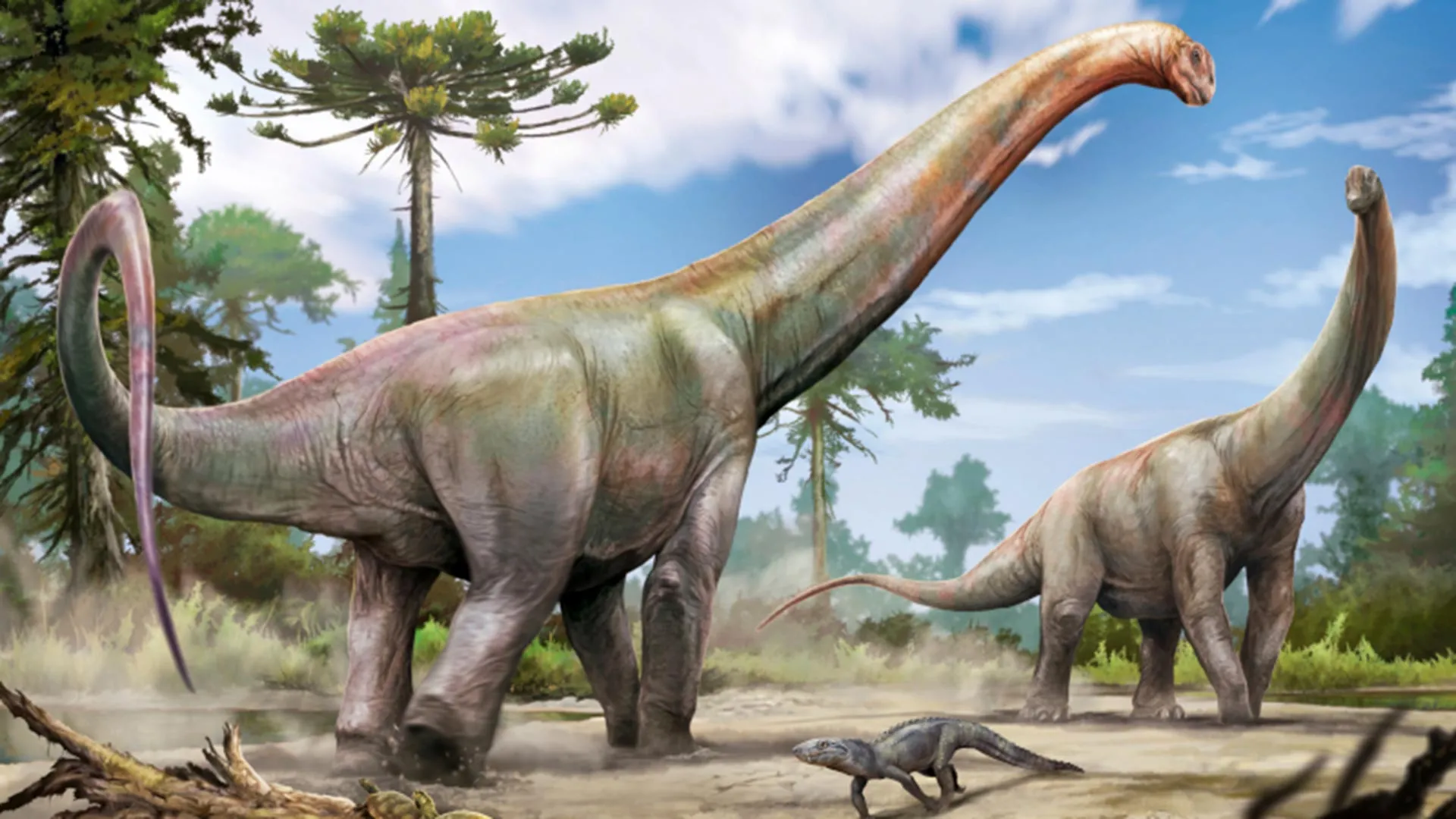
Эрдэмтэд 120 сая жилийн настай аварга үлэг гүрвэлийн үлдэгдлийг илрүүлсэн нь Европ тивтэй холбоотой хувьслын түүхийг шинээр нээлээ.
Бразилын Мараньяо мужийн Давинополис хотод авто замын терминал барих явцад 20 метр урттай аварга үлэг гүрвэлийн чулуужсан яс олджээ. Journal of Systematic Palaeontology сэтгүүлд нийтлэгдсэн судалгаагаар, Dasosaurus tocantinensis хэмээн нэрлэсэн энэхүү зүйл нь ойролцоогоор 120 сая жилийн өмнө амьдарч байсан болохыг тогтоов. Анх барилгын ажилчид болон археологичид үүнийг эртний хөхтөн амьтны үлдэгдэл гэж таамаглаж байсан ч геологийн тогтоц болон олдворын байрлалаас харахад илүү эртний үед хамаарахыг Элвер Луиз Майер тэргүүтэй эрдэмтэд баталсан байна.
Энэхүү олдвор нь Европ тив дэх үлэг гүрвэлүүдтэй хувьслын хувьд ойр холбоотой болохыг харуулж байгаа нь Атлантын далайгаар тусгаарлагдсан тивүүд нэгэн цагт нэгдсэн байсныг илтгэнэ. Судлаачдын таамаглаж буйгаар, Dasosaurus tocantinensis-ийн өвөг дээдэс 140-120 сая жилийн өмнө Гондвана супертив нэгдсэн байх үед Хойд Африкаар дамжин Өмнөд Америкт иржээ. Олдвор нь сүүлний нугалам, 1.5 метр урттай гуяны яс, хавирга болон хөлний ясыг агуулсан тул харьцангуй бүрэн бүтэн гэж үнэлэгддэг.
Ясны бичил бүтцийг шинжлэхэд титанозавр болон бусад эртний сауроподуудын шинжийг хослуулсан өсөлтийн хэв маяг ажиглагдсан нь үлэг гүрвэлийн хувьслын үе шатыг ойлгоход чухал ач холбогдолтой юм. Макс Лангер тэргүүтэй эрдэмтэд энэхүү олдвор нь Мараньяо мужаас олдсон хамгийн том үлэг гүрвэл болохыг онцолсон бөгөөд талбай дээр цаашид малтлага хийх боломжтой гэж үзэж байна.
Энэхүү нээлт нь дэд бүтцийн бүтээн байгуулалтын ажил нь палеонтологийн судалгаанд шинэ боломж олгодог ч нөгөө талаар олдворуудыг гэмтээх эрсдэлтэйг сануулж байна. Судлаачид барилгын компанитай хамтран ажиллаж, олдворыг хамгаалах, цаашид үргэлжлүүлэн судлах чиглэлээр хэлэлцээр хийж байгаа юм. Одоогоор олдворыг Мараньяо мужийн Байгалийн түүх, археологийн судалгааны төвд хадгалж байна.
Дэлгэрэнгүйг эх сурвалжаас харах
↓Эх сурвалжийг нээх ↓
A newly identified dinosaur species discovered during construction work in northeastern Brazil is offering fresh clues about how giant dinosaurs spread across ancient continents.
The species, named Dasosaurus tocantinensis, is described in a study published in the Journal of Systematic Palaeontology. The animal measured about 20 meters long and lived roughly 120 million years ago. Its fossils were found at the site of a road rail terminal under construction in Davinópolis, a city in the state of Maranhão.
One of the most striking aspects of the discovery is the dinosaur’s evolutionary connection to Europe. Its closest known relative lived in what is now Spain, suggesting that these animals belonged to a broader lineage that once occupied regions that are now separated by the Atlantic Ocean.
Researchers propose that the ancestors of Dasosaurus tocantinensis reached South America by moving through North Africa sometime between 140 and 120 million years ago. At the time, these landmasses were still connected within the supercontinent Gondwana.
Maranhão’s Largest Known Dinosaur
“It’s the largest known dinosaur for Maranhão, which has other species, but not sauropods like this one; rather, it has smaller ones, such as the diplodocid Amazonsaurus maranhensis, which was about 10 meters long,” says Elver Luiz Mayer, a professor at the Federal University of the São Francisco Valley (UNIVASF) in the state of Bahia.
Mayer normally studies mammals from the Quaternary period, which is far more recent than the age of the dinosaur fossils. He became involved with the find in 2021 while working in São Félix do Xingu in the state of Pará, where he was then a professor at the Federal University of Southern and Southeastern Pará (UNIFESSPA)
The fossils had been uncovered by archaeologists who were monitoring the Davinópolis construction project as part of environmental licensing requirements. At first, the remains were thought to belong to large prehistoric mammals that may have lived alongside ancient humans.
Mayer quickly suspected that the bones were much older.
“Given its depth of about eight meters, I realized that it was much older. The age of the geological formation was already known from previous research and indicated that it was material from the transition from the Lower to the Upper Cretaceous, about 120 million years ago,” says Mayer. He then contacted various specialists and formed a multidisciplinary group to study the specimen.
A Remarkably Complete Fossil
The fossils went through an extensive preparation process before being analyzed in Pará. Afterward, the specimen was returned to Maranhão. It is now kept in São Luís, the state capital, at the State Center for Natural History and Archaeology Research, which also took part in the research.
The preserved skeleton includes several major bones, making it unusually informative for a dinosaur of its kind.
“Because it includes tail vertebrae, a 1.5-meter femur, ribs, foot bones, and arm and leg bones, this is considered a relatively complete specimen. We believe there are more fossils from this same specimen yet to be excavated at the site,” says Max Langer, a professor at the Ribeirão Preto School of Philosophy, Sciences, and Letters at the University of São Paulo (FFCLRP-USP), who participated in the study.
Langer coordinates the project “Exploring the Diversity of South American Cretaceous Dinosaurs and Their Associated Faunas,” which is supported by FAPESP.
Why the Dinosaur Was Named Dasosaurus
The species name reflects both the landscape of Maranhão and the location where the fossils were found.
“Daso” means “forest,” a reference to the region’s wooded environment. Early Portuguese colonizers described those forests as forming a dense tangle, or “maranhão.” The second part of the name, “Tocantinensis,” refers to the Tocantins River because the fossil site lies near its eastern bank.
Researchers also examined the microscopic structure of the dinosaur’s bones. The analysis, led by Tito Aureliano and Aline Ghilardi of the Federal University of Rio Grande do Norte (UFRN), revealed a growth pattern that combines traits seen in older sauropods with features found in titanosaurs, a group closely related to the newly discovered species.
The results indicate that some patterns of bone growth and remodeling may have appeared earlier in dinosaur evolution than scientists previously believed. That could help explain how certain sauropods were able to grow to such enormous sizes.
Construction Projects Can Reveal Hidden Fossils
The discovery of Dasosaurus also highlights a complicated reality for paleontology. Major construction projects can damage or destroy fossil deposits, but they can also expose layers of rock that scientists would otherwise have little chance of reaching with traditional excavation tools.
“Brazil is a tropical country with dense vegetation. Geologists and paleontologists rely heavily on human activity to excavate, expose the rocks, and reveal the fossils. If we map Brazil’s fossil sites, we’ll see highways and quarries. These projects are important for understanding our heritage. But it’s obvious that specialized monitoring and artifact recovery are necessary, which doesn’t always happen,” says Langer.
“That’s why it’s urgent to foster closer cooperation between the parties to reconcile construction projects with federal legislation on fossils and promote new discoveries while ensuring the proper preservation of our heritage,” Mayer comments.
The researchers are now negotiating with the construction company for permission to return to the site and continue excavating. Additional fossils could reveal more about Dasosaurus tocantinensis and the larger dinosaur group to which it belonged.
The work received support from FAPESP in the form of a doctoral scholarship, postdoctoral fellowship, and a grant under the Young Investigator modality.

