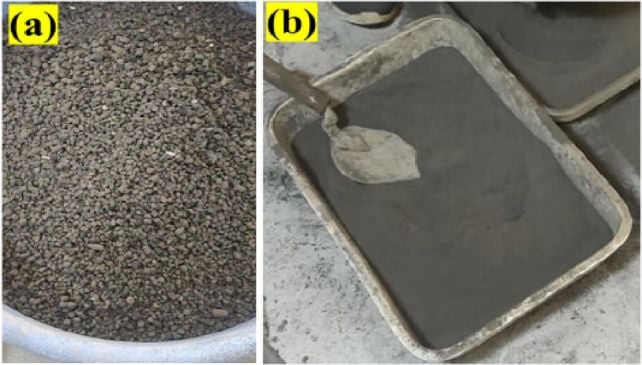
Энэтхэгийн Манипал их сургуулийн судлаачид ариутгалын лагийг боловсруулж гаргаж авсан био-нүүрсийг бетоны орцонд ашиглах туршилт хийжээ.
Инженер Рагувеш Тивари болон түүний багийнхан Энэтхэгийн Варангал хотын бохир ус цэвэрлэх байгууламжийн ялгадсыг хатаан, хүчилтөрөгчийн бага орчинд халааж, нүүрстөрөгчөөр баялаг нунтаг гарган авсан байна. Уг нунтгийг бетоны цементийн тодорхой хувийг орлуулах байдлаар 5%, 10%, 15%-ийн харьцаатайгаар хольж, шахалт, гулзайлт, ус шингээлт болон бичил хагарал үүсэлтийн туршилтуудад оруулжээ. Туршилтын үр дүн 91 хоногийн дараа хамгийн тодорхой илэрсэн бөгөөд 10%-ийн био-нүүрс агуулсан бетон нь хяналтын сорьцтой харьцуулахад шахалтын бат бөх чанар 21%, гулзайлтын бат бөх чанар 42 хувиар өссөн байна.
Судлаачдын тайлбарласнаар, био-нүүрсний сүвэрхэг бүтэц нь бетоныг хатуурах явцад чийгийг хадгалж, цементийн гидратацийн химийн урвалд шаардлагатай усыг ялгаруулдаг ажээ. Мөн био-нүүрсэнд агуулагдах цахиурын нэгдлүүд нь бетоны бүтцийг илүү нягт болгож, бэхжүүлэх нөлөө үзүүлсэн байна. Гэсэн хэдий ч 15%-ийн орцтой хольцонд бат бөх чанар буурч, бүтцийн хувьд илүү их хагарал, сүвэрхэг хэсгүүд ажиглагдсан нь тогтоогджээ.
Энэхүү судалгаа нь цементийн үйлдвэрлэлийн байгаль орчинд үзүүлэх сөрөг нөлөөг бууруулах зорилготой боловч био-нүүрс ашиглах үйл явцын нийт нүүрстөрөгчийн ялгарлыг хараахан тооцоолоогүй байна. Түүнчлэн бохир усны лаг дахь хүнд металлын агууламж болон цаг агаарын эрс тэс нөхцөл, хөлдөлт-гэсэлтийн мөчлөгийн үед бетоны эдэлгээ даах чадварыг цаашид нарийвчлан судлах шаардлагатай гэж үзжээ.
Дэлгэрэнгүйг эх сурвалжаас харах
↓Эх сурвалжийг нээх ↓
At a fecal-sludge treatment plant in Warangal, India, human waste is dried, heated in a low-oxygen chamber, and turned into a dark, carbon-rich powder. By then, it bears little resemblance to what entered the facility. Ground and sieved, the material becomes biochar, fine enough to mix into concrete.
Civil engineer Raghuvesh Tiwari and colleagues at Manipal University Jaipur used that powder to replace part of the cement in conventional concrete. They tested mixtures containing 5%, 10%, and 15% fecal-sludge biochar, then put the hardened material through compression, bending, water absorption, shrinkage, and microscopic cracking tests.
The clearest result came after 91 days.
Concrete containing a 10% biochar replacement showed a 21% increase in compressive strength and a 42% increase in flexural strength compared with the control mixture. The 5% mixture also improved on the control. At 15%, however, the gains did not continue.
Turning Sewage Sludge Into a Cement Substitute
Concrete normally combines aggregate, water, and cement, with cement serving as the binder that lets the mixture harden. It is also one of concrete’s biggest environmental liabilities.
Making Portland cement requires high-temperature processing and produces large amounts of carbon dioxide. An overview of concrete’s environmental impact cites estimates putting concrete’s contribution at roughly 4% to 8% of global CO2 emissions, with cement responsible for much of that footprint. A Buildings & Cities commentary similarly describes Portland cement as the particularly energy-intensive part of modern concrete.
Replacing even part of that cement is therefore a major research target.
Biochar is one candidate. It is produced by heating organic material with little oxygen, and in this experiment the feedstock came from fecal sludge at a treatment facility. A sanitation waste stream ended up as a material that could replace a share of the cement in concrete.
That does not make fecal sludge a simple industrial raw material. A World Health Organization sanitation guide notes that the amount and characteristics of feces produced by a person can vary with factors including diet and climate. Any attempt to use it consistently depends heavily on what happens during treatment and processing.
And this was treated material, not raw sewage.
Before the researchers added it to the cement mixture, the sludge had already been processed and converted into biochar.
Why a Small Dose Made the Concrete Stronger
The researchers point to several reasons the lower biochar mixtures became stronger.
One is the material’s porosity. Tiny cavities in biochar can absorb water during mixing and release some of it as the concrete cures, keeping moisture available for the chemical reactions involved in cement hydration.
Its chemistry may matter too. The biochar contains silica capable of taking part in pozzolanic reactions that contribute additional calcium-silicate compounds to the hardened cement matrix. At the same time, the finest biochar particles can settle into spaces between larger particles. The result is tighter packing and, at the right concentration, a denser structure.
Microscope images were consistent with that explanation.

Concrete containing 5% biochar showed a denser, more tightly bonded structure than the conventional mixture. The lower replacement levels also held up in tests beyond strength: water absorption and porosity remained competitive with the control, while mortar containing 10% biochar showed drying shrinkage after 120 days similar to ordinary Portland cement mortar.
Then the pattern broke.
At 15% cement replacement, overall strength fell behind the 5% and 10% mixtures. Microscopy also showed more pores, more cracks, and more poorly bonded areas.
The Environmental Payoff Has Not Been Measured Yet
Turning treated human waste into a building material raises another question immediately: what else is in the sludge?
Heavy metals are a known concern in sewage sludge. A 2020 review in Environmental Pollution found that toxic metals can restrict how sewage sludge is reused or disposed of and examined methods intended to remove them.
Tiwari’s team reported decreasing heavy-metal concentrations in its concrete specimens as biochar content increased. That suggests the material may help limit the release of harmful substances. It does not show what those contaminants would do after decades of weathering, however, or under every environmental condition.
The carbon case is also unfinished.

Although replacing cement could cut emissions because cement production is carbon intensive, the researchers did not calculate the carbon emissions of the proposed process. Their experiment therefore cannot show how much climate benefit the biochar mixture would actually deliver once sludge treatment, drying, pyrolysis, grinding, transportation, and concrete production are counted.
Durability remains another open problem. The researchers identify freeze-thaw cycles, salinity, and extreme temperatures among the conditions that still need testing.
Their own samples already showed one hard limit. At 15% cement replacement, the microstructure contained more pores, cracks, and poorly bonded regions than the lower-biochar mixtures.
Enjoyed this article? Subscribe to our free newsletter for engaging stories, exclusive content, and the latest news.

