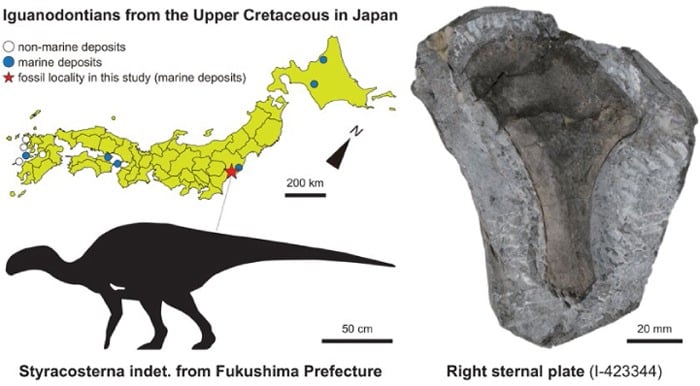
Фукушима мужийн музейн сан хөмрөгт олон арван жил хадгалагдаж байсан ясны хэлтэрхий нь 90 сая жилийн тэртээх далайн эргийн экосистемийн олон янз байдлыг илтгэж байна.
Иваки хотын Аммонитын төвийн сан хөмрөгт 1999 оноос хойш хадгалагдаж байсан нэгэн ясыг судлаачид нарийвчлан судалж, үүнийг “Styracosterna” бүлгийн үлэг гүрвэлийн баруун талын өвчүүний яс болохыг тогтоожээ. Уг олдвор нь Цэрдийн галавын үед хамаарах Ашизава формацийн далайн эргийн орчноос олдсон бөгөөд тухайн үед амьдарч байсан үлэг гүрвэлийн биеийн уртыг ойролцоогоор 3 метр хэмээн тооцоолсон байна.
Өмнө нь тус бүс нутгаас 8 метр урттай игуанодонт үлэг гүрвэлийн олдвор олдож байсан тул энэхүү шинэ судалгаа нь нэгэн геологийн бүсэд биеийн хэмжээгээрээ эрс ялгаатай үлэг гүрвэлүүд зэрэгцэн амьдарч байсныг харуулж байгаа юм. Хэдийгээр олдвор нь бүтэн биеийн яс биш ч, эртний Азийн далайн эрэг орчмын экосистем нь урьд өмнө төсөөлж байснаас илүү баялаг бүтэцтэй байсныг гэрчилж байна.
Судлаачид энэхүү ясны морфологийн шинж чанарт тулгуурлан ангилал зүйг тогтоосон боловч олдвор цөөн тооны хэлтэрхийгээс бүрдэж байгаа нь тухайн үлэг гүрвэлийн төрөл, зүйлийг нарийвчлан тодорхойлоход хязгаарлалт болж байна. Японы нутаг дэвсгэрээс олддог игуанодонт төрлийн үлэг гүрвэлийн чулуужсан яс ихэвчлэн бүрэн бус, тархай бутархай байдаг нь эдгээр амьтдын экологийн ялгаатай байдлыг судлахад хүндрэл учруулсаар иржээ.
Дэлгэрэнгүйг эх сурвалжаас харах
↓Эх сурвалжийг нээх ↓
A single, unassuming bone sat in storage at the Iwaki City Ammonite Center for more than twenty years before anyone took a close look at it. Researchers in Tsukuba have identified it as the sternal plate of a small styracosternan, a member of the dinosaur group that includes the hadrosauroids, and estimate the animal was only about 3 meters long, a modest size next to the roughly 8-meter iguanodontian already known from the same rock formation.
Iguanodontians were among the most successful herbivorous dinosaurs of their time, ranging across the Late Jurassic through the Late Cretaceous and spreading across nearly the entire Laurasian supercontinent. Their intercontinental dispersal between Asia, North America, and Europe is considered a key driver of their diversification, and fossils from Japan come from the eastern margin of Asia, a region where the fossil record for this group remains thin.
Most iguanodontian material recovered in Japan consists of fragments, isolated teeth and scattered bone, rather than complete skeletons, leaving large gaps in scientists’ understanding of how diverse and ecologically varied these animals actually were along the ancient Asian coastline.
An Overlooked Find from a Museum’s Own Grounds
The fossil itself wasn’t unearthed in a formal excavation but discovered in 1999 directly on the premises of the Iwaki City Ammonite Center in Fukushima Prefecture. The site lies within the Obisagawa Member of the Ashizawa Formation, part of the lower Upper Cretaceous Futaba Group, dated to approximately 90 to 88 million years ago.
According to Paleontological Research, this formation represents a shallow-marine depositional environment, a coastal setting where terrestrial animal remains occasionally washed in or were preserved alongside marine sediments.
Despite its discovery on museum grounds, the specimen was only tentatively identified at the time as the sternal plate of a hadrosauroid dinosaur, and it went unstudied for more than two decades afterward.
Identifying the Fossil as a Right Sternal Plate
The new study provides a detailed morphological description of the bone, concluding that it is the right sternal plate of an indeterminate styracosternan, a more derived branch within Iguanodontia that encompasses hadrosauroids. The taxon could not be pinned down to a specific genus or species based on this single element, but its placement within Styracosterna was established through comparison with related forms.
That same comparative approach allowed researchers to estimate the animal’s body length at approximately 3 meters. As explaiend by the researchers in a statement, this is significantly smaller than other iguanodontian fossils previously recovered from the same formation, including the roughly 8-meter individual reported in earlier work, a substantial size difference within a single geological unit.

The Tiny Fossil With a Big Story
The significance of the find lies less in the bone itself than in what it implies about the community of animals living along this stretch of coastline roughly 90 million years ago. Larger iguanodontians, including hadrosauroids, are already known to have inhabited Japan during the Late Cretaceous. The presence of a much smaller individual in the same formation suggests that iguanodontians of varying body sizes shared these coastal habitats simultaneously.

As the study notes, this points toward greater size diversity within these dinosaur communities than the fragmentary Japanese fossil record had previously indicated. In a region where complete skeletons remain rare and most evidence comes down to isolated bones and teeth, this long-overlooked sternal plate adds another piece to the puzzle. It helps reveal just how rich and diverse the coastal ecosystems of ancient East Asia truly were.
Enjoyed this article? Subscribe to our free newsletter for engaging stories, exclusive content, and the latest news.

