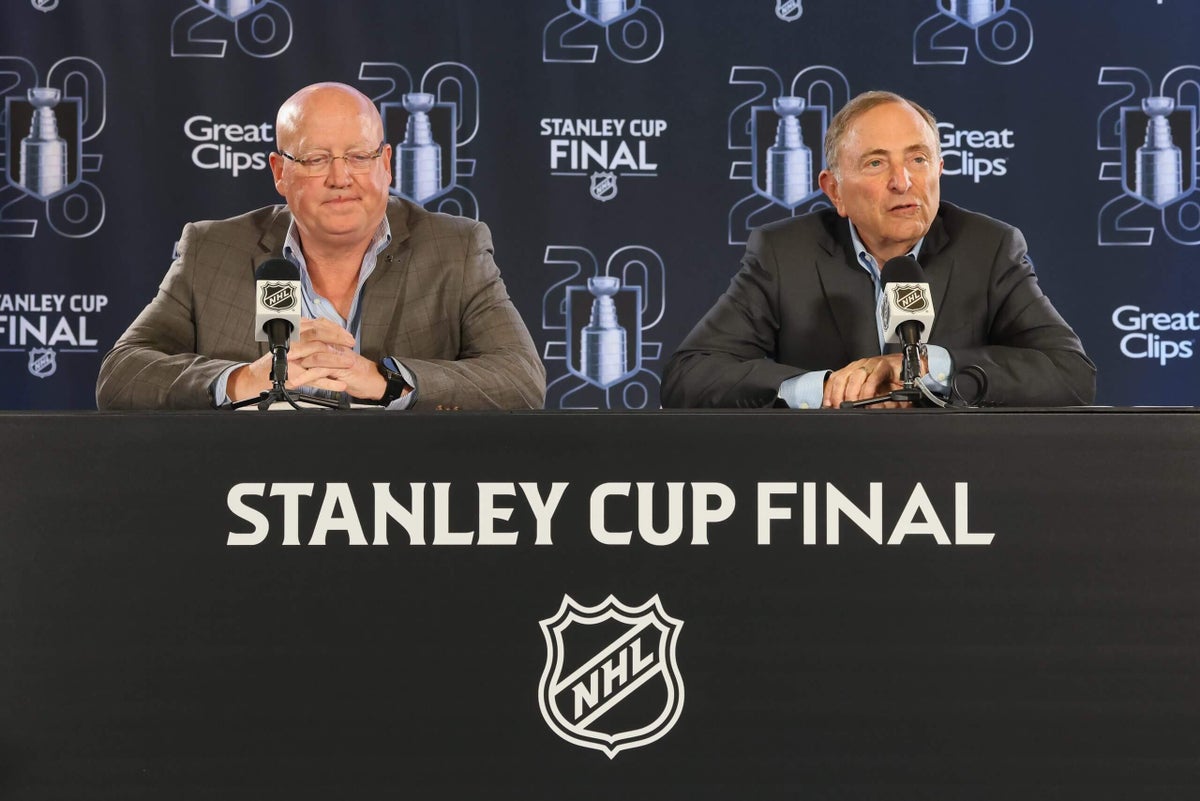
NHL-ийн дэд комиссар Билл Дэйли лигийн өргөжин тэлэлтийн талаарх яриаг эрт гэж үзэж байгаагаа илэрхийллээ.
NHL-ийг Тексас муж руу тэлэх асуудал ирээдүйд боломжтой ч энэ нь ойрын хугацаанд хэрэгжих баталгаагүй гэдгийг дэд комиссар Билл Дэйли мэдэгдлээ. Лигийн удирдлагууд Хьюстон хотын тэрбумтан Дэн Фридкин болон Хьюстон эсвэл Остин хотод 33 дахь багийг байгуулах талаар хэлэлцээ хийж байгаа ч тодорхой үр дүнд хүрээгүй байна. Энэ асуудлыг есдүгээр сарын 22-нд болох NHL-ийн Удирдах зөвлөлийн хурлаар хэлэлцэх юм.
Дэйлийн хэлснээр, талууд тодорхой зорилго тавин ажиллаж байгаа ч одоогоор ямар нэгэн заавал биелүүлэх үүрэг хүлээгээгүй байна. Мөн шинэ баг хүлээн авахын тулд тухайн хотуудад олон улсын стандартад нийцсэн шинэ ордон барих шаардлагатай байгаа нь 2029-2030 оны улиралд багтаан эхлүүлэх төлөвлөгөөг хойшлуулж болзошгүй юм. Хэрэв энэ хугацаанд амжихгүй бол 2030-2031 оны улирлыг онилж байгаагаа тэрээр онцоллоо.
Лиг тэлэх нь тоглогчдын ажлын байрыг нэмэгдүүлж, эзэмшигчдийн хувьд их хэмжээний орлого олох боломжтой ч зарим клубүүд лигийн түвшин буурах вий гэсэн болгоомжлолыг илэрхийлсээр байна. Даллас Старс багийн төвийн тоглогч Уайатт Жонстон Тексас мужид хоёр дахь баг нэмэгдэх нь өрсөлдөөнийг улам сонирхолтой болгоно гэж үзэж байгаагаа хэллээ. Лигийн зүгээс энэ оны эцэс гэхэд Хьюстон эсвэл Остин хотуудын аль нэгэнд баг байгуулах эсэхээ шийдвэрлэхээр төлөвлөж байна.
Дэлгэрэнгүйг эх сурвалжаас харах
↓Эх сурвалжийг нээх ↓
LAS VEGAS — NHL expansion to Texas might be inevitable, but that doesn’t mean it’s imminent.
Deputy commissioner Bill Daly pumped the brakes on the notion of rapid league expansion Wednesday at the NHL/NHLPA player media tour in Las Vegas — talk Daly fueled at the European stop on the media tour in Munich on Aug. 22. Though the league has engaged in significant discussions with Houston billionaire Dan Friedkin about bringing a 33rd franchise to Houston or Austin, there are still a few hurdles to clear.
The first comes Sept. 22, when the NHL board of governors will weigh in.
“I don’t want to get ahead of the board,” Daly said Wednesday. “I don’t want to treat it like a done deal, because it’s not. It’s not a done deal on the Friedkin side, and it’s not a done deal on our side. And that’s why it’s kind of a nonbinding term sheet (agreed to with the league). We’re both going to work hard to achieve that goal. But at the end of the day, it might not happen.”
Another hurdle is that either city would need to build a new arena to attract an NHL expansion franchise. Toyota Center, home of the NBA’s Houston Rockets, isn’t an option for the new team. Neither is Moody Center, Austin’s 4-year-old multipurpose arena on the University of Texas campus. Arenas take time to plan and build, meaning Daly’s previously stated target of a 2029-30 season debut might be overly optimistic.
But Daly expressed little concern about that Wednesday.
“I don’t think there’s any magic about the date of entry,” Daly said. “If it’s not ’29-’30, it’ll be ’30-’31. I don’t think that’s going to be a prime gating factor.”
The success of the Vegas Golden Knights since the franchise’s 2017 founding triggered an expansion gold rush in the NHL. The Seattle Kraken debuted as the 32nd team in the 2021-22 season, and a second team is almost sure to come to Texas at some point. Atlanta and Phoenix are also in the early stages of bringing the NHL back to their cities. A 36-team league in the not-too-distant future seems plausible.
It’s easy to understand why. Players love the idea of adding 23 NHL jobs every time a new team joins the league, and owners love the hefty expansion fees, which could reach $2 billion for the potential Texas franchise. But aside from the economic benefits, there have been concerns about the league diluting its talent pool by getting too big, too fast. After all, the NFL, the most popular and valuable professional sports league in the United States, has only 32 teams.
Asked whether there were any dissenting voices within NHL leadership, Daly said, “In recent weeks, and as recently as the June board meeting (where the Friedkin bid was discussed), we actually did have some clubs that expressed some concern.”
NHLPA executive director Marty Walsh said the players’ association is “monitoring” the expansion process but noted, “We really have no say in what happens.” Ron Hainsey, the union’s executive director, also lowered the temperature on the idea of rapid expansion. Asked whether players were troubled about how difficult winning the Stanley Cup would be in a 36-team league, Hainsey downplayed the idea.
“Thirty-six is a little stretch,” he said. “No one’s talking about adding four teams in the next year. It’s hard at 32, certainly. So, obviously, just by definition, if you go to 36, it’s harder. (Or) if you go to 33. When players see things like expansion and cities, there is a process going on; they have a ton of questions. The league is going to go through their process and make a decision, as they’ve said, by the end of the calendar year on whether they’re going to add a team in Houston or Austin.”
Between the two cities, Houston is the more likely landing spot for a new team. It’s the fourth-largest city in the United States, with a population of roughly 2.4 million. But the NHL has had success in mid-tier markets such as Raleigh, N.C., San Jose, Calif., Nashville, Tenn., and Las Vegas. Being the first major team to come to a city rather than entering a crowded market has its advantages. Austin would fall into that category.
“I’ve heard that, and I feel it, as well,” Daly said. “Austin, we’d be the first of the major four (leagues) to put a franchise there. And there’s some benefit to coming first. It’s an up-and-coming, growing city. Young, affluent — it has a lot going for it. But Houston is, like you said, enormous, and it is a major market that we’re not in. We don’t have the same footprint across the United States that the other major professional leagues do. So, to add a city of Houston’s size and demographics to our league, there would be certainly benefits associated with that.”
A new team in Texas would create a natural rival for the Dallas Stars. Dallas center Wyatt Johnston loves the idea of adding a team in Houston or Austin. Even if it causes a few headaches for the Stars’ marketing department.
“Being in Dallas, our thing is ‘Texas Hockey,’ so it would be a little different having to share it,” Johnston said, smiling. “I think it’s great, though. Just getting more eyes and getting different markets into the game is great for the game. Selfishly, you want to keep all of Texas for yourself, meaning the Stars, but I think it would obviously create a pretty cool rivalry.”

