
Шинэ судалгаагаар ADHD буюу анхаарал сулрах, хэт хөдөлгөөнтөх эмгэгтэй хүүхдүүдийн хүүхэн харааны хариу урвал эрүүл хүүхдүүдээс ялгаатай байж болохыг тогтоожээ.
Indraprastha Institute of Information Technology Delhi-ийн судлаачид Чили улсын 10-12 насны 50 хүүхдийн нүдний хөдөлгөөний өгөгдөлд дүн шинжилгээ хийжээ. Судалгаанд ADHD оноштой 28 хүүхэд болон эрүүл 22 хүүхдийг хамруулсан бөгөөд тэд ой тогтоолтын даалгавар гүйцэтгэх үед нүдний хүүхэн харааны өөрчлөлтийг секундэд 1,000 удаа хэмжсэн байна. Үр дүнд нь эм уугаагүй ADHD-тай хүүхдүүдийн хүүхэн харааны хариу урвал даалгаврын туршилт хооронд 23 хувиар илүү хэлбэлзэлтэй байжээ.
Судалгааны багийн гишүүн, компьютер судлаач Саумья Ядав хүүхэн харааны хэлбэлзэл нь анхаарал болон оролцооны өөрчлөлтийг илэрхийлж болохыг дурдсан байна. Эм уусан ADHD-тай хүүхдүүдийн хувьд хүүхэн харааны хариу урвал илүү тогтвортой, хяналтын бүлэгтэй төстэй байсан ч энэ нь эмчилгээ анхаарлыг бүрэн “хэвийн” болгосон гэсэн үг биш гэдгийг судлаачид анхаарууллаа. Эмийн бодис нь физиологийн системд шууд нөлөөлдөг тул энэ нь анхаарал сайжирсных уу, эсвэл эмийн шууд нөлөө юу гэдгийг ялгахад бэрхшээлтэй байна.
Энэхүү арга нь одоогоор ADHD-ыг оношлох эмнэлзүйн хэрэгсэл болоогүй байгааг судалгааны баг онцолж байна. Оролцогчдын тоо цөөн, судалгааны аргачлал хязгаарлагдмал тул цаашид илүү өргөн хүрээтэй, урт хугацааны судалгаа шаардлагатай. Хэрэв үр дүн батлагдвал нүдний хөдөлгөөн хянах технологи нь эмч нарын оношилгоо, ажиглалтад туслах нэмэлт хэрэгсэл болох боломжтой юм.
Дэлгэрэнгүйг эх сурвалжаас харах
↓Эх сурвалжийг нээх ↓
The eyes are said to be windows to the soul. Scientists now suspect they might offer a glimpse of something else, too: the rhythm of our attention.
The clue is not necessarily in where we look. It may be hidden intiny changes in the pupilsas the brain tries to remember something, ignore a distraction, or make a decision.
A new studysuggests this rhythm may be subtly different in children with attention deficit hyperactivity disorder ( ADHD).
ADHD is a neurodevelopmental disorder involving persistent difficulties with attention, hyperactivity, or impulsivity. Yet attention does not work like a light switch. It can hold steady one moment and wander the next.
There is no single test for ADHD.Diagnosiscombines medical assessments, personal history, and observations of behavior in different settings.
Researchers from the Indraprastha Institute of Information Technology Delhi wondered whether the pupils could add another piece to that picture.
The team reanalyzed existing eye-tracking data from 50 children aged 10 to 12 in Chile. Twenty-eight had combined-type ADHD, while 22 had no neurodevelopmental diagnosis.
The children played what was essentially a memory game. They watched dots appear on a grid and tried to remember their positions. After a distracting image flashed on the screen, another dot appeared. The children had to decide whether it occupied a position they had seen before.
They repeated the task 160 times while an eye tracker measured their pupil diameter 1,000 times every second.
Pupils do more than adjust to light. They also respond to effort, arousal, fatigue, and engagement.
Previous research has often focused on average pupil size. This team asked whether each child’s pupils responded consistently to the same challenge.
“Looking at how pupil responses vary from trial to trial may provide information that is missed when we only look at average pupil size or behavioral performance,” first author and computer scientist Saumya Yadav told ScienceAlert.
After accounting for age, IQ, and task difficulty, the researchers’ statistical model estimated about 23 percent greater trial-to-trial variability in the pupil responses of unmedicated children with ADHD than in controls.
But the pattern changed depending on how variability was measured. Pupil responses varied more across separate trials, yet fluctuated less within each individual trial in the unmedicated ADHD group. This suggests that the two measurements capture different aspects of pupil dynamics.
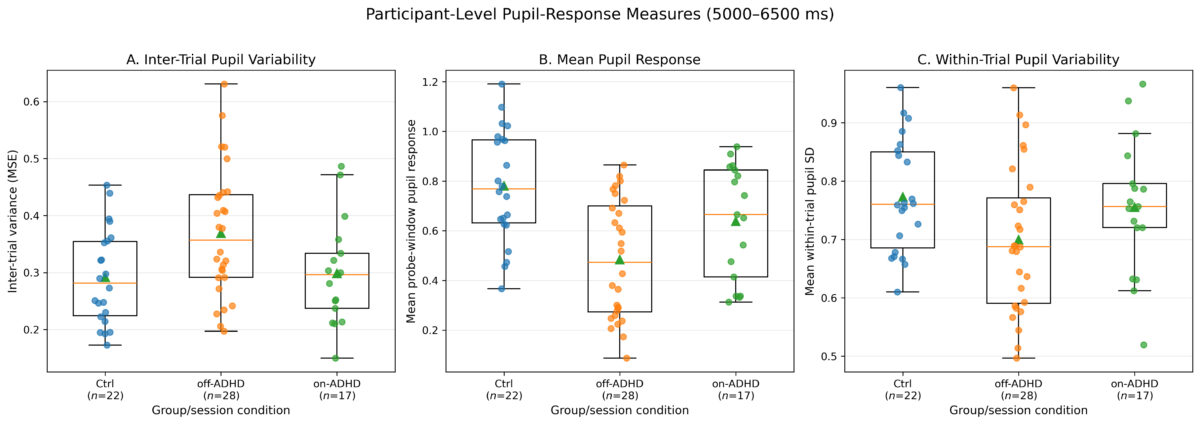
Among the unmedicated children with ADHD, those with greater pupil variability also tended to answer less accurately. Their pupils appeared to echo shifts in attention or engagement.
That does not mean a restless pupil equals a restless mind. Pupil size changes for many reasons, making it an indirect signal of attention.
Still, another part of the experiment made the pattern more intriguing.
Seventeen children with ADHD completed the task twice: once after pausing methylphenidate for 24 hours, and once after taking their usual medication.
When medicated, their pupils responded more strongly during the task and fluctuated less between rounds. The overall shape and timing of their responses also looked more like those of the control group.
It would be tempting to say the medication had ‘normalized’ their attention. The researchers warn against that conclusion.
Methylphenidate can directly affect the physiological systems that influence pupil size. The experiment could not reveal whether the difference came from improved attention, the drug’s direct action on the body, or both.
“We would not interpret this as evidence that medication ‘normalized’ attention,” Yadav said.
“We could not completely separate these pharmacological effects from cognitive effects.”

The researchers did not know each child’s dose or drug formulation. The two tests were also separated by an average of about six months, so maturation, practice, or other period-related effects may have influenced the results.
There was another reason for caution. Although a model based on thousands of trials identified greater variability, the direct comparison between individual participants narrowly missed statistical significance after correction for multiple tests.
Greater pupil variability was linked to lower accuracy in the unmedicated ADHD group, but that relationship was not significantly stronger than the equivalent pattern in controls.
“It is still too early to consider pupil measurements as a clinical diagnostic tool,” Yadav emphasized.
The study was small, used existing data, and involved a controlled laboratory task. A real classroom would be far messier.
Larger, independent, and longer-term studies would be needed to test whether these pupil patterns are reliable across different people and everyday environments.
Related: Women With ADHD May Be Losing Years of Treatment, Experts Warn
If they are, eye tracking would not replace doctors, interviews, or behavioral assessments. Instead, it might complement them by showing how one person’s attention changes over time or responds to treatment.
For now, the eyes cannot diagnose ADHD.
But they may reveal something usually hidden: attention shifting, fading, and returning from one moment to the next.
The study was published inScientific Reports.
This article was fact-checked by Peter Dockrill and edited by Peter Dockrill. While we pride ourselves on our process, we are only human. If you spot a mistake, please let us know.

