
Эрдэмтэд Саккара дахь эртний байгууламжийн бүтэц нь чулуун блокуудыг өргөхөд ашигласан усан хангамжийн цогц системийн нэг хэсэг байсан байж магадгүй хэмээн үзжээ.
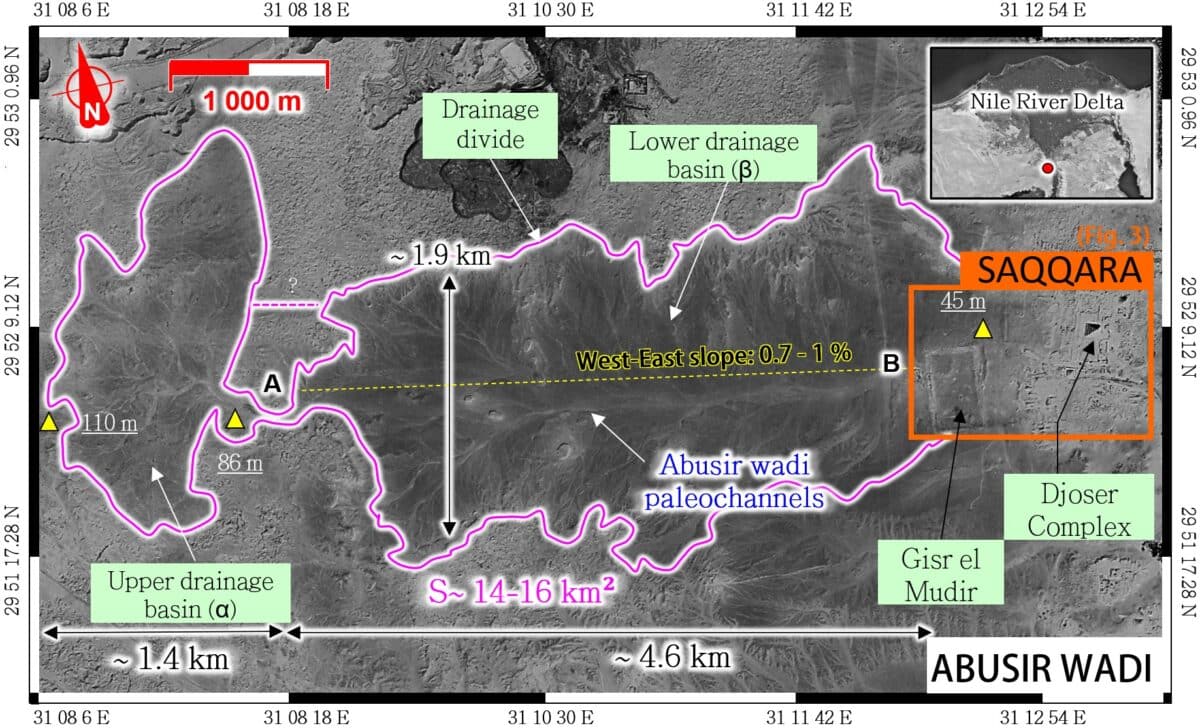
Парис дахь “Paleotechnic” хүрээлэнгийн судлаач Ксавье Ландрогоор ахлуулсан баг гидрологи, геодези болон иргэний инженерчлэлийн шинжилгээнд үндэслэн Саккара дахь Жосерийн шаталсан пирамидын барилгын технологийг судалжээ. Тэдний таамаглалаар, пирамидын ойролцоох “Gisr el-Mudir” хэмээх аварга том чулуун хашаа нь үерийн усыг хуримтлуулж, тунадасжуулах далангийн үүрэг гүйцэтгэж байсан байна. Энэхүү цэвэршүүлсэн ус нь пирамидыг тойрсон гүн сувгаар дамжин пирамидын доторх босоо амнууд руу чиглэдэг байжээ.
Судлаачдын загварчлалаар, босоо амнууд дахь боржин чулуун хайрцагнууд нь усны урсгалыг хянах хавхлагын үүрэгтэй байсан гэж үзэж байна. Ус нэмэгдэхэд хөвөгч тавцан дээшилж, улмаар пирамидын чулуун блокуудыг өндөрт өргөх механик хүчийг бий болгодог байсан нь уг байгууламжийг “гал уулын” зарчмаар дотроос нь гадагш чиглүүлэн барьсан байх боломжийг бүрдүүлжээ.

Гэсэн хэдий ч энэхүү таамаглал нь эрдэмтдийн дунд маргаан дагуулсаар байна. Тухайлбал, Кэмбрижийн их сургуулийн геоархеологич Жудит Банбери зэрэг судлаачид тухайн үеийн эх сурвалжуудад ийм төрлийн өргүүрийн тухай дурдагдаагүй байгааг онцолжээ. Мөн уг системийн үйл ажиллагаанд шаардлагатай усны хэмжээг байгалийн хур тунадаснаас бүрэн хангах боломжтой эсэх нь эргэлзээтэй байгаа бөгөөд илүү нарийвчилсан малтлага, геологийн судалгаа хийх шаардлагатай байна.
Дэлгэрэнгүйг эх сурвалжаас харах
↓Эх сурвалжийг нээх ↓
A limestone trench surrounding the Step Pyramid of Djoser at Saqqara has puzzled archaeologists for decades. Roughly 3 kilometers long and cut as much as 20 meters into the bedrock, it was carved with a precision that left excavators in the 1930s and 1940s struggling to make sense of it as either a quarry or a spiritual monument. A new analysis, published in PLOS ONE, offers a third possibility: the trench formed part of a hydraulic system used to raise the pyramid’s stones from within.
Built roughly 4,700 years ago for King Djoser, the Step Pyramid is the oldest of Egypt’s seven monumental pyramids and the first structure in the world constructed entirely from dressed stone.
More than 2.3 million limestone blocks went into it, averaging around 300 kilograms each. How those blocks were stacked to a height of about 60 meters is still genuinely unsettled. Ramps, cranes, rope-and-pulley systems, and rolling wooden rods have all been proposed, but as the study authors note, no widely accepted model exists.
Xavier Landreau, a materials scientist and CEO of the Paris-based research institute Paleotechnic, led a team of ten researchers who brought hydrology, geotechnics, satellite imaging, and civil engineering analysis to the Saqqara site. Their argument comes in three stages.
The Mysterious Enclosure West of the Pyramid Was Actually a Dam
About 400 meters west of the pyramid stands the Gisr el-Mudir, a massive rectangular stone enclosure measuring approximately 360 by 620 meters, with walls 15 meters thick.
Its purpose has been debated by archaeologists since the 18th century, with explanations ranging from an unfinished pyramid to a cattle pen. Landreau’s team, using satellite imagery and digital elevation models, mapped the watershed upstream of the structure for the first time and found that the enclosure sits directly across the path of the Abusir wadi, an intermittent desert stream draining a 15-square-kilometer catchment.
The wall itself is another part of their case. Its layered construction, they argue, resembles the cross-section of a known Old Kingdom dam: outer limestone faces around a graded inner fill running from coarse rubble to fine sand and silt. That arrangement matches the zoned-earthen design of the Sadd el-Kafara, a roughly contemporary structure on the Wadi al-Garawi and one of the oldest known dams in the world. In the team’s model, the resemblance is functional, not accidental.
The Gisr el-Mudir trapped sediment-laden floodwater, let the coarser particles settle, and released cleaner water eastward toward the pyramid complex.
The “Dry Moat” Was Neither Dry Nor Decorative, It Filtered Water
From there, the researchers propose, the water entered the so-called Dry Moat surrounding Djoser’s complex, particularly a narrow, deep channel in its southern section known as the Deep Trench. The trench is approximately 27 meters deep and 3 meters wide and connects at least three large, precisely carved underground compartments. Only about 240 meters of its probable 410-meter length has been excavated.
Those compartments, Landreau’s team argues, worked as a sequential water treatment system.
![View Of Compartment 1 Of The Rock Cut Deep Trench [78] (1943), 27m Deep, 3m Wide.](https://dailygalaxy.com/wp-content/uploads/2025/09/View-of-compartment-1-of-the-rock-cut-deep-trench-78-1943-27m-deep-3m-wide-1200x733.jpeg)
An initial settling basin would have allowed suspended coarse particles to drop out, followed by a retention basin whose stone paving and clay-bound mortar joints limited seepage. A side purification basin was likely used for drinking water. Four surface wells gave workers access to the water. Together with the Gisr el-Mudir, the trench would have supplied sediment-free water to the pyramid’s interior shafts.
Four surface wells.
Granite Boxes at the Bottom of Two Shafts Were Valves, Not Tombs
Inside the pyramid complex are two large vertical shafts: one beneath the structure itself, the north shaft, and a companion shaft roughly 200 meters to the south. Both end in granite boxes sealed with multi-ton stone plugs.
A recently discovered underground tunnel connects the shafts at depth.
The north shaft’s architecture is central to the team’s interpretation. Around the granite box is permeable limestone fill; above it is a mortar-sealed ceiling. Excavators in the 1930s also documented lifting ropes and a wooden beam, while a hemispherical vault extends upward into the pyramid body. Landreau and his colleagues argue that the box was not simply funerary equipment but a water inlet and outlet valve.
In their reconstruction, water from the Deep Trench entered the north shaft and raised a massive wooden float, which was connected by ropes over pulleys to a platform below. As the water filled the shaft, the platform descended to a loading area at ground level, where workers placed stone blocks onto it, and when the shaft was drained, the descending float pulled the platform and its cargo upward to each new construction level.
The pyramid, in other words, would have risen from its center outward, in what Landreau calls a “volcano fashion.”
A simplified numerical model suggests the Wadi Taflah, a larger tributary that may have been artificially connected to the Abusir wadi, could have supplied between 4 and 54 million cubic meters of water over 20 to 30 years of construction. That range is consistent with the model’s upper-bound requirement of 18 million cubic meters if the hydraulic lift handled all stone elevation from ground level.
Eighteen million cubic meters.
Archaeologists Are Not Convinced, and Point to What’s Still Missing
Independent researchers remain skeptical. Judith Bunbury, a geoarchaeologist at the University of Cambridge, told Ars Technica that evidence for a hydraulic lift is missing from Old Kingdom tomb scenes and texts, including the Red Sea Scrolls, which document other construction technologies in detail.
Oren Siegel of the University of Toronto raised a more basic problem: whether the Gisr el-Mudir could have held enough water from periodic rainfall to keep such a hydraulic system operating. Kamil Kuraszkiewicz of the University of Warsaw pointed out that Djoser’s 300-kilogram blocks were manageable enough that building the hydraulic machinery may have taken more effort than simply moving the stones by hand.
The gaps are substantial, and the team acknowledges them.
Approximately 170 meters of the Deep Trench remain unexcavated because later mastabas above it are too fragile to excavate safely. The upper section of the north shaft, inside the pyramid body, has not been explored. Without more excavation, the proposed link between the Deep Trench and the interior shafts remains inferred rather than confirmed.
Landreau is calling for geological sampling inside the Gisr el-Mudir to determine its operating period and for further investigation above the north shaft’s vault. That is where evidence of the proposed lift mechanism’s structural supports would need to turn up.
Enjoyed this article? Subscribe to our free newsletter for engaging stories, exclusive content, and the latest news.

