Аргентины өмнөд хэсгээс олдсон чулуужсан өндөгний хальс нь аварга том үлэг гүрвэлүүд хүйтэн уур амьсгалтай бүс нутагт үр төлөө бойжуулдаг байсныг баталж байна.
Аргентины Чоррилло тогтоцын нутгаас 2020 болон 2024 онд 255 ширхэг өндөгний хальсны хэлтэрхий олдсон нь 68 сая жилийн тэртээх үед хамаарч байна. Тухайн үед энэ бүс нутгийн уур амьсгал нь одоогийн Нью-Йорк хотынхтой төстэй, сэрүүн байсан гэж Калгарийн их сургуулийн палеонтологич Дарла Зеленицки тэргүүтэй судлаачид тэмдэглэжээ. Өмнө нь эдгээр аварга амьтад хүйтэн бүсэд түр оршин суудаг байсан уу, эсвэл тэнд үрждэг байсан уу гэдэг нь тодорхойгүй байсан бол шинэ судалгаа энэхүү асуултад хариулт өгч байна.
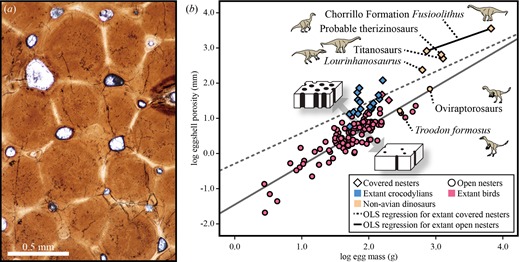
Судлаачид өндөгний хальсны сүвэрхэг бүтцийг микроскоп болон микро-CT сканнераар шинжилж, тэдгээр нь маш сүвэрхэг болохыг тогтоожээ. Ийм өндөг нь ил задгай орчинд байвал амархан хатаж, үр хөврөл нь үхэх эрсдэлтэй байсан тул титанозаврууд орчин үеийн матрын адилаар өндгөө элс, шороо эсвэл ялзарсан ургамлын овоонд булж дулаацуулдаг байсан хэмээн таамаглаж байна. Ургамлын задралын үйл явц нь өндгийг дулаан, чийглэг байлгах дулааны эх үүсвэр болж байжээ.
Royal Society Open Science сэтгүүлд нийтлэгдсэн уг судалгаа нь аварга том амьтад эрс тэс уур амьсгалд хэрхэн дасан зохицож, үр төлөө амжилттай бойжуулдаг байсныг харуулж байна. Гэсэн хэдий ч олдсон өндөг нь яг ямар төрлийн титанозаврт хамаарах нь одоогоор тодорхойгүй байна. Тухайн газраас олдсон колоссозаврийн ясны үлдэгдэл болон өндөгний хооронд шууд холбоо тогтоогдоогүй байгаа нь энэ чиглэлээр цаашид нарийвчилсан судалгаа шаардлагатайг харуулж байна.
Дэлгэрэнгүйг эх сурвалжаас харах
↓Эх сурвалжийг нээх ↓
Fossilized eggshell fragments unearthed in southern Argentina reveal that titanosaurs, among the largest animals ever to walk the Earth, laid their eggs in surprisingly cold, high-latitude regions. A new study suggests these colossal dinosaurs relied on a trick still used by crocodiles today: piling up rotting vegetation to keep their eggs warm and moist enough to survive.
These long-necked, four-legged sauropods have turned up in fossil records from Antarctica and southern Argentina all the way to Mongolia and Texas, showing they were capable of living in wildly different environments across the globe.
Until now, though, it wasn’t clear whether these massive animals actually reproduced in the colder regions they occupied, or whether they simply passed through. The new findings, published in the journal Royal Society Open Science, close that gap and offer researchers fresh insight into how such enormous creatures managed to breed successfully far from the warmth of the equator.
A Cold-Climate Nesting Ground in Patagonia
The evidence comes from 255 egg fragments recovered from Argentina’s Chorrillo Formation in 2020 and 2024. The fossils date back roughly 68 million years, to a period when the site sat between 55 and 60 degrees south latitude. According to study co-author Darla Zelenitsky, a paleontologist at the University of Calgary, the region’s climate at that time would have resembled present-day New York City rather than the tropical settings typically associated with dinosaur nesting.
As explained by the paper, this location is significant because reproducing at such southern latitudes poses a much greater challenge than nesting near the equator. Large animals generally require abundant, stable resources to breed successfully, and colder conditions tend to make those resources harder to come by. The Chorrillo Formation findings suggest titanosaurs found a way around that obstacle.
How Titanosaurs Kept Eggs Warm?
To understand how the eggs might have survived the cold, Zelenitsky‘s team examined the pores on the fossilized eggshells using microscopes and micro-CT scanners. The shells turned out to be highly porous, a feature with an important consequence, because eggs of that kind would dry out and their embryos would die if left exposed in the open.
That porosity is why researchers now believe titanosaurs incubated their eggs the way modern crocodiles do, by burying them in mounds of sand, soil, or decaying plant matter. As the vegetation broke down, it would generate enough heat to keep the nest warm, while the surrounding material kept the eggs humid and damp enough for the embryos inside to develop.

Robert Reisz, a University of Toronto paleontologist who was not involved in the research, called it inherently interesting that:
“titanosaurs laid eggs at such high latitudes is inherently interesting, especially since the evidence points to mound incubation by plant decay as the main source of heat for these animals.”
Which Titanosaur Laid These Ancient Eggs?
Despite the strength of the eggshell evidence, researchers still don’t know precisely which titanosaur species laid these particular eggs. Fossilized teeth found at the same site belonged to colossosaurian titanosaurs, a subgroup within the broader titanosaur family.
The study’s authors note, however, that there is no direct link between the eggshells and these skeletal remains, leaving open the possibility, but not the certainty, that the two belong to the same species.

Zelenitsky points out that if the eggs do belong to colossosaurians, the hatchlings would have needed access to plenty of nutritious food in that environment to eventually grow into such massive adults. The precise species behind these eggs is still unknown, but the discovery has sharpened researchers’ picture of just how adaptable titanosaurs really were.
Enjoyed this article? Subscribe to our free newsletter for engaging stories, exclusive content, and the latest news.

