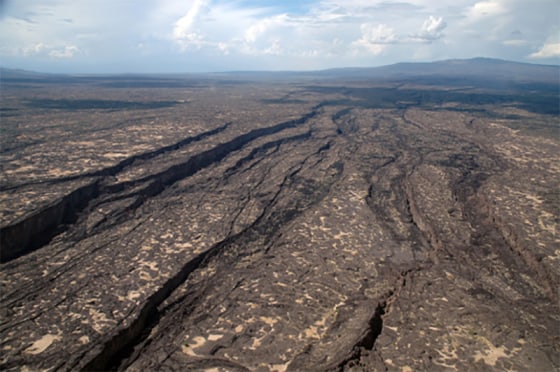
Кени улсын Туркана нуурын доорх газрын царцдас ердөө 13 километр зузаантай болж нимгэрсэн нь эх газар салж буйг илтгэх томоохон нотолгоо болж байна.
Nature Communications сэтгүүлд нийтлэгдсэн судалгаагаар, Зүүн Африкийн хагарлын системийн нэг хэсэг болох Туркана бүсэд тектоникийн ялтаснууд жил бүр 4.7 миллиметрээр салж байгааг тогтоожээ. Колумбын их сургуулийн судлаачид газар доорх акустик долгионыг хэмжих замаар царцдасын зузааныг зураглахад, гол хэсгээрээ ердөө 12.7 километр болж нимгэрсэн нь тогтоогдсон байна. Энэхүү үзэгдлийг геологичид “нарийсах” (necking) үе шат хэмээн нэрлэж байгаа бөгөөд энэ нь эх газар цаашид салж, шинэ далай үүсэх магадлал өндөртэйг харуулж байна.
Судалгаанд дурдсанаар, Туркана орчмын бүсэд 45 сая жилийн өмнөөс эхэлсэн эртний хагарлын ул мөр болон орчин үеийн тектоникийн идэвхжил давхцаж байгаа нь царцдасыг илүү сул дорой болгожээ. Үүний улмаас хагарал бусад бүс нутгийг бодвол харьцангуй хурдацтай явагдаж, магма дээшлэх замыг нээж өгч байна. Энэхүү геологийн өөрчлөлт нь сүүлийн 4 сая жилийн хугацаанд тухайн бүс нутагт хурдас чулуулаг хуримтлагдах нөхцөлийг бүрдүүлж, хүний хувьслын үеийн олдворууд сайн хадгалагдахад нөлөөлсөн байж болзошгүй гэж судлаачид таамаглаж байна.
Эх газрын хагарал нь сая сая жилийн турш үргэлжлэх удаан үйл явц бөгөөд Туркана бүс нь одоогоор чухал геодинамикийн босгыг давжээ. Судлаачид энэхүү үйл явцыг ажиглах нь эх газар хэрхэн салж, шинэ далай бүрэлддэг механизмыг ойлгоход чухал ач холбогдолтой гэж үзэж байна. Одоогоор энэхүү таамаглалыг батлах нэмэлт судалгааг үргэлжлүүлэн хийх шаардлагатай байгаа юм.
Дэлгэрэнгүйг эх сурвалжаас харах
↓Эх сурвалжийг нээх ↓
The crust beneath Kenya’s Lake Turkana is roughly 13 kilometers, or 8 miles, thick. That is not a typo. Typical continental crust can extend 35 kilometers or more, yet along the axis of the Turkana Rift, roughly two-thirds of that thickness is gone.
A new study, published in Nature Communications, argues that the extreme thinning is one of the clearest signs yet that this part of eastern Africa has entered a more advanced stage of continental breakup.
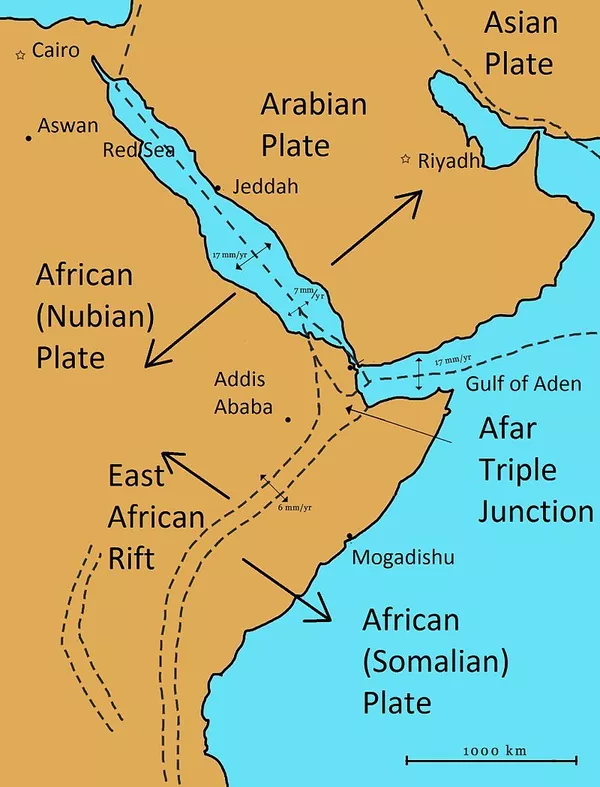
The Turkana Rift is a roughly 500-kilometer-wide, low-lying region spanning Kenya and Ethiopia. It forms part of the much larger East African Rift System, which stretches from the Afar Depression in northeastern Ethiopia south toward Mozambique.
Near Turkana, the African and Somali plates are moving apart at about 4.7 millimeters per year. As the crust is pulled sideways, it fractures, deforms and weakens, creating pathways for magma to rise from below.
Not every continental rift ends with a continent splitting apart. According to the study’s authors, Turkana increasingly looks like one that might.
A Crust Pinched to 13 Kilometers
Christian Rowan, a PhD student in Earth and Environmental Sciences and researcher at Columbia University’s Lamont-Doherty Earth Observatory tracked how acoustic waves reflected from layers beneath the surface. Those reflections allowed them to map buried sediments and estimate the thickness of the crust across the rift.
Along the rift axis, the crystalline crust averages about 12.7 kilometers thick. At the rift flanks, it exceeds 35 kilometers.
Geologists describe that pattern as “necking,” a stage in which material being pulled apart becomes dramatically narrower in the middle. Rowan compares the process to stretching saltwater taffy from both ends: the center becomes thinner and longer while the edges remain comparatively unchanged.
“The thinner the crust gets, the weaker it becomes, which helps promote continued rifting,” he says. That weakening matters because thinner crust becomes easier to stretch further, reinforcing the process already underway.
“We’ve reached that critical threshold” of crustal breakdown, says Anne Bécel, a geophysicist at Lamont and co-author of the study. “We think this is why it is more prone to separate.”
No active continental rift had previously been identified as clearly undergoing this necking phase.
That makes Turkana unusual. It gives geologists a chance to observe an active process that, until now, has largely been reconstructed from ancient and abandoned rift zones preserved along continental margins around the world.
An Older Rift Left the Crust Weakened
Rifting around Turkana began roughly 45 million years ago. The researchers estimate that necking started much later, around 4 million years ago, following a period of widespread volcanic activity.
That appears to be earlier than conventional models predicted for this part of the East African Rift System.
The study points to an explanation buried beneath Turkana.
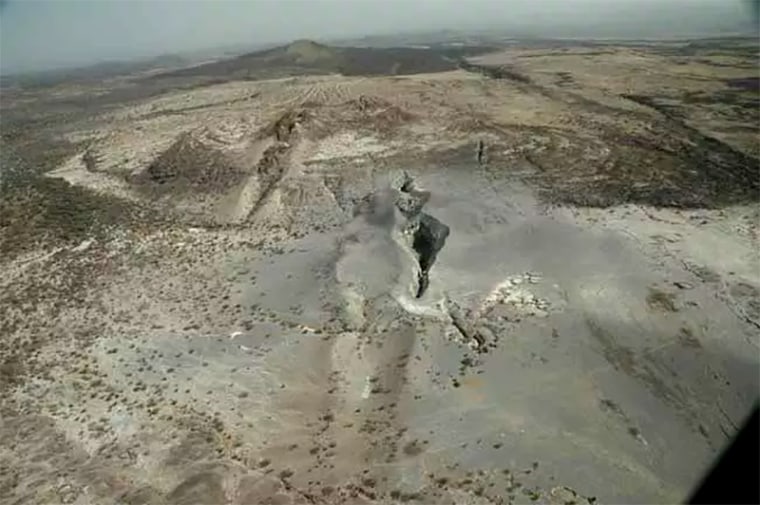
Two generations of rifting overlap there: an older Mesozoic to early Cenozoic rift system and the younger East African Rift System that remains active today. Researchers identified previously unrecognized depocenters associated with the older system, evidence that an earlier episode of extension had already thinned and weakened the crust before the modern phase of rifting began.
The timing may have mattered just as much.
Because relatively little geological time separated the older rifting episode from the younger one, the crust may not have fully recovered its strength before it was stretched again. That inherited weakness could help explain why Turkana reached the necking stage faster than neighboring sections of the rift.
“It challenges some of the more traditional ideas of how continents break apart,” Rowan says.
Elsewhere in the East African Rift System, crustal thicknesses remain above 25 kilometers, suggesting those regions are still in an earlier stretching phase. Turkana has progressed beyond that stage, and its older geological scars, combined with repeated volcanic activity, appear to have accelerated the process.
The Fossil Record, Reconsidered
The Turkana Basin has produced more than 1,200 hominin fossils spanning the past 4 million years, representing roughly one-third of the hominin fossils discovered across Africa.
For decades, that extraordinary concentration has helped establish Turkana as one of the most important regions in the study of human evolution. Many paleoanthropologists have interpreted the basin as a center of intense evolutionary activity.
The new geological results raise another possibility.
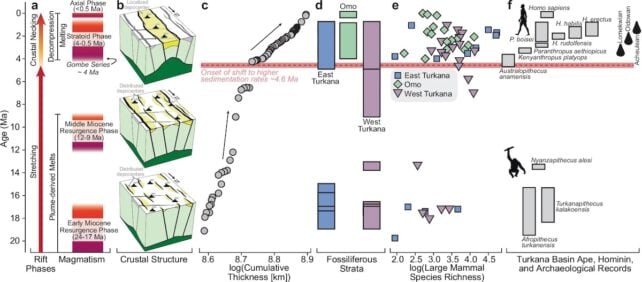
Around 4 million years ago, after widespread volcanism, necking caused the Turkana Rift to subside. As the basin sank, fine-grained sediments capable of preserving fossils began accumulating rapidly.
“The conditions were right to preserve a continuous fossil record,” Rowan says. In other words, Turkana’s unusually rich fossil record may reflect preservation as much as evolutionary activity.
The basin may not necessarily have produced an exceptional number of evolutionary events; it may simply have recorded those events unusually well because tectonic conditions created an excellent sedimentary archive.
Before roughly 4 million years ago, the fossil record in Turkana is more fragmented, with thick volcanic deposits interrupting the sedimentary sequence. After that point, sediment accumulation increased sharply as the rift shifted from stretching into necking.
The idea is still a hypothesis. “But other researchers can now use our results to explore those ideas,” Rowan says.
East Africa’s Rift Is Entering a More Advanced Stage
Two parts of the East African Rift System have now reached stages commonly associated with successful continental breakup.
In the Afar region, incipient oceanization is already underway. In Turkana, the new study identifies active necking.
Co-author Folarin Kolawole, also with Lamont, says understanding the evolution of the rift can help researchers reconstruct past landscapes, vegetation and climate, linking deep geological change with environmental conditions at the surface.
“Then we can use that knowledge to understand what’s going to happen in our future, even on shorter time scales,” Bécel adds.
The researchers conclude that Turkana has crossed an important geodynamic threshold, with feedbacks now in place that favor continued thinning and extension.
Continental breakup is not imminent. Processes like this unfold over millions of years. But beneath Turkana, the crystalline crust has already narrowed to less than 13 kilometers at its thinnest point.
Enjoyed this article? Subscribe to our free newsletter for engaging stories, exclusive content, and the latest news.

