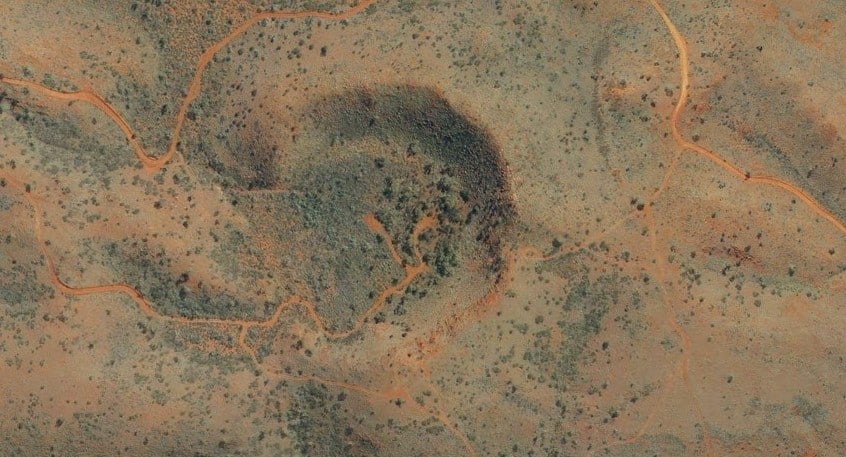
Геологич Артур Хикман хиймэл дагуулын зураг ашиглан судалгаа хийж байхдаа санамсаргүй байдлаар солирын нөлөөгөөр үүссэн тогоог олж илрүүлжээ.
2007 оны долдугаар сард Баруун Австралийн Геологийн албаны геологич Артур Хикман төмрийн хүдэр хайх зорилгоор хиймэл дагуулын зураг ажиглаж байхдаа Офталмиа нурууны орчимд ер бусын дугуй хэлбэртэй бүтэц анзаарчээ. Тэрээр тухайн үед солирын тогоо хайгаагүй байсан ч өөрийн мэргэжлийн туршлагадаа үндэслэн энэхүү содон дүрсийг илрүүлсэн байна. Уг сэжиг бүхий талбайг баталгаажуулахаар Австралийн Үндэсний их сургуулийн эрдэмтэн, доктор Эндрю Гликсон газар дээр нь очиж судалгаа хийснээр энэ нь солирын нөлөөгөөр үүссэн тогоо болохыг тогтоожээ.
Тус тогоо нь 260 метр орчим өргөн, 30 орчим метр гүн бөгөөд эрдэмтэд үүнийг ойролцоогоор 50,000 жилийн өмнө 10-15 метр диаметртэй төмөр-никелийн найрлагатай солир унасны улмаас үүссэн гэж таамаглаж байна. Тухайн бүс нутгийг өмнө нь зураглаж байсан хэдий ч энэ онцлог шинж тэмдэг анзаарагдалгүй өнгөрсөн байжээ.
Шинжлэх ухааны хувьд бүрэн баталгаажуулах ажил арван жил үргэлжилсний эцэст 2012 онд Баруун Австралийн Геологийн алба болон Atlas Iron Ltd компани хамтран тус тогооны төв хэсэгт өрөмдлөгийн ажил гүйцэтгэжээ. Өрөмдлөгийн дээжээс сансрын гаралтай болохыг илтгэх ириди, паллади зэрэг элементийн өндөр агууламж илэрсэн нь уг байгууламжийг солирын тогоо болохыг эргэлзээгүй нотолсон байна. Одоо энэхүү байгууламжийг анх олж илрүүлсэн геологичийн нэрээр “Хикманы тогоо” хэмээн нэрлэдэг.
Дэлгэрэнгүйг эх сурвалжаас харах
↓Эх сурвалжийг нээх ↓
In July 2007, Australian geologist Arthur Hickman was scanning satellite imagery for iron ore deposits when a mysterious circle caught his eye. He saw an almost perfectly circular structure tucked into the remote Ophthalmia Range of Western Australia.
What began as a routine desktop search for mineral resources turned into the discovery of a genuine meteorite impact crater, one that would take a full decade of scientific work to confirm beyond doubt. Hickman, who worked for the Geological Survey of Western Australia, wasn’t hunting for craters at all. He was simply doing his job, poring over satellite images the way geologists routinely do, when his trained eye picked up on a shape that didn’t belong.
Satellite tools like Google Earth have quietly become part of the geologist’s toolkit, turning armchair observation into a legitimate method of discovery. But recognizing a shape on a screen is only the first step.
A Circular Anomaly Spotted From a Desk
As mentioned by Times of India in a report, Hickman was browsing Google Earth images specifically while searching for iron ore when he noticed the unusually circular structure.
“I wasn’t looking for it,” Hickman explained in a phone interview. “I was high up in Google Earth [the free program that enables users to scour the Earth using stitched together aerial and satellite images] when I spotted this little circular structure which struck me as odd.”
He didn’t rely on the image alone. Instead, he sent a screenshot and the coordinates to a colleague, Dr. Andrew Glickson at the Australian National University, who traveled to the site in person to assess it directly.That on-the-ground visit was decisive.
Glickson confirmed, in his study, that what Hickman had spotted from behind a computer screen was, in fact, a well-preserved impact crater, one that had gone completely unnoticed despite the surrounding area having already been mapped by the Survey roughly two decades earlier.
The structure sits about 16 kilometres northeast of the Hope Downs 4 Mine and some 35 kilometres north of the town of Newman, in a landscape that, at first glance, gives few clues to its violent origin.
How Big It Is and What Created It?
The crater itself is modest in scale but scientifically rich in detail. It measures roughly 260 metres, or about 850 feet, across, and reaches a depth of around 30 metres. Researchers place its age somewhere between 10,000 and 100,000 years, placing it firmly within the Pleistocene epoch, though newer research has narrowed that estimate to somewhere closer to 50,000 years.
As for what actually struck the outback, scientists believe the responsible object was an iron-nickel meteorite measuring somewhere between 10 and 15 metres in diameter at the moment of impact. It’s a relatively small object by cosmic standards, yet large enough to leave a mark that has endured for tens of thousands of years in an otherwise unremarkable stretch of Western Australian terrain.

Ten Years Later, Drilling Confirms the Impact
Spotting a shape and confirming its origin, however, are two very different things. It wasn’t until 2012 that the Geological Survey of Western Australia, working alongside Atlas Iron Ltd, launched a proper drilling project into the centre of the crater. The findings, later presented at a Geoscience Research workshop in 2017, gave the discovery its scientific seal.
Drilling revealed elevated levels of siderophile elements, notably iridium and palladium, both considered telltale markers of extraterrestrial material. These chemical signatures, combined with the physical structure of the crater, left little doubt about its origin.
What Hickman had noticed from his desk years earlier was not just a simple circle, but the scar of a meteorite strike, later fittingly named the Hickman Crater in recognition of the man who first spotted it while looking for something else entirely.
Enjoyed this article? Subscribe to our free newsletter for engaging stories, exclusive content, and the latest news.

