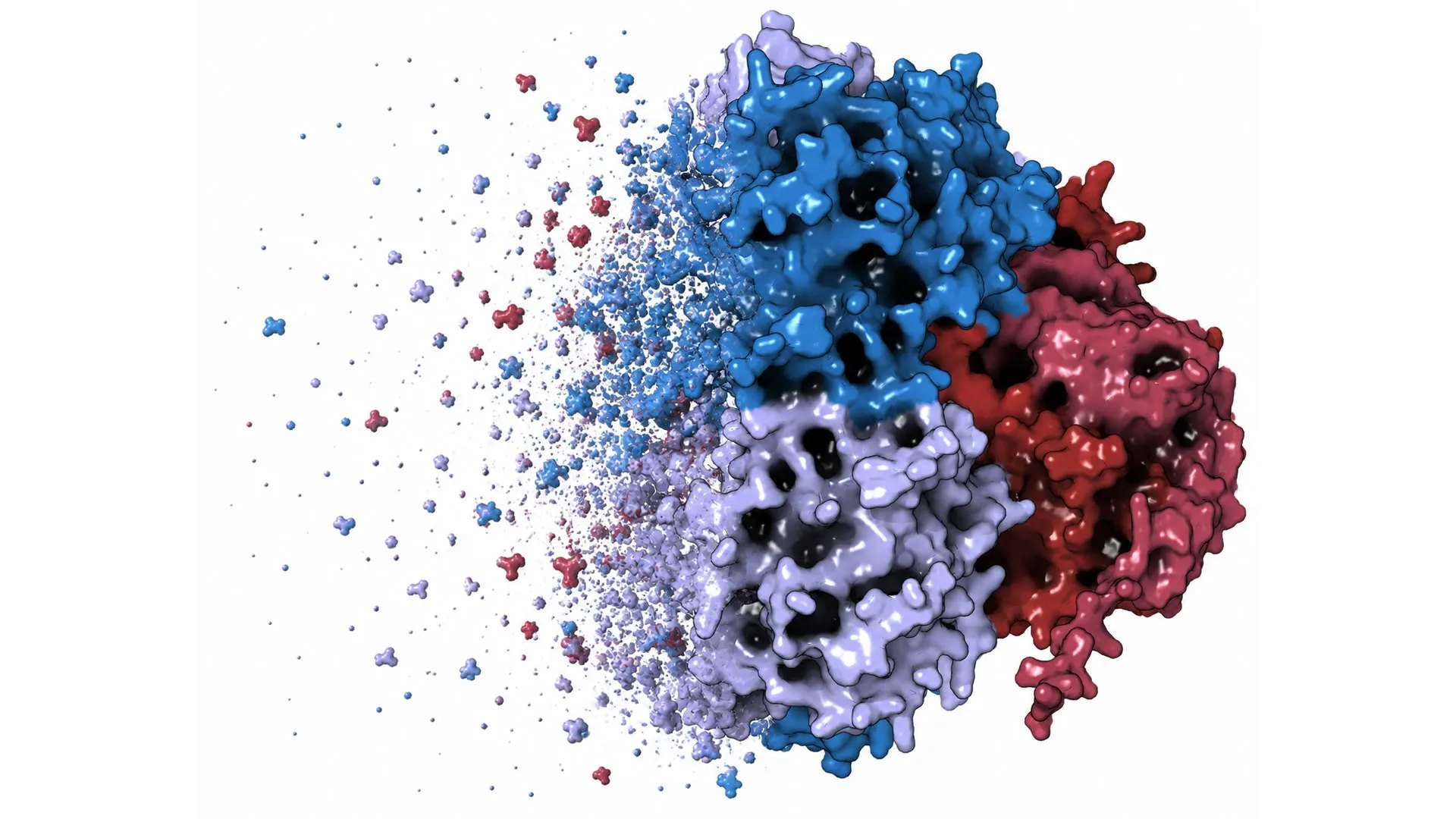
Судлаачид NUDT5 уураг нь ферментийн идэвхээс үл хамааран лейкемийн эмчилгээний үр дүнд хэрхэн нөлөөлдгийг тогтоожээ.
Австрийн Шинжлэх ухааны академийн CeMM төв болон Оксфордын их сургуулийн судлаачид 6-тиогуанин (6-TG) хэмээх лейкемийн эсрэг эмийг эсүүд яагаад өөр өөрөөр хүлээн авдаг болохыг судалжээ. Долоон арван жилийн турш эмчилгээнд ашиглагдаж ирсэн уг эмийн үйлчлэлийг өмнө нь зөвхөн ферментийн үйл ажиллагаатай холбон тайлбарладаг байсан бол шинэ судалгаагаар NUDT5 уураг нь өөр нэгэн чухал үүрэг гүйцэтгэдэг болохыг илрүүлсэн байна.
Science сэтгүүлд 2025 онд нийтлэгдсэн судалгааны үр дүнгээс үзэхэд, NUDT5 нь химийн урвалд оролцогч катализаторын үүргээс гадна эсийн бодисын солилцоог зохион байгуулагч молекул бүтцийн үүрэг гүйцэтгэдэг аж. Судлаачид NUDT5-ыг ферментийн идэвхээр нь хаах оролдлого хийхэд эсийн эмэнд үзүүлэх хариу урвалд төдийлөн өөрчлөлт гараагүй байна. Гэвч зорилтот уураг задралд оруулах (targeted protein degradation) аргыг ашиглан NUDT5-ыг эсээс бүрмөсөн устгахад эсүүд эмийн хорт нөлөөнөөс хамгаалагдсан нь тогтоогджээ.
Түүнчлэн, NUDT5 нь лейкемийн эмчилгээний хариу урвалд нөлөөлдөг NUDT15 уурагтай эсрэг тэсрэг үйлчилгээ үзүүлдэг болохыг ажиглажээ. NUDT15 дутагдалтай эсүүд эмэнд илүү мэдрэг болдог бол NUDT5-ыг багасгахад эсүүд эмэнд тэсвэртэй болж байна. Энэхүү нээлт нь уургууд нь ферментийн идэвхээс бүрэн хамааралгүйгээр эсийн үйл ажиллагаанд чухал нөлөө үзүүлдэг болохыг харуулж байна.
Энэхүү судалгаа нь шинэ эмчилгээний арга болоогүй ч 6-TG эмийн үйлчлэлийн нууцлаг механизмыг тайлбарлаж байна. Цаашид энэ төрлийн судалгаа нь уламжлалт фермент дарангуйлагчдын илрүүлж чаддаггүй эсийн биологийн үйл явцыг судлахад ач холбогдолтой юм.
Дэлгэрэнгүйг эх сурвалжаас харах
↓Эх сурвалжийг нээх ↓
For more than seven decades, doctors have used the drug 6-thioguanine (6-TG) to treat leukemia. Its effects in patients are well documented, but researchers are still working to understand the molecular details that determine why some cells are killed by the drug while others manage to withstand it.
A team at the CeMM Research Center for Molecular Medicine of the Austrian Academy of Sciences, working with scientists at the University of Oxford, the Weizmann Institute of Science and the University of Dundee, has now identified an unexpected factor in that response: a protein called NUDT5.
The finding follows a recent discovery from the Kubicek and Huber laboratories (Science, 2025). That earlier work showed that NUDT5 has an important role inside cells that does not depend on its usual enzymatic activity. Rather than functioning only as a catalyst that drives chemical reactions, NUDT5 can also act as a molecular scaffold that helps organize cellular metabolism.
That unusual function appears to matter for how cells respond to 6-TG.
“We initially expected that NUDT5 would influence 6-TG through its enzymatic activity,” says co-first author Tuan-Anh Nguyen from CeMM. “Instead, we found that inhibiting the enzyme had little effect. What mattered was whether the protein itself was present.”
Removing NUDT5 Changes the Drug Response
Many drugs that target enzymes are designed to block the chemical reactions those enzymes perform. The researchers wanted to know whether suppressing NUDT5 in this way would also change the effects of 6-TG.
To test that idea, they used an emerging strategy known as targeted protein degradation. Instead of merely blocking a protein’s activity, this method causes the cell to eliminate the protein altogether.
“We developed a cell-based platform to accelerate the discovery of NUDT5 degraders. This platform helped guide the medicinal chemistry efforts that ultimately produced dNUDT5, our most active degrader,” said Anne-Sophie Marques, a first author of the paper whose work at Oxford contributed to the findings.
A medicinal chemistry program led by the Huber laboratory at the University of Oxford produced a collection of highly selective NUDT5 degraders. The researchers also created matched control compounds that could bind to NUDT5 without causing the protein to be destroyed.
They then compared the effects of these molecules with conventional NUDT5 inhibitors.
The difference was clear. Blocking NUDT5’s enzymatic activity did not meaningfully change how cells responded to 6-TG. Removing NUDT5 from the cells, however, protected them from the toxic effects of the drug. Genetic experiments led to the same conclusion.
“Chemical degraders give us a way to separate what a protein does as an enzyme from what it does as a physical presence in the cell,” says Professor Kilian Huber, Centre for Medicines Discovery at the University of Oxford and co-corresponding author of the study. “In this case, that distinction was decisive: removing NUDT5 revealed biology that conventional inhibitors missed.”
A Hidden Function Beyond Enzyme Activity
The results indicate that NUDT5 affects sensitivity to thiopurine drugs through a mechanism that does not depend on its catalytic activity. In other words, studying what the enzyme chemically does is not enough to explain its influence on 6-TG.
“As the results came in, it became immediately clear that the dNUDT5 was protecting cells from 6-thioguanine toxicity in a dose-dependent manner. That was an incredibly exciting moment,” said Ludwig Bauer, a first author of the paper.
The researchers also discovered an intriguing connection between NUDT5 and another protein called NUDT15, which is already known to affect how patients respond to thiopurine drugs.
The two proteins appear to have opposing effects.
Loss of NUDT15 makes cells more sensitive to 6-TG. Reducing NUDT5, by contrast, makes cells more resistant to the treatment. The findings suggest that the proteins influence thiopurine response through different mechanisms that can push cells in opposite directions.
“Our results show that proteins can have important biological functions that are completely independent of their enzymatic activity,” says corresponding author Stefan Kubicek, Principal Investigator at CeMM. “By removing NUDT5 rather than simply inhibiting it, we were able to uncover a hidden layer of biology that helps determine how cells respond to a clinically important drug.”
A New Window Into Leukemia Drug Response
The findings do not immediately lead to a new treatment, but they reveal an unexpected mechanism that helps control the effects of a long-used leukemia drug.
By showing that NUDT5 influences 6-TG through a non-catalytic function, the research could help scientists better understand why responses to thiopurine treatment can differ. It also demonstrates how targeted protein degradation can expose biological functions that may remain invisible when researchers rely only on traditional enzyme inhibitors.
This work was supported by the European Research Council (ERC) under the European Union’s Horizon 2020 research and innovation program, the Austrian Science Fund (FWF), the Vienna Science and Technology Fund (WWTF), the Marie Skłodowska-Curie Actions Postdoctoral Fellowships program, the Innovative Medicines Initiative 2 Joint Undertaking (IMI2 JU), the Wellcome Trust, Merck Sharp & Dohme Corp. and Janssen Pharmaceutica NV.

