Хойд Каролины Улсын Их Сургуулийн инженерүүд хагарал үүссэн тохиолдолд дулааны аргаар дотоод бүтцээ нөхөн сэргээх чадвартай, өндөр бат бэх нийлмэл материалыг туршиж байна.
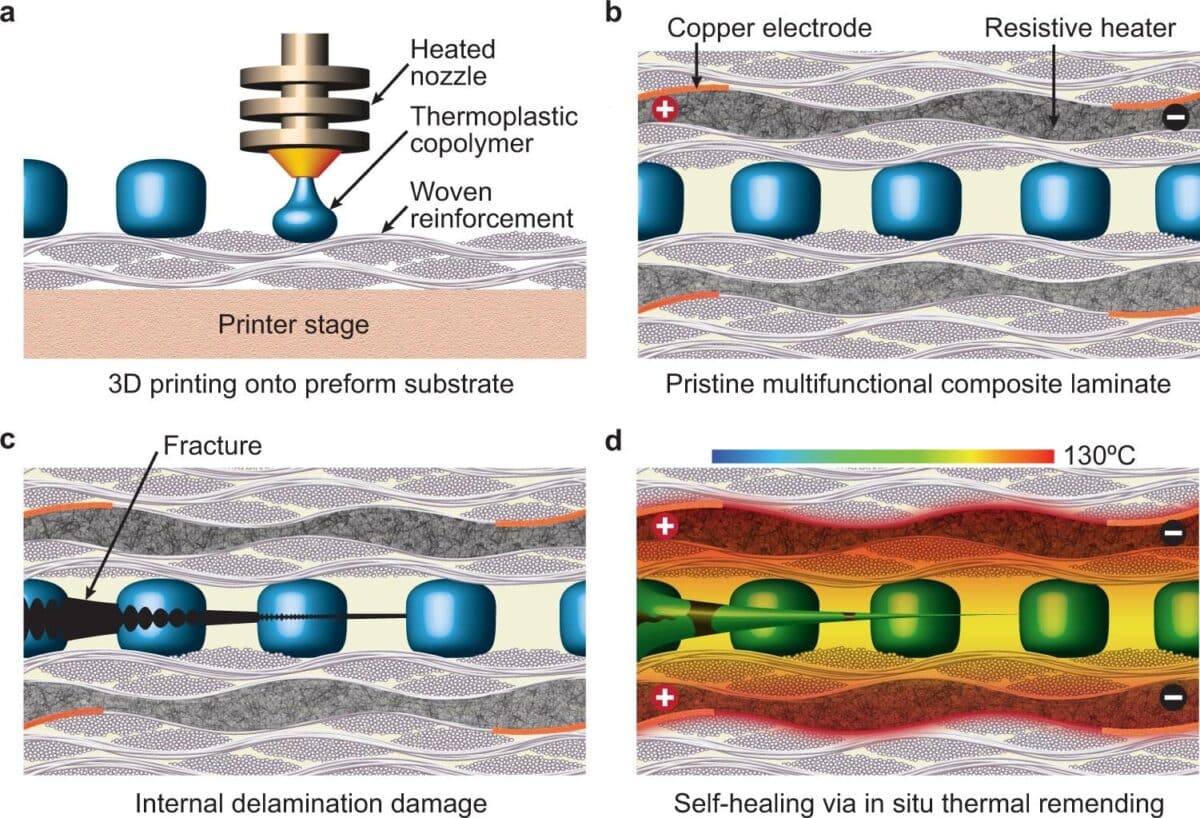
Орчин үеийн нисэх онгоц, салхин сэнс болон сансрын хөлгүүдэд ашиглагддаг нийлмэл материалууд нь давхаргууд хоорондоо салж хагарах (delamination) сул талтай байдаг. Proceedings of the National Academy of Sciences сэтгүүлд нийтлэгдсэн судалгаагаар, судлаачид поли(этилен-ко-метакрилийн хүчил) буюу EMAA хэмээх термопластик полимерийг материалын давхаргууд хооронд 3D хэвлэлээр байршуулж, энэхүү асуудлыг шийдвэрлэхийг зорьжээ. Материалын дотор суурилуулсан цахилгаан халаагуур нь хагарал үүсэх үед полимерийг хайлуулж, завсрыг дүүргэн бэхжүүлэх замаар бүтцийг анхны байдалд нь оруулдаг.
Туршилтын явцад уг материал 1000 удаагийн дахин давтагдах хагарал болон нөхөн сэргээлтийн циклийг амжилттай давсан байна. Судалгааны багийн гишүүн Жак Туричекын тайлбарласнаар, энэхүү материал нь уламжлалт нийлмэл материалуудаас илүү бат бөх бөгөөд олон удаагийн нөхөн сэргээлтийн дараа ч бүтцийн чанараа аажмаар алддаг байна. Энэхүү технологи нь материалын ашиглалтын хугацааг онолын хувьд олон зуун жилээр уртасгах боломжтойг загварчлалын тооцоолол харуулжээ.
Гэсэн хэдий ч энэхүү үр дүн нь лабораторийн хяналттай орчинд хийгдсэн туршилт бөгөөд бодит нөхцөлд тулгардаг чичиргээ, цаг агаарын нөлөөлөл, гадны цохилт зэрэг хүчин зүйлсийг бүрэн тусгаагүй юм. Тиймээс уг технологийг арилжааны зориулалтаар ашиглахаас өмнө удаан хугацааны ядаргааны болон бат бэхийн нэмэлт туршилтуудыг хийх шаардлагатай байна. Гэвч энэхүү нээлт нь сансрын хөлөг зэрэг засвар үйлчилгээ хийхэд хүндрэлтэй орчинд ажилладаг технологиудын ашиглалтын хугацааг нэмэгдүүлэх өндөр ач холбогдолтой юм.
Дэлгэрэнгүйг эх сурвалжаас харах
↓Эх сурвалжийг нээх ↓
Fiber-reinforced composites are central to modern aircraft, wind turbines, cars, and spacecraft because they combine low weight with high strength. Their layered construction, however, creates a familiar weakness: delamination, in which cracks spread between internal layers and cause them to separate. Once that damage develops, structural performance can fall quickly enough to require inspection, repair, or replacement.
A team at North Carolina State University is testing whether some of that damage can be repaired from inside the material itself. In a study published in the Proceedings of the National Academy of Sciences, the researchers report that their composite survived 1,000 cycles of deliberate cracking and self-repair. The automated experiment ran for about 40 days and repeatedly created a delamination in the same specimen, triggered an internal heating system, and then loaded the material again after repair.
That endurance is the main point of the work. Many self-healing materials can repair damage once or a small number of times, but repeated use may consume the healing agent or reduce its effectiveness. The NC State experiment was designed to see how long the same repair mechanism could continue working under repeated damage.
The Repair Material Is Built Into the Laminate
At the center of the design is a thermoplastic polymer called poly(ethylene-co-methacrylic acid), or EMAA. It is 3D-printed directly onto the fiber reinforcement before the laminate is assembled, creating a patterned interlayer between adjacent sheets. The polymer contributes to toughness even before any repair is needed: the team found that the modified laminate could be roughly two to four times more resistant to delamination than comparable conventional composites.
Thin electrically resistive heater layers provide the second part of the system. When current passes through them, the temperature rises enough to soften or melt the EMAA. The polymer then moves into cracks and microfractures within the damaged interface and solidifies as the structure cools, restoring the bond between separated layers. The researchers refer to this process as thermal remending.
Because both the healing polymer and the heat source are embedded during manufacturing, the structure does not depend on an external patch or injected adhesive. That architecture also differs from self-healing materials based on microcapsules, where a finite supply of repair fluid can be exhausted once the capsules rupture.
From 100 Healing Cycles To 1,000
The same research group had previously demonstrated 100 healing cycles in a 2022 study. Reaching 1,000 required an automated test rig capable of running the damage-and-repair sequence repeatedly without manual intervention after every cycle.
For each round, tensile loading produced a delamination roughly 50 millimeters long. The heater layers were then activated, allowing the EMAA to repair the interface before the specimen was loaded again. This sequence continued until the material had undergone 1,000 cycles.
Its mechanical performance did not remain unchanged. Resistance to delamination declined gradually as the number of cycles increased, but the loss was relatively slow.

“Because our composite starts off significantly tougher than conventional composites, this self-healing material resists cracking better than the laminated composites currently out there for at least 500 cycles,” said lead author Jack Turicek, a graduate student at NC State. “And while its interlaminar toughness does decline after repeated healing, it does so very slowly.”
The decline followed a Weibull statistical distribution, which the team used to model longer-term performance beyond the duration of the experiment.
Where the 500-Year Estimate Comes From
Those projections produced the study’s most eye-catching numbers. A component that required one healing event every three months could theoretically remain usable for about 125 years, according to the model. If healing occurred only once per year, the projected lifetime rose to roughly 500 years.
Neither figure represents a demonstrated service life. The experiment used laboratory specimens subjected to a controlled form of delamination, whereas an operating aircraft or turbine blade would experience more complicated combinations of fatigue, environmental exposure, vibration, and impact damage. The model also assumes that the degradation behavior observed during the test remains applicable over much longer periods.

Additional work would therefore be needed before the material could be considered for commercial structures. Long-duration fatigue testing, moisture exposure, temperature cycling, and realistic impact scenarios such as hail or bird strikes would all be relevant. Aerospace applications would also have to pass certification requirements that go well beyond laboratory fracture testing.
The 1,000-cycle result is still useful because it establishes that repeated thermal remending can remain functional after far more repair events than the group had previously demonstrated.
Wind Turbines Could Benefit From Longer Service Life
Wind turbine blades are one possible application because they rely heavily on fiber-reinforced composites and can be difficult to recycle once decommissioned. An American Clean Power Association white paper notes that the composite materials used in blades are generally non-toxic but remain challenging to recycle economically at large scale.
The amount of waste is expected to increase as more turbines reach retirement. Researchers at the National Renewable Energy Laboratory have estimated that cumulative U.S. wind-blade waste could reach about 2.2 million tons by 2050 under current decommissioning trends.
Self-healing composites would not make those blades recyclable, but extending their usable life could reduce how often they need to be replaced. Whether that benefit would outweigh the added complexity of embedded heaters, damage detection, and repair control remains an engineering and economic question.
Space Presents a Different Repair Problem
Spacecraft offer another potential use case because conventional maintenance may not be available at all once a vehicle leaves Earth. A repair system already embedded in the structure could therefore be useful in situations where sending technicians or replacement hardware is impossible.
“This provides obvious value for large-scale and expensive technologies such as aircraft and wind turbines, but it could be exceptionally important for technologies such as spacecraft, which operate in largely inaccessible environments that would be difficult or impossible to repair via conventional methods on-site,” said Jason Patrick, the study’s corresponding author and an associate professor at NC State.
For now, the work demonstrates durability under repeated laboratory damage rather than a ready-to-deploy aerospace material. Its main contribution is evidence that a thermally activated healing system can continue operating through 1,000 fracture cycles while losing performance gradually rather than abruptly.
Enjoyed this article? Subscribe to our free newsletter for engaging stories, exclusive content, and the latest news.

