Танзани улсаас олдсон 240 сая жилийн настай өвсөн тэжээлт амьтны олдвор нь тухайн бүс нутгийн эртний олдворуудын насжилтыг дахин нягтлах шаардлага үүсгэж байна.
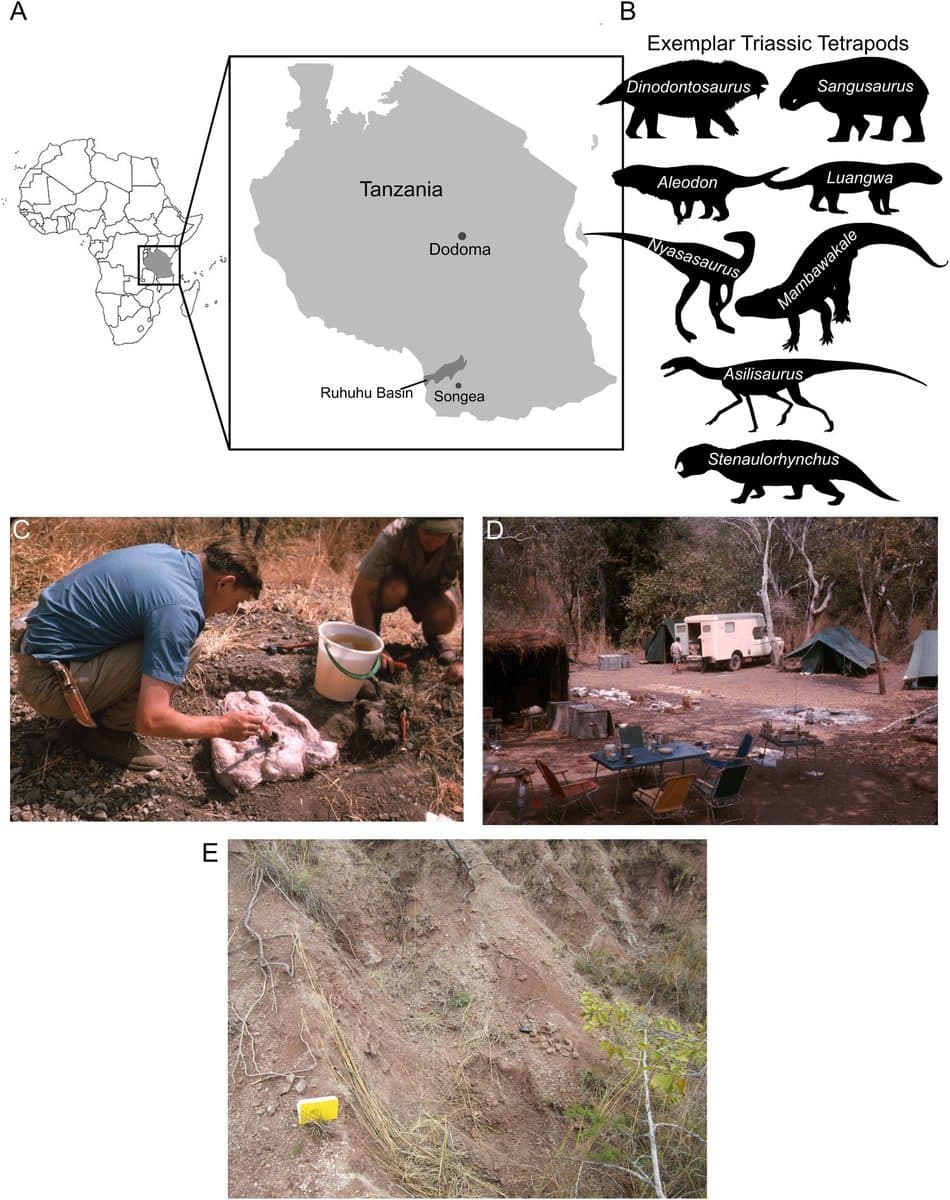
Бристолын их сургуулийн судлаачдын баг Танзанийн Рухуху сав газраас олдсон олдворуудыг судалсны дүнд Dinodontosaurus isiyavamanda хэмээх шинэ зүйлийн дицинодонт амьтныг илрүүлжээ. Энэхүү амьтан нь динозавр үүсэхээс өмнө амьдарч байсан хөхтөн амьтдын өвөг дээдэс болох синапсид бүлэгт хамаардаг. Өмнө нь зөвхөн Өмнөд Америкаас олддог байсан энэ төрлийн амьтан Танзаниас олдсон нь хоёр тивийн чулуулгийн давхаргыг харьцуулан судлах шинэ боломжийг нээж байна.
Судалгааны багийнхны мэдээлснээр, Танзанийн чулуулгийн давхарга болон Өмнөд Америкийн чулуулгийн насжилт ижил төстэй болох нь тогтоогджээ. Радиометрийн шинжилгээгээр Өмнөд Америкийн чулуулгийн давхарга нь Өмнөд Африкийнхаас 10 сая хүртэлх жилээр залуу болох нь батлагдсан нь динозаврын үүслийн хугацааг илүү нарийвчлан тогтооход нөлөөлж байна. Ингэснээр Танзаниас олдсон хамгийн эртний байж болзошгүй динозаврын олдворуудыг өмнө нь таамаглаж байснаас илүү залуу байж болзошгүй гэж үзэж байна.
Энэхүү олдвор нь 1963 онд Танзаниас авчирсан боловч Лондоны Байгалийн түүхийн музейд олон арван жил судлагдаагүй байсан цуглуулгаас олдсон юм. Судлаач Найджел Ларкин 1994 онд магистрын ажлынхаа хүрээнд уг олдворыг шинжлэх ухаанд шинэ зүйл болохыг анх таамаглаж байсан ч орчин үеийн микро-CT сканнердах технологийн ачаар сая бүрэн тодорхойлжээ. Одоогоор уг амьтны гавлын яснаас бусад хэсэг буюу араг ясны үлдэгдлийг цаашид үргэлжлүүлэн судлах шаардлагатай байна.
Дэлгэрэнгүйг эх сурвалжаас харах
↓Эх сурвалжийг нээх ↓
A newly identified plant-eating relative of mammals that lived around 240 million years ago in what is now Tanzania may change the age assigned to some of the world’s oldest possible dinosaur fossils. Dinodontosaurus isiyavamanda comes from the same rocks as those dinosaur candidates, and its discovery points to a younger date for them.
The animal is a dicynodont, a member of a group of plant-eating synapsids. Synapsids are vertebrates in the mammal lineage that flourished before the rise of dinosaurs. An international team led by the University of Bristol described the species in the Journal of Vertebrate Paleontology.
The age of the Tanzanian deposits had rested partly on comparisons with rocks elsewhere. A genus once known only from South America has now turned up in Africa, which gives researchers a new way to compare the ages of fossil-bearing rocks, with implications for when and where dinosaurs first evolved.
One Genus, Two Continents
The team placed the animal within Dinodontosaurus, a genus previously known only from South America. Hady George, the study’s lead author and a PhD student in Bristol’s School of Earth Sciences, said:
“Our discovery marks the first confirmed record of the genus Dinodontosaurus outside South America.” He added that the finding “links the Tanzanian and South American fossil-bearing rocks, showing they are of equivalent age.”
The anatomy put the fossils in Dinodontosaurus, but differences showed they represented a previously unknown species. The researchers named it after the land of the Wamanda people, who inhabit the region where the fossils were found.
A Younger Date for the Dinosaur Candidates
Researchers had thought the Tanzanian and South African locations shared some fossil genera, and they considered the South African rocks to be Middle Triassic in age. The South American connection points to a younger age for the Tanzanian deposits.
According to the University of Bristol, recent radiometric dating, which estimates age by measuring the decay of radioactive elements, suggests the South American rock sequences are up to 10 million years younger than the South African ones.

The finding adds evidence against treating the Tanzanian dinosaur candidates as the oldest known. In George‘s words:
It “helps confirm that the oldest dinosaur candidates from Tanzania are probably no older than those from South America, refining the timeline of dinosaur origins.”
Rediscovered in a Museum Collection
The main specimen has a long backstory. A British expedition to what is now Tanzania brought back an extensive collection of synapsid fossils in 1963. The fossils were housed at the Natural History Museum in London, but the collection remained only partly studied, leaving some specimens unidentified.
For the new study, researchers examined a previously undescribed skeleton from that collection alongside a fragmentary skull discovered more recently. Both belonged to dicynodonts.
Dr. Mike Day, the museum’s curator of non-mammalian tetrapods, said that:
“This fossil specimen from Tanzania has been in our care for over 60 years, and it’s wonderful that its identity has now been brought to light,” adding that the case shows “how revisiting museum collections can change our understanding of the past just as much as finding new fossils in the field.”

Co-author Nigel Larkin, a visiting research fellow in the University of Reading’s School of Biological Sciences, has an even longer connection to the bones. He studied the skeleton for his MSc thesis at University College London in 1994 and judged it a species new to science, yet it took him nearly 30 years to start writing it up.
“I’m glad I waited,” he said, noting that micro-CT scanning and easier international collaboration let the team do far more than he could have alone. As for the delay, he offered a shrug of a comparison: “It’s the blink of an eye compared to the age of this prehistoric specimen.”
The work is not finished. Much of the Tanzanian Dinodontosaurus material still awaits examination, particularly the postcranial skeleton, meaning the bones other than the skull.
Enjoyed this article? Subscribe to our free newsletter for engaging stories, exclusive content, and the latest news.

