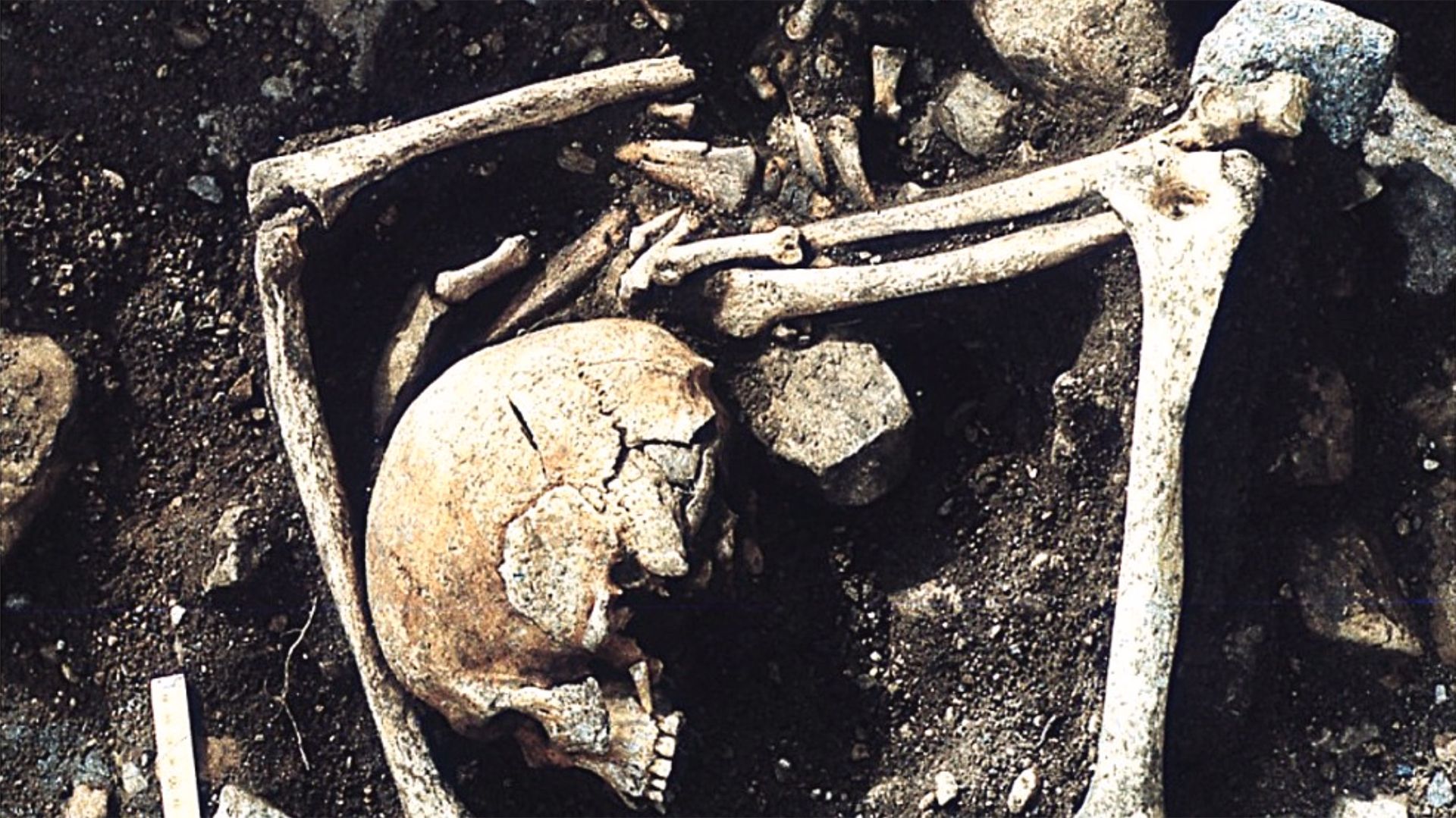
Латви улсын нутаг дэвсгэрээс олдсон нэгэн булшинд хамтдаа оршуулагдсан зургаан хүний үлдэгдэл нь викингийн дээрмийн халдлагын золиос болсон байж болзошгүйг шинжлэх ухааны шинэ судалгаа харууллаа.
Латвийн их сургуулийн археологич Элина Пэтерсоне-Гордина тэргүүтэй судлаачид “Journal of Archaeological Science: Reports” сэтгүүлд нийтэлсэн судалгаандаа тус оршуулгыг шинжилжээ. Радиокарбоны аргаар он цагийг тогтооход уг булш нь МЭ IX зууны хоёрдугаар хагаст буюу викингийн эриний эхэн үед хамаарч байна. ДНХ-ийн шинжилгээгээр тэдгээр зургаан хүн нь бүгд нутгийн уугуул балтийн гаралтай, нэг гэр бүлийн хэлхээ холбоотой болохыг тогтоожээ.
Рига булангийн ойролцоох Чүнкани-Дреҥери оршуулгын газраас олдсон энэхүү булшинд дөрвөн эрэгтэй, нэг хүү, нэг охин байсан бөгөөд гурван эрэгтэй нь сэлэм эсвэл сүхний шархтай байсан нь тогтоогдсон байна. Тухайлбал, нэг хүний эрүү хагарч, нөгөө нь бараг толгойгүй болтлоо зүсэгдсэн байжээ. Хэдийгээр тэдгээр хүмүүс хүчирхийллийн замаар амиа алдсан ч оршуулгыг орон нутгийн заншлын дагуу, эд зүйлс хамт хийж маш хүндэтгэлтэй гүйцэтгэсэн нь тэднийг тухайн нийгэмд хүндтэй хүмүүс байсныг илтгэж байна.
Судлаачид энэ нь олноор нь булшилсан масс булш биш, харин нэгэн зэрэг амиа алдсаны дараа эмх цэгцтэйгээр оршуулсан “олон хүний булш” гэж дүгнэжээ. Энэхүү халдлагыг викингийн дайралт байсан гэх таамаглал дэвшүүлж байгаа нь тухайн үед Балтийн тэнгисийн бүс нутагт викингийн үйл ажиллагаа идэвхтэй байсантай холбоотой юм. Тус судалгаа нь IX зууны үеийн балтийн овог аймгуудын нийгмийн зохион байгуулалт болон язгууртны бүтэц бүрэлдэж байсан үйл явцыг ойлгоход чухал ач холбогдолтой байна.
Дэлгэрэнгүйг эх сурвалжаас харах
↓Эх сурвалжийг нээх ↓
Six people buried in a single grave in Latvia more than 1,000 years ago may have been killed in a bloody Viking raid, a new study suggests.
Genetic research into the deceased — four men, a boy and a girl — reveals family connections: The boy was the son of one of the men, while another man was a third-degree relative, perhaps a first cousin or great uncle, the researchers found.
The father, the relative, and one other man died from “sharp force” injuries — maybe wounds from an ax or a sword; but it’s unknown how the other three individuals died, the researchers reported in the study, which was published in the September issue of the Journal of Archaeological Science: Reports.
One possibility is that those in the grave were killed in a battle, maybe with a neighboring community. But suspicion also falls on the Vikings: “We will never know if they were killed in a raid, but it remains a possibility because of the date of the grave” and the fatal trauma suffered by three of the men, said study co-author Elīna Pētersone-Gordina, an archaeologist at the University of Latvia.
Radiocarbon dating indicates that the grave is from the second half of the ninth century, which is considered the early Viking Age.
The grave is one of hundreds at the Čunkāni-Dreņģeri cemetery, near the Gulf of Riga, a sheltered bay of the Baltic Sea. The cemetery site was discovered in 1924 and contains people who were buried in riverside terraces there between the seventh and 11th centuries, during Latvia’s Iron Age.
Most graves in the region contain only a single set of remains. But here, six people were buried in a single grave, and it seems that at least three were killed during a violent event, the researchers reported.
Strange burial
Despite the apparently violent deaths, the group was buried with care and interred with traditional grave goods and according to local customs. The only female was buried with her head pointing toward the northwest, while all of the males were placed in a row beside her, with their heads pointing toward the southeast — a distinction also seen at other local burials from this time.
The researchers stressed that this was not a “mass grave,” where bodies were quickly dumped without order. Instead, they consider it a “multiple burial,” where each body was properly laid out and accompanied by traditional grave goods.
This careful burial hints that the dead were members of a respected group, while their burial in a single grave indicates that they died at the same time, the researchers wrote in the study.
“They were most likely local people,” Pētersone-Gordina told Live Science in an email.
Genetic studies showed that all of the dead had Indigenous Baltic ancestry, while aspects of the burial matched others in the Čunkāni-Dreņģeri cemetery, she said.
In the ninth century, Latvia was not part of the Scandinavian Viking world but was inhabited by descendants of Indigenous Balts, which included peoples such as the Semigallians and the Curonians, she said. The six people in the newly analyzed burial were Semigallian, an Iron Age group who farmed the region’s large and fertile plains.
It’s plausible that the people in the grave were killed by raiders, and the Vikings were the most obvious suspects, the researchers noted. “Given the timing, a Viking raid remains a possibility,” Pētersone-Gordina said.
It’s known Vikings or their predecessors were in the Eastern Baltic area around that time: two Scandinavian boat burials dated to around 750, for example, were found on the Estonian island of Saaremaa in 2008 and 2010. These burials held the remains of men with battle wounds, indicating they had suffered violent deaths.
No relation
Although two of the men and the boy buried in the Semigallian grave (and possibly the girl, but ancient DNA could not be extracted from her remains) were related, the two other men were not.
This suggests that the two unrelated men were from the same community or extended household as the other victims, rather than from the same family, but were killed in the same violent event, the researchers wrote in the study.
Whatever it was — a raid or a battle — the event was brutal. Marks on the bones show that one man suffered defensive cuts on his forearm and hand, another was killed by a blow that shattered his jaw, and the third was almost decapitated.
It’s possible that the fourth man and the two children died from soft-tissue injuries that could not be determined from the surviving remains, the researchers noted.
Rimantas Jankauskas, an anthropologist and archaeologist at Vilnius University in Lithuania who was not involved in the study, welcomed the investigation into the Eastern Baltic’s Viking Age.
Although these individuals could have died from violence within their own community or from a neighboring community, it’s also possible that they perished in a Viking raid, he told Live Science in an email.
Additionally, the study provides new insight into the social organization of the Semigallian people at that time, including hints of an emerging aristocratic structure that was reflected in the care lavished on the burial, Jankauskas said.
See how much you know about ancient norsemen with our Viking quiz.

