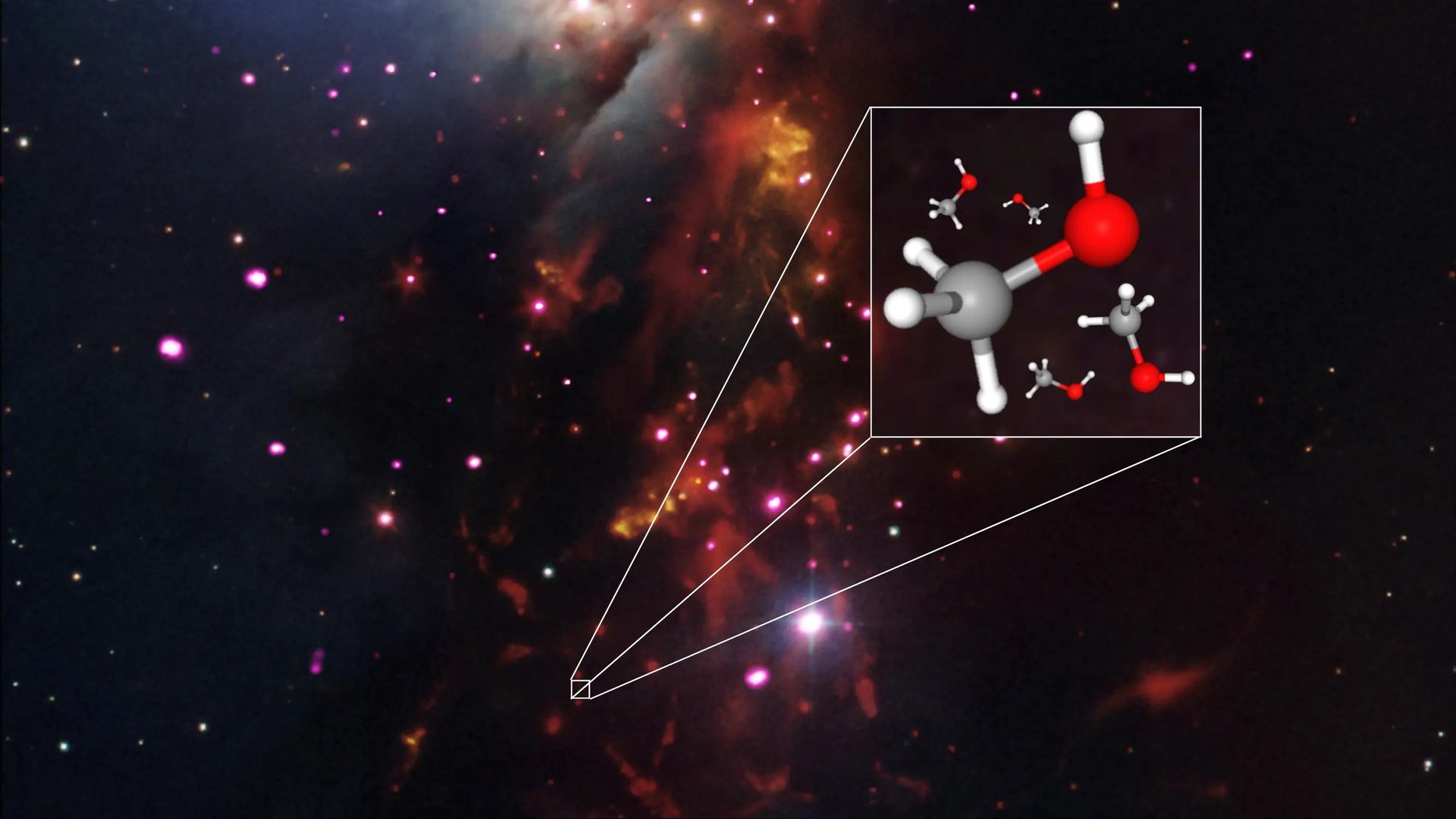
Эрдэмтэд Персейн молекул үүлэн дэх прото-одны орчмоос бүрэн дейтерижсэн метанол илрүүлсэн нь сансрын химийн хувьслын талаарх бидний ойлголтыг өргөжүүлж байна.
ALMA COMPASS хөтөлбөрийн хүрээнд хийсэн судалгаагаар IRAS4A2 хэмээх залуу одны эргэн тойрноос “хүнд метанол” буюу бүрэн дейтерижсэн метанол (CD3OD) молекулыг анх удаа илрүүлжээ. Энэхүү нээлтийг Макс Планкийн Радио одон орон судлалын хүрээлэнгийн эрдэмтэн Арно Беллошийн удирдсан олон улсын баг гүйцэтгэсэн бөгөөд үр дүнг Astronomy & Astrophysics сэтгүүлд нийтэлсэн байна. Уг молекул нь од болон гариг үүсэх явцад нарийн бүтэцтэй органик нэгдлүүд хэрхэн бүрэлдэн тогтдогийг судлахад чухал ач холбогдолтой юм.
Судалгааны багийнхны ажигласнаар, тухайн бүс дэх бүрэн дейтерижсэн метанолын хэмжээ нь одоогийн химийн загварчлалын таамаглалаас 100 дахин их байгаа нь шинжлэх ухааны хувьд томоохон сорилт болж байна. Энэ нь бидний одоо ашиглаж буй онолын загваруудад тусгагдаагүй, молекулын үүсэлд нөлөөлөгч тодорхойгүй үйл явц явагдаж байгааг илтгэж байна.
Эрдэмтэд цаашид метанолын олон дахин дейтерижсэн бусад хэлбэрүүдийг (CH2DOD болон CHD2OD) илрүүлэхээр төлөвлөж байгаа бөгөөд үүний тулд лабораторийн системчилсэн судалгааг үргэлжлүүлж байна. Макс Планкийн Гариг хоорондын физикийн хүрээлэнгийн эрдэмтэн Сильвиа Спеццаногийн тайлбарласнаар, дейтерижсэн нэгдлүүд нь оддын үүслийн явцад молекулын химийн хувьслыг мөрдөн хянах “химийн тэмдэг” болдог ажээ. Энэхүү нээлт нь сансрын үүлнээс гаригийн систем рүү молекулын төвөгтэй бүтэц хэрхэн шилждэгийг ойлгоход чухал хувь нэмэр оруулна.
Дэлгэрэнгүйг эх сурвалжаас харах
Эх сурвалжийг нээх ↓
Today, the question of where life’s building blocks come from is largely settled. Thanks to numerous discoveries in recent decades, scientists have confirmed that the organic molecules are found in space. In addition, recent research has also confirmed that amino acids can be found in Near-Earth Asteroids (NEAs) and proteins can form entirely on their own. Alas, some pieces of the puzzle are still missing, which are crucial to finding how these building blocks come together.
This includes Methanol (CH3OH), also known as wood alcohol, an organic molecule that plays an essential role in the formation of complex organic molecules in space. However, new research from the ALMA COMPASS Large program has detected fully deuterated methanol (aka. “heavy methanol”) (CD3OD) around the protostar IRAS4A2. The abundance of this molecule around this very young star challenges current chemical models, which cannot reproduce the amount observed.
The study was led by Arnaud Belloche at the Max Planck Institute for Radio Astronomy (MPIfR). He was joined by researchers from the Max Planck Institute for Extraterrestrial Physics (MPE), the Institut de Recherche en Astrophysique et Planétologie (IRAP), the Niels Bohr Institute, the National Radio Astronomy Observatory (NRAO), the European Southern Observatory (ESO), the RIKEN Pioneering Research Institute, and many other universities and institutes. The results are published in the current issue of Astronomy & Astrophysics.
The chemical structure of complex organic molecules detected in a protoplanetary disc. © Credit: ESO/L. Calçada/T. Müller (MPIA/HdA)
Scientists have already detected evidence of other complex molecules (like isopropanol, or “rubbing alcohol”) around very young star systems. Experiments suggest they likely form on the surface of icy dust grains in cold nebular clouds, reacting slowly with carbon, oxygen, hydrogen, and other atoms to form increasingly complex molecules long before a new star forms. Once the protostar begins to shine and warm its surroundings, these compounds are released as gases.
At that point, only instruments like the Atacama Large Millimeter-submillimeter Array (ALMA), located in Chile, are able to detect them. This latest study is one of many conducted through the ALMA Complex Organic Molecules in Protostars with ALMA Spectral Surveys (COMPASS) program, which relied on ALMA to examine 11 nearby Sun-like protostars that are known to host complex organic molecules.
One such system was IRAS4A2, a protostar located 1,000 light-years away in the Perseus molecular cloud. Here, scientists unambiguously detected fully deuterated methanol for the first time, a form of methanol in which hydrogen atoms are replaced by deuterium (D, or “heavy hydrogen”). It was also the first time a quadruply deuterated molecule was detected in interstellar space. Said Silvia Spezzano, the research group leader at the MPE and co-author of the study:
Deuteration enables us to trace the chemical evolution of molecules during the formation of stars and planets. This helps us understand their chemistry and, ultimately, how molecular complexity is transferred from interstellar clouds to planetary systems.
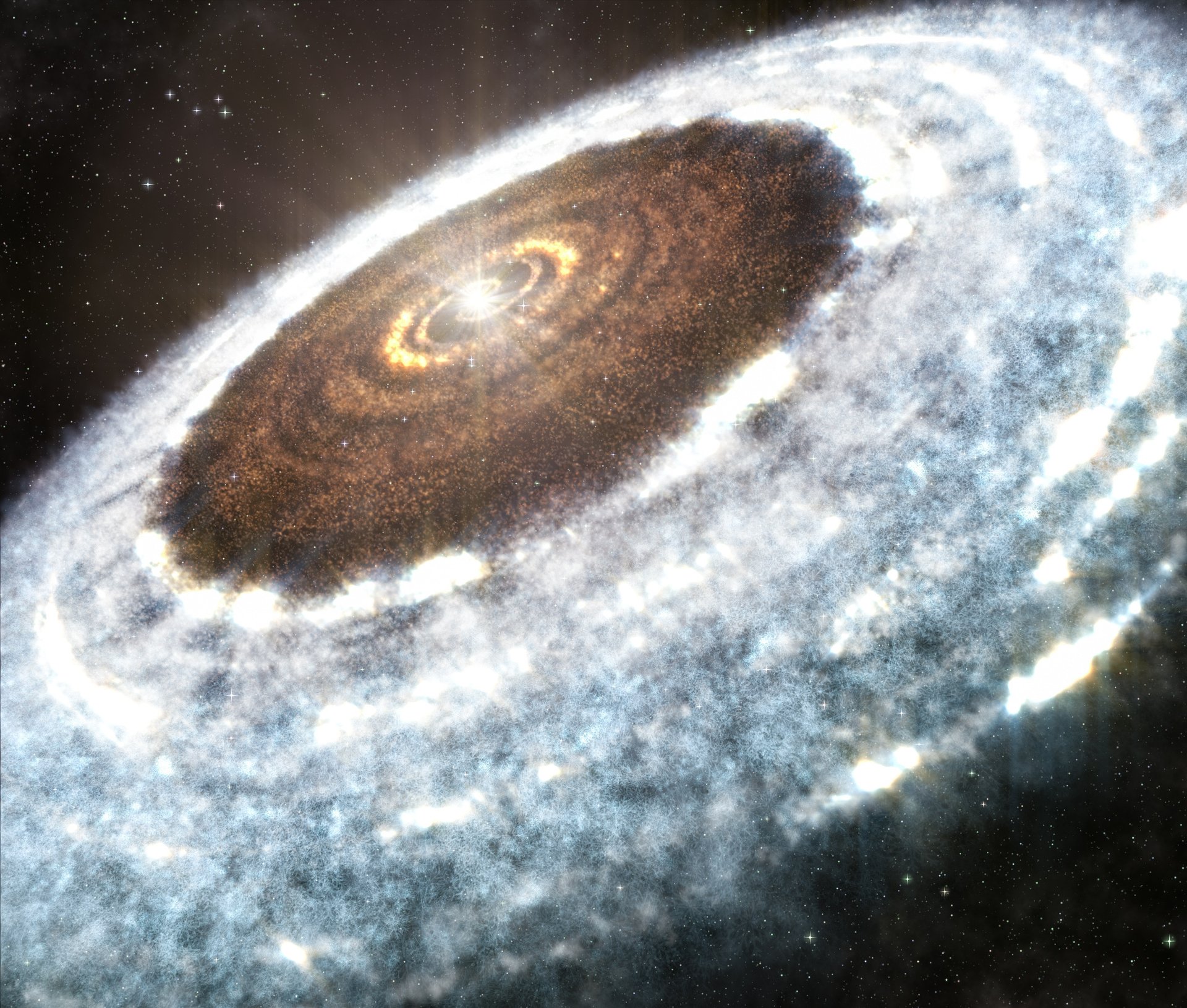 Artist’s impression of the water snowline around the young star V883 Orionis, as detected with the Atacama Large Millimeter Array (ALMA) in 2016. Credit: A. Angelich (NRAO/AUI/NSF)/ALMA (ESO/NAOJ/NRAO)
In addition to detecting CD3OD, the ALMA data also allowed the team to determine the chemical abundances of various methanol variants around the protostar. Their results showed that the CD3OD variant is about 100 times more abundant than chemical models predict. This suggests an unknown process is driving the formation of fully deuterated methanol, one that current models miss.
The team also detected several spectral lines they can’t yet identify. But given the detection of fully deuterated methanol, they suspect these could come from multiply deuterated forms of methanol, such as mono-deuterated methyl deuterated alcohol (CH2DOD) and dideuteriomethyl deuteroxide (CHD2OD). The team is currently working to secure the laboratory data needed to confirm this. Said Spezzano:
At the Center for Astrochemical Studies at MPE, we are conducting a systematic laboratory program to study the spectroscopy of deuterated complex organic molecules, including CH2DOD and CHD2OD. These molecules allow us to study isotopic substitutions across different functional groups, which serve as chemical ‘tags’ to trace the growth of molecular complexity.
In addition to the team’s paper, six other studies from the COMPASS project are being published. Together, they shed light on the diversity of complex organic molecules in space.
Further Reading: Max Planck Institute for Extraterrestrial Physics

