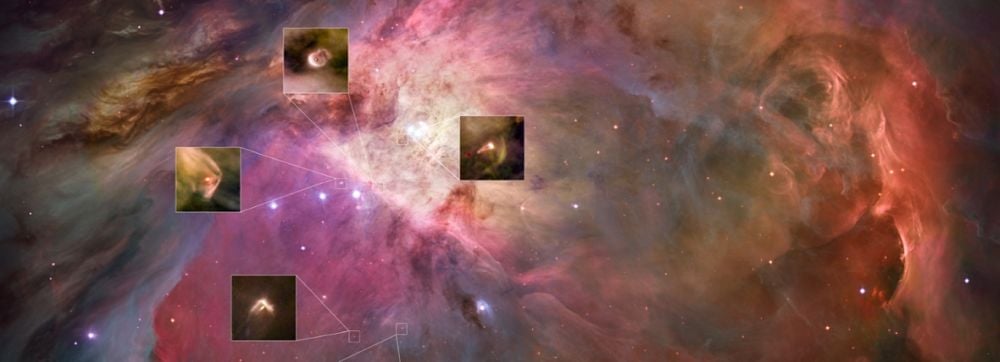
Орион мананцар дахь оддын хөгжил болон тэдгээрийг тойрсон хийн бүрхүүлийн насны зөрүүг оддын нэгдэл үүсгэсэн байж болзошгүй гэж эрдэмтэд үзэж байна.
Орион мананцарт байрлах “проплид” буюу сүүлтэй төстэй бүтэц бүхий протопланетар дискүүд болон уг мананцарын хийн бүрхүүл нь тухайн бүс нутгийн оддоос хамаагүй залуу харагддаг нь одон орон судлалын томоохон парадокс байсаар ирсэн. Лейдений их сургуулийн одон орон судлаач Майтэ Вилхэлм тэргүүтэй эрдэмтдийн “Astronomy and Astrophysics” сэтгүүлд нийтлүүлсэн шинэ судалгаагаар, энэхүү зөрүүг Орион дахь хамгийн асар том од болох “Theta-1 Orionis C1”-ийн үүсэлтэй холбон тайлбарлажээ. Тус од нь хоёрдогч оддын системтэй нэгдсэний үр дүнд үүссэн байх магадлалтай бөгөөд энэ үйл явц нь мананцарын цацраг идэвх болон хийн тэлэлтийн хурдад эрс өөрчлөлт оруулсан байна.
Судлаачдын дэвшүүлж буй таамаглалаар, “Theta-1 Orionis C1” од нь гурвалсан оддын системийн нөлөөгөөр хоёр од нэгдсэнээс үүсжээ. Мөргөлдөөний өмнө тус бүсийн оддын цацраг сул байсан тул протопланетар дискүүд илүү удаан хугацаанд оршин тогтнох боломжтой байв. Харин нэгдлийн дараа одны гэрэлтэлт огцом нэмэгдсэнээр гадаад фото-ууршилт эрчимжиж, мананцарын хийн бүрхүүлийн тэлэлтийг хурдасгасан байна.
Гэсэн хэдий ч зөвхөн оддын нэгдэл нь мананцарын бүрхүүл яагаад ийм залуу байгааг бүрэн тайлбарлаж чадахгүй юм. Эрдэмтэд ууршиж буй дискүүдээс ялгарсан хүйтэн хий нь мананцарын халуун хийтэй холилдож, тэлэлтийг дэмжих нэмэлт хүчийг бий болгосон байх магадлалтай гэж үзэж байна. Мөн “Theta-1 Orionis C1” одны соронзон орны хазайлт болон азотын илүүдэл зэрэг нь энэхүү оддын мөргөлдөөний онолыг батлах чухал нотолгоо болж байна.
Энэхүү судалгаа нь сансрын ойрын бүсэд томоохон оддын мөргөлдөөн тохиолдож болохыг харуулсан анхны тохиолдол юм. Гуравласан оддын систем дэх нарийн төвөгтэй харилцан үйлчлэлүүд нь од үүсэх орчин болон гариг эрхсийн төлөвшилд гүнзгий нөлөө үзүүлдэг болохыг эрдэмтэд онцолж байна.
Дэлгэрэнгүйг эх сурвалжаас харах
Эх сурвалжийг нээх ↓
When the Hubble Space Telescope was launched in 1990, an eager astronomy community had a massive list of targets they hoped the new telescope would observe. One of them was the well-known Orion Nebula, visible with the naked eye. At about 1400 light years away, Orion is the closest massive star-forming region to Earth. For its first few years, the Hubble suffered through a flawed mirror problem, but once that was fixed, the telescope examined Orion.
One of its discoveries was the unusual, dark objects that appeared to have tails. They’d been seen before, but not in such detail. In a 1993 paper, researchers determined that they were protoplanetary disks, and coined the term proplyd. But these proplyds were different than others because of their tails. These tails are part of a paradox in the Orion Nebula.
Some early Hubble images of proplyds in Orion. Image Credit: O’Dell, Wen, and Hu 1992. ApJ.
Why do the disks and their extended gas shells appear to be so much older than the stars themselves?
New research in Astronomy and Astrophysics has an answer. It’s titled “A triple-induced merger in θ 1 Ori C solves the proplyd lifetime problem and the curiously young shell of M42.” The lead author is Maite Wilhelm, an astronomer at Leiden University in the Netherlands.
“A longstanding tension exists between the stellar ages in the Orion Nebula Cluster (ONC) and the rapid external photoevaporation of its protoplanetary discs,” the authors write.
This research focuses on Orion’s most massive star: 1 Ori C1 (Theta-1 Orionis C1). 1 Ori C1 is also the most massive star in the famous Trapezium Cluster, dominated by a group of four stars in the heart of Orion. Its powerful radiation is stripping material away from protoplanetary disks in the region. The disk material streams away, forming a tail-like shape.
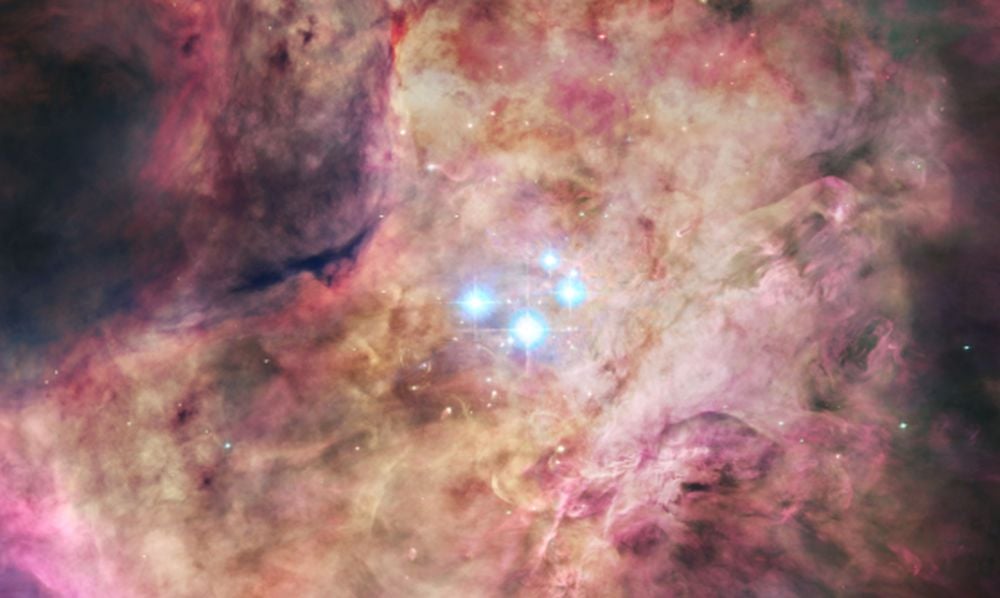
The Trapezium Cluster in the heart of the Orion Nebula. 1 Ori C1 is the brightest star in this image. Image Credit: Data: Hubble Legacy Archive , Processing: Robert Gendler
But the amount of material stripped away so far doesn’t match the age of 1 Ori C1 and other stars. The stars are one million years old, so the material should’ve been stripped away long ago.
There’s an additional puzzle. “More recently, the shell of the Orion Nebula has also been found to be dynamically younger than its stars,” the authors write.
We’ve learned a lot more about Orion since the Hubble’s early days. Many things have been observed more deeply and measured more accurately, including how rapidly Orion’s shell is expanding.
“More recently, the expansion velocity of the shell component of the Orion Nebula was measured to be ∼13 km/s,” the researchers explain. The shell has a radius of about 2.5 pc, so this indicates an age of only about 0.3 million years. Since the shell’s expansion is mostly driven by the stellar winds coming from the stars in the Orion Nebula Cluster, this creates another dilemma.
“It is striking to observe that two processes powered by the ONC’s massive stars both appear to have younger dynamical ages than the inferred stellar age,” the authors write.
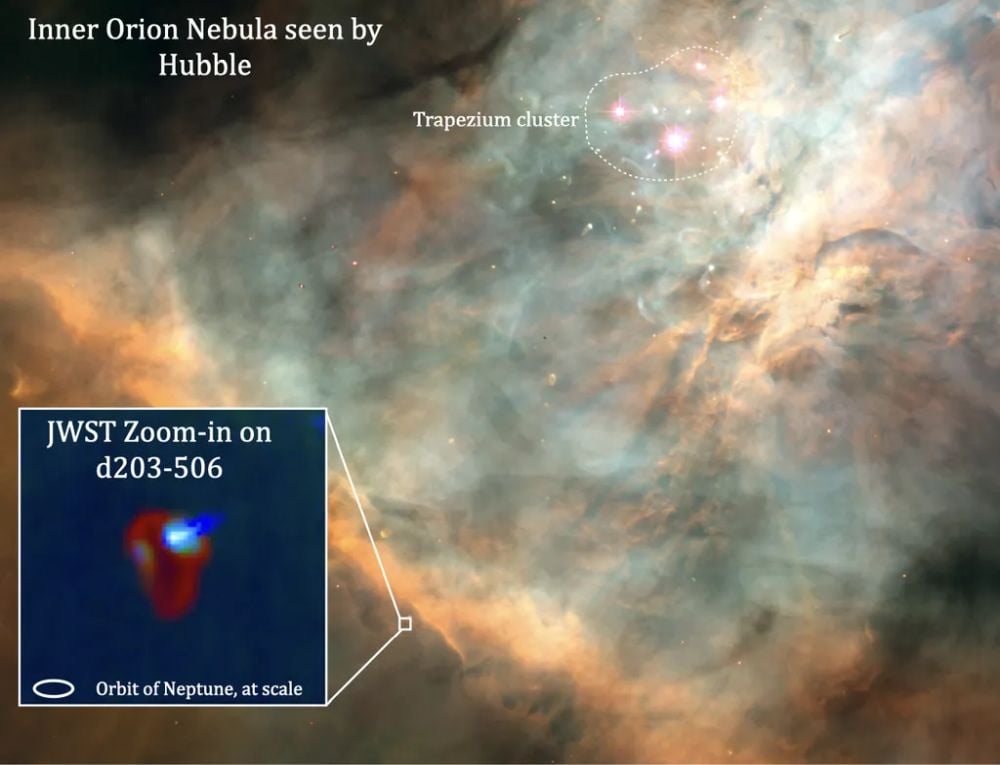 The large image of the Trapezium cluster in Orion is from the Hubble. The inset image is a closeup of one of the stars in Orion, showing how the stellar wind is eroding its proplyd. Image Credit: NASA/STScI/Rice Univ./C.O’Dell et al / O. Berné, I. Schrotter, PDRs4All)
Other researchers proposed an explanation for these discrepancies. Maybe there are different populations of stars with different ages, driven by the ejection of massive stars that disrupted and triggered different episodes of star formation. But that explanation didn’t stick.
In this work, the authors propose that a stellar merger explains Orion’s puzzle.
“We propose a new scenario aimed at resolving both age issues,” the researchers write. “In our scenario, the most massive star of the ONC, θ 1 Ori C1, formed from the merger between two binary stars…”
1 Ori C1 has a current binary partner, 1 Ori C2, and its presence triggered the merger between 1 Ori C1 and another partner star, according to the authors.
This created the 1 Ori C1 we see today. It’s a massive and hot O-type star, the most massive type of star on the main sequence. 1 Ori C1 has more than 33 solar masses, and its UV radiation provides most of Orion’s illumination.
Lead author Wilhelm and her co-researchers tested this idea against simulations. They showed that the merger scenario is plausible. Prior to the merger, the radiation from the stars was much weaker, and the proplyds were better able to withstand them. That means that the dusty disks survived for most of their stars’ lifetimes. But after the merger, the outpouring of radiation from 1 Ori C1 changed the game.
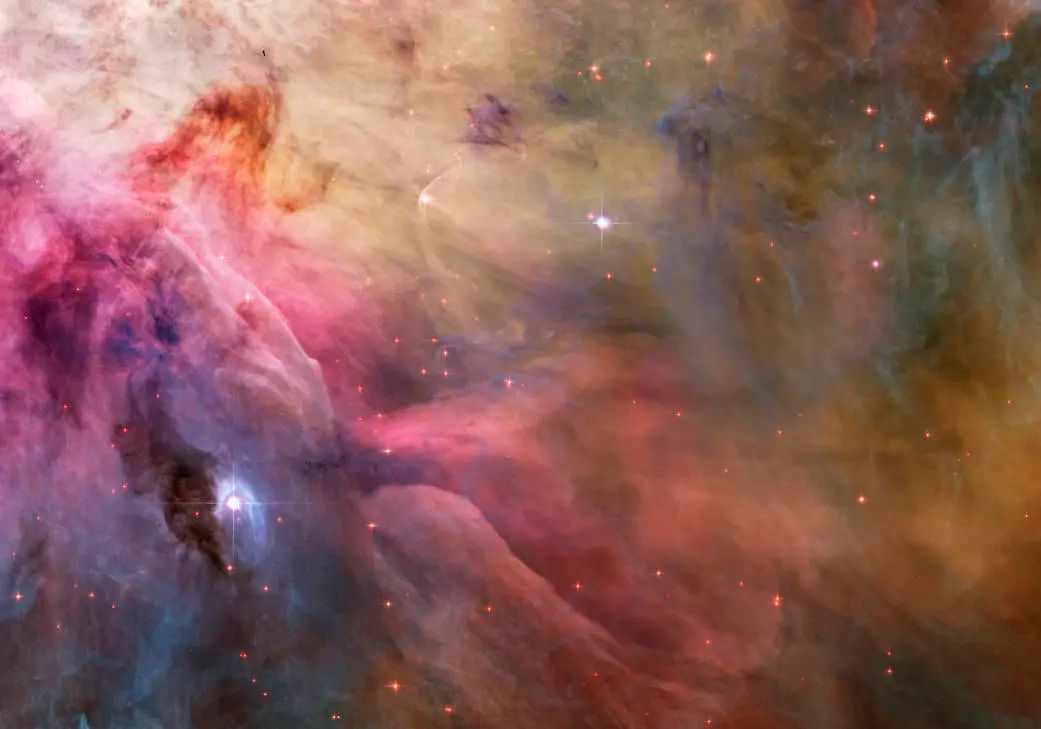 This image shows part of Orion. The star LL Orionis, though not part of this work, illustrates the power of stellar winds. It’s just up and to the left of center, highlighted by its bow shock. The star is emitting a powerful stellar wind that creates the shock, as its wind slams into the gas in Orion. The complex gas morphology in Orion is created by winds from different stars. Image Credit: NASA, ESA and the Hubble Heritage Team
“This merger, taking place between the last episode of star formation and today, resulted in an increased luminosity, leading to stronger external photoevaporation and accelerated expansion of the shell,” the authors explain.
But this can’t explain how the Orion Nebula’s shell appears to be younger than its stars. “However, the required increase in the stellar wind luminosity would be greater than a simple merger would be equipped to explain,” the researchers write. The gas shell’s rapid expansion required an additional element. The merger alone couldn’t have driven all of the expansion.
The researchers say that cooler gas from the evaporation disks played a role. By mixing with the hotter gas inside the expanding shell, it could’ve generated the additional force needed to explain the shell’s expansion.
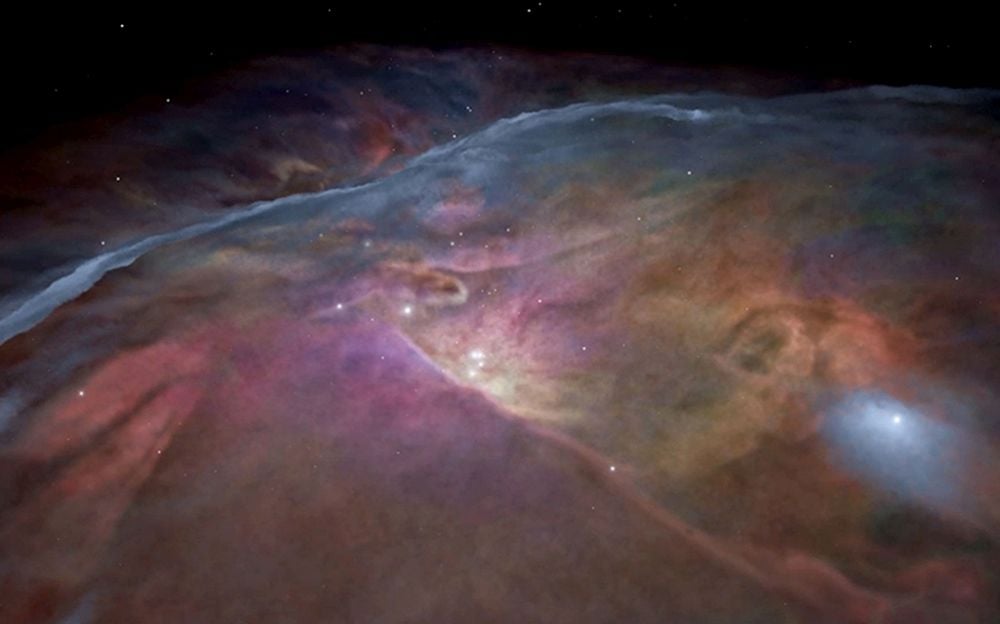 This 3D model image shows Orion’s expanding gas bubble in blue. The stellar merger isn’t enough on its own to explain the bubble’s expansion. Image Credit: NASA, ESA, Frank Summers (STScI), Greg T. Bacon (STScI), Lisa Frattare (STScI), Zolt G. Levay (STScI), K. Litaker (STScI) Acknowledgment: Axel Mellinger, Robert Gendler, Rogelio B. Andreo
This work also explains a couple other curiosities: 1 Ori C1 has a tilted magnetic field and excessive nitrogen, both of which can be explained by a merger.
“This is the first time we have witnessed the consequences of a major stellar collision in a our own cosmic neighbourhood,” co-author Simon Portegies Zwart said in a press release. “It also shows that stellar collisions may be much more common than we previously thought, and that they can have far-reaching consequences.”
“Our idea shows that subtle effects in triple-star systems can have a major impact on the environments in which stars form, and potentially even on planets that are still taking shape,” said lead author Wilhelm.
“We propose a novel scenario that can help explain both the proplyd lifetime problem in the ONC and the Orion Nebula shell lifetime problem. Our scenario involves the merger of a stellar binary into the present-day massive star θ 1 Ori C1, mediated by vZLK oscillations induced by the present-day binary companion θ 1 Ori C2,” the authors conclude.

