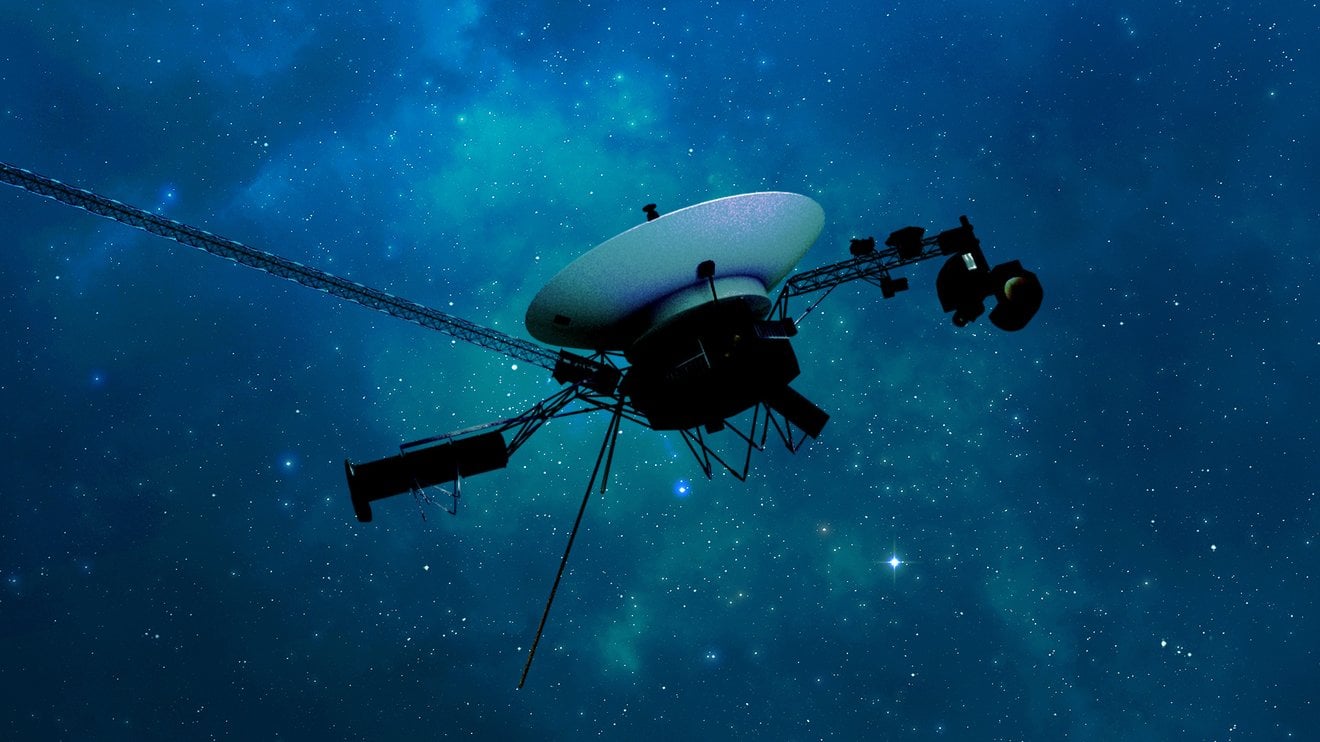
NASA-гийн алдарт Voyager 1 хөлөг “Big Bang” хэмээх шинэлэг шийдлийн ачаар сансрын уудамд түүхэн амжилт тогтоож, дэлхийгээс нэг гэрэл-өдрийн зайд хүрэх гэж байна.
1977 онд хөөргөсөн Voyager 1 сансрын хөлөг аравдугаар сарын 20-нд холбоо тасарсан хүндрэлтэй тулгарсан ч NASA-гийн инженерүүд “Big Bang” хэмээх аргачлалыг амжилттай хэрэгжүүлснээр хөлгийг дахин ажиллагаанд оруулжээ. Энэхүү засвар нь хөлгийн үндсэн халаагуур болон хуучин соронзон хальсны бичигчийг бага чадлын нөөц хувилбараар сольсон бөгөөд 48 цаг үргэлжилсэн холбооны тасалдлыг амжилттай шийдвэрлэсэн байна. Ижил аргыг өнгөрсөн наймдугаар сард Voyager 2 хөлгийг ажиллагаатай байлгахад мөн амжилттай ашиглажээ.
Хөлгийн эрчим хүчний эх үүсвэр болох плутоны генераторууд жил бүр 4 ватт орчим чадлаа алдаж байгаа тул инженерүүд чухал сонголтууд хийхэд хүрч байна. Тухайлбал, эрчим хүч хэмнэх үүднээс 2026 оны эхээр LECP багажийг унтраасан бөгөөд цаашид ч ийм төрлийн хүнд шийдвэрүүд гаргах шаардлага тулгарч болзошгүйг мэргэжилтнүүд онцолсон юм. Одоогоор хөлгийн Plasma Wave Subsystem (PWS) болон соронзон хэмжигч багаж хэвийн ажиллаж байна.
Voyager 1 хөлөг арваннэгдүгээр сарын 18-ны өдрийн 5:16 цагт (EST) нарны аймгийн хил хязгаараас 26 тэрбум км буюу 172 одон орны нэгж (AU) зайд орших “нэг гэрэл-өдрийн” заагт хүрэх анхны хүн төрөлхтний бүтээл болно. Энэхүү түүхэн аялал нь Офиукус болон Геркулес одны ордын чиглэлд үргэлжилж буй бөгөөд ирэх онд хөлөг сансарт 50 жил ажилласан түүхэн ойгоо тэмдэглэх юм. NASA-гийн Дэлхийн гүн сансрын сүлжээ (DSN) дамжуулж буй сул дохиог үргэлжлүүлэн хянасаар байна.
Дэлгэрэнгүйг эх сурвалжаас харах
Эх сурвалжийг нээх ↓
An innovative solution helps to put the venerable Voyager 1 spacecraft past a key milestone.
Flashback to 1977. Jimmy Carter was U.S. president, Star Wars was a box office hit, and the two Voyager spacecraft departed on an historic Grand Tour of the solar system. Now, teams at NASA’s Jet Propulsion Laboratory are working to keep the missions active, as they push the boundaries of interstellar space beyond the solar system.
NASA recently announced that after a brief bit of drama and loss of communications with Voyager 1, a fix dubbed the ‘Big Bang’ was successful in resuscitating the spacecraft. The Big Bang swap alternated three units (two primary heaters and an old 8-track digital tape recorder) with three low power secondary options. The brief loss of communications occurred on October 20th, and lasted for 48 hours.
Engineers work on a Voyager spacecraft prior to launch. Credit: NASA/JPL-Caltech
“This is the first time we’ve seen the spacecraft do something like this, but we are also at a point in the mission where we have to expect the unexpected,” said Kareem Badaruddin, in a recent press release. “We’re relieved to be back in contact with Voyager 1 and are eager to understand what happened.”
The Big Bang method was also successfully implemented to keep Voyager 2 functioning this past August.
Traveling far from the Sun, the Voyager missions rely on Plutonium-fueled radioisotope thermoelectric generators for power. PU-238 has a half-life of just under 88 years, meaning the missions are now steadily losing power.
This loss equates to about 4 watts of power each year. Voyager 1 currently utilizes a little over 200 watts of power, about enough to power an electric blanket. This has forced mission controllers to make some tough choices, including turning off the Low Energy Charged Particle experiment LECP in early 2026. The missions launched with 10 instruments in 1977.
The swaps had to occur at the same time, as the units involved also heat the spacecraft and assure that it continues to operate in the chilly depths of deep space.
The Voyager Program’s Legacy
Voyager 1 launched on September 5, 1977, actually after Voyager 2. Voyager 1 flew past Jupiter in 1979 and Saturn in 1980. A flyby past enigmatic Titan to get a close look on November 12, 1980 meant the mission would depart the plane of the solar system afterwards. Voyager 2 went on to pass Uranus in 1986 and Neptune in 1989.
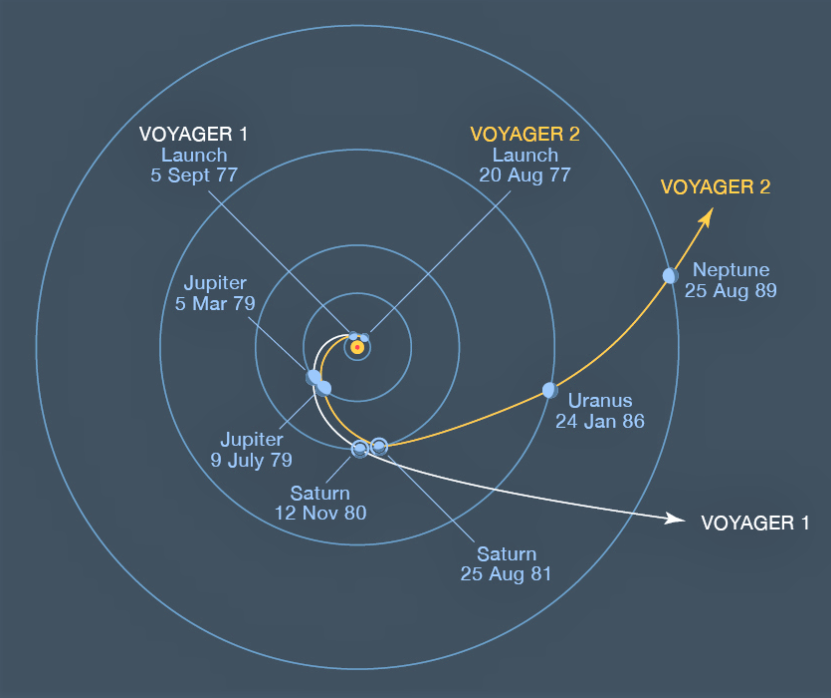 The paths of Voyagers 1 and 2 out of the solar system. Credit: NASA/JPL-Caltech
The Voyagers continue to do science as they travel through interstellar space beyond the fringes of the outer solar system. The two Voyagers are the first missions to sample the region of space beyond the heliosphere directly.
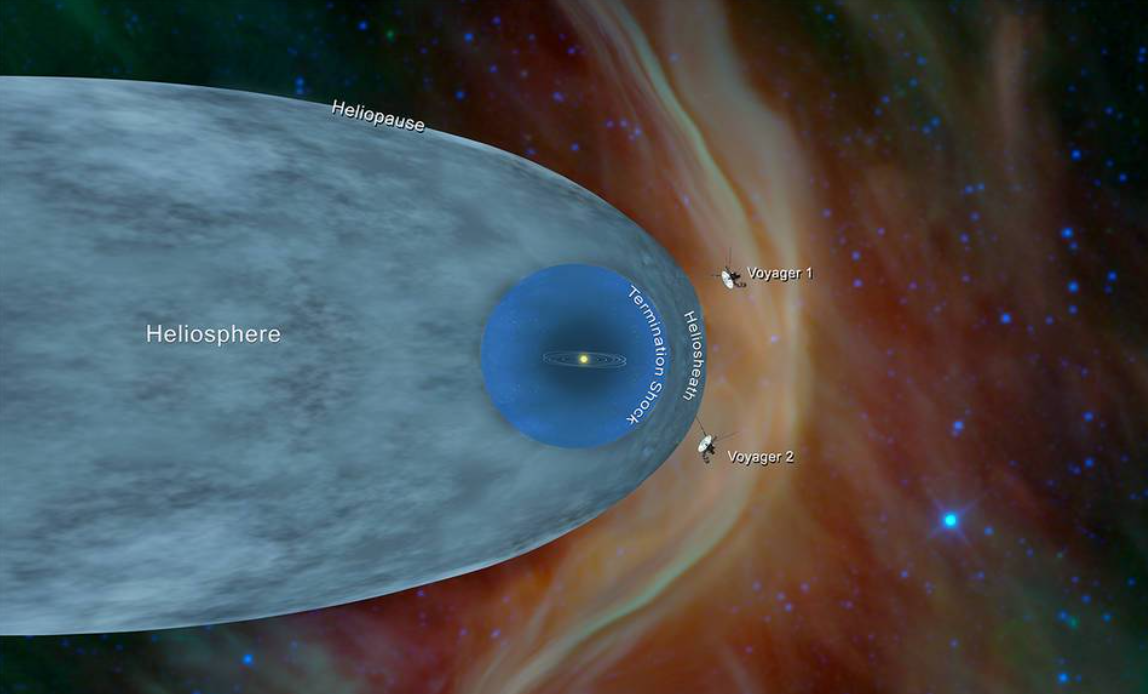 The Voyagers head out beyond the bowshock of the solar system into interstellar space. Credit: NASA
Right now, the important Plasma Wave Subsystem (PWS) plus a magnetometer instrument on Voyager 1 remain active. Without the Big Bang shuffle, mission controllers would have had to make the hard decision turn off yet another crucial instrument in 2027.
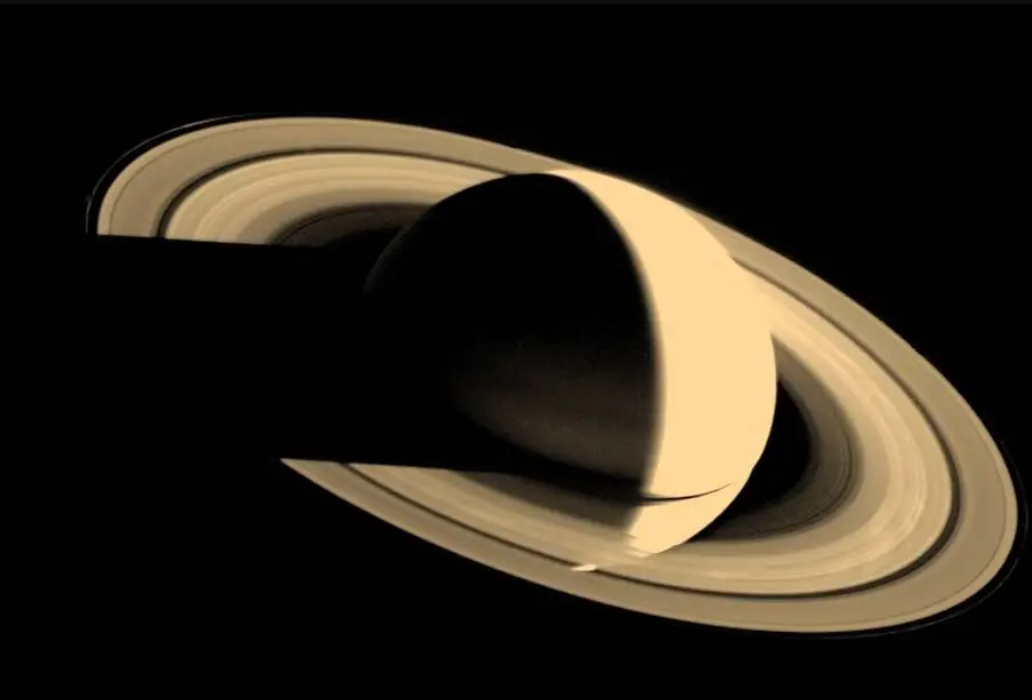 Voyager 1 witnesses a ‘crescent Saturn’. Credit: NASA/JPL-Caltech
Crossing the ‘One Light Day’ mark
Moving at 16.9 kilometers per second relative to the Sun and the solar system, Voyager 1 will become the first human-made artifact to reach the one light-day mark this month on Wednesday, November 18th at 5:16 AM EST. That’s roughly 26 billion kilometers or 172 Astronomical Units (AU) distant. For context, the Moon and cis-lunar space marking the farthest humans have traveled to date is just over one light-second distant.
NASA’s global Deep Space Network continues to monitor the ever fainter signals from the Voyager spacecraft. Controllers will likely have to contend with more signal outages in the years to come.
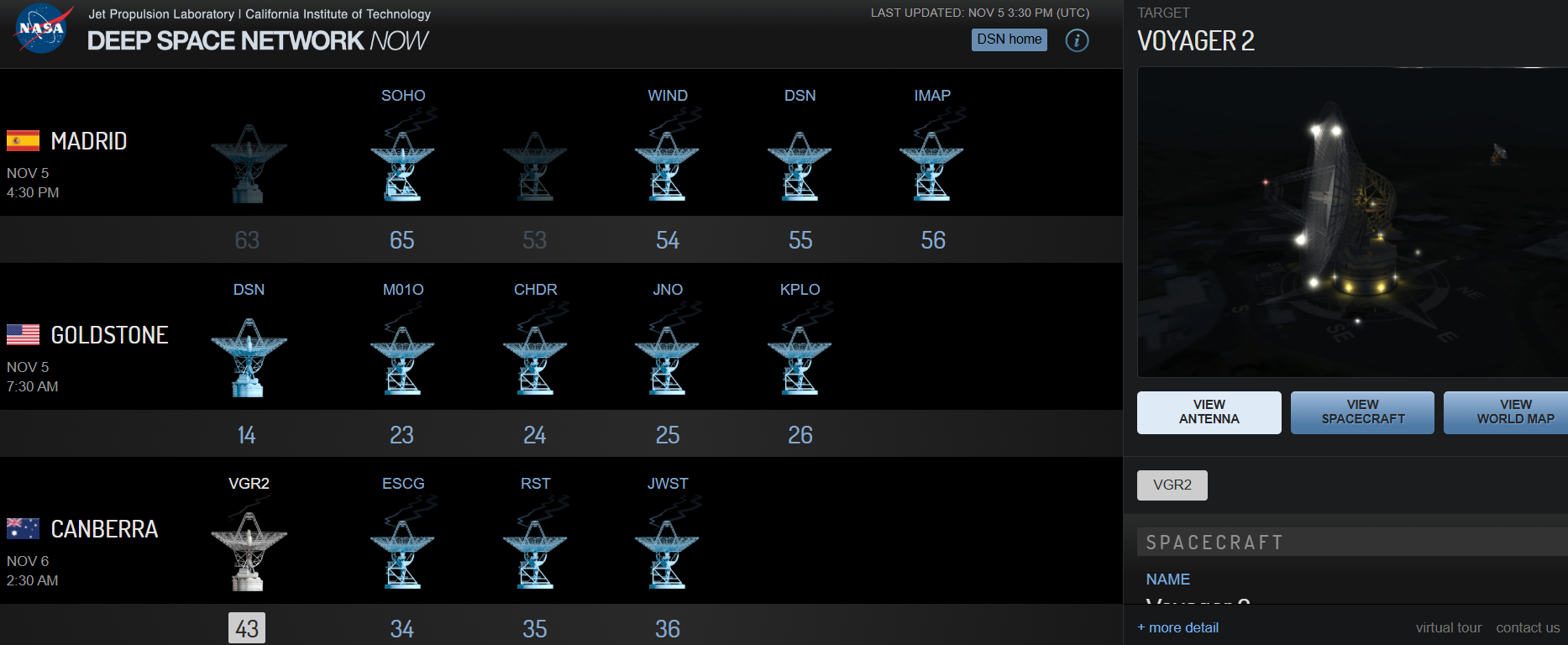 The worldwide DSN tracks missions including one of the Voyager spacecraft. Credit: NASA/DSN
Along with the now silent Pioneers 10 and 11 and the still active New Horizons mission, Voyagers 1 and 2 are now leaving the solar system for galactic space. The upper stage Star boosters that help these missions achieve escape velocity are on their way outbound as well. The next mission escaping the solar system won’t happen for a while, though the proposed Interstellar Probe mission could one day make the trip. Voyager 1 is now outbound in the direction of the constellation Ophiuchus near its border with Hercules.
Congrats the intrepid and resourceful Voyager 1 team. Hopefully the mission will surpass its half-a-century birthday in space, coming right up next year.

