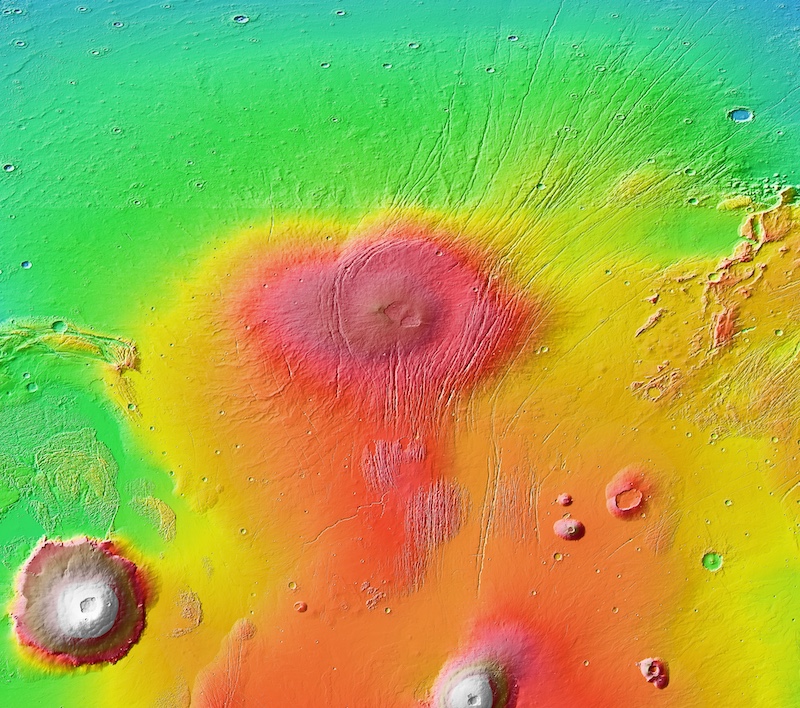
Trace Gas Orbiter Ангарагийн Альба Монс орчмын ан цавын дээгүүр устөрөгчийн хлорид илрүүлсэн нь газрын гүнд магма хөдөлж байж болзошгүйг示ж байна.
ESA-гийн Trace Gas Orbiter сансрын аппарат Альба Монс галт уулын бүсийн гадаргын геологийн хувьд шинэхэн ан цавын дээгүүр устөрөгчийн хлоридын ул мөр илрүүлжээ. Хий хүйтэн улиралд, Ангараг нарнаас хамгийн хол байх үед тухайн бүсэд төвлөрөн илэрсэн бөгөөд хэмжээ нь төсөөлснөөс өндөр байсан ч ирээдүйн судалгаагаар илрүүлэлт батлагдах эсэх нь тодорхойгүй байна. Судалгааг 2026 оны арваннэгдүгээр сарын 4-нд Science Advances сэтгүүлд нийтэлжээ.
Устөрөгчийн хлорид Дэлхийд газрын гүнд халуун магма хөдөлж байх үед үүсэх нь элбэг. Судлаачид Ангараг дээр илэрсэн хий ан цаваар нэвчин гарсан байж болзошгүй гэж үзэж байгаа ч энэ нь идэвхтэй галт уулын дэлбэрэлт болж байгааг батлахгүй; галт уулын хий магмын биетээс шууд эсвэл түүний дээрх мөнх цэвдгийн давхаргаар дамжин гарсан байж болно. Ангарагийн галт уулс одоогоор дэлбэрч буй нь тогтоогдоогүй ч газрын гүнд магма хөдөлж байх боломжийг үр дүн үгүйсгэхгүй.
Одоогоор ажигласан хүхрийн давхар исэл идэвхтэй дэлбэрэлтийн шинж тэмдэг болж болох ч илрээгүй байна. Харин эрдэмтэд магмын хөндийг илрүүлэхэд устөрөгчийн хлорид зэрэг галоген агуулсан хий газрын гүнээс шүүрэх нь тус болох боломжтой гэж үзжээ. NASA-гийн InSight төхөөрөмж өмнө нь Ангараг дээр 1,300 гаруй газар хөдлөлтийн үйл явдал бүртгэсэн нь гарагийн дотоод идэвхтэй байдлын талаарх судалгааг өргөжүүлсэн юм.
Хэрэв газрын гүнд магмын дулаан мөсийг хайлуулж, усан дулааны систем үүсгэдэг бол энэ орчин бичил биетэнд тохиромжтой нөхцөл бүрдүүлж болох юм. Гэвч энэ нь одоогоор боломжит хувилбар төдий бөгөөд Ангараг дээр амьдрал илэрсэн гэсэн үг биш.
Дэлгэрэнгүйг эх сурвалжаас харах
Эх сурвалжийг нээх ↓
- Are there still active volcanoes on Mars? The planet’s volcanoes are no longer erupting, but there could still be flowing magma underground.
- The European Space Agency’s Trace Gas Orbiter has detected hydrogen chloride coming out of cracks in the surface in the Alba Mons volcano region.
- The noxious gas is often produced by hot magma moving below the surface on Earth.
Science news, night sky events and beautiful photos, all in one place. Click here to subscribe to our free daily newsletter.
Are there active volcanoes on Mars?
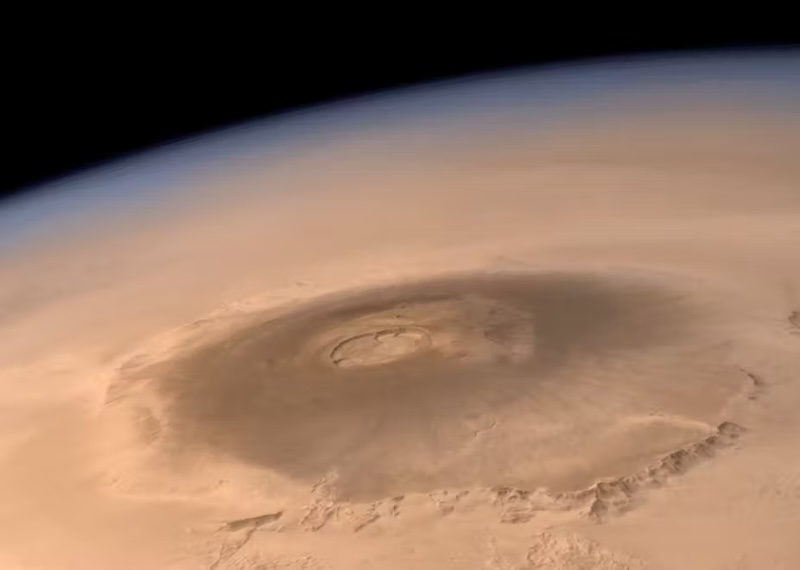
Mars’ enormous volcanoes — including Olympus Mons, the largest in the solar system — are remnants of an active volcanic past. But, unlike Earth, Mars has no moving tectonic plates to continually reshape its surface. And so, for much of the space age, Mars has been considered a largely dormant world.
But that picture has been changing. NASA’s InSight lander detected more than 1,300 seismic events, revealing that Mars still experiences marsquakes. And evidence of relatively recent volcanic activity has been accumulating, too.
Now, an international team of researchers says it has found perhaps the strongest evidence yet that Mars might still be volcanically active, with magma moving beneath its surface.
The researchers said on November 4, 2026, that the European Space Agency’s Trace Gas Orbiter (TGO) has detected the gas hydrogen chloride (HCl) above cracks in the Martian surface in the region of the Alba Mons volcano. Alba Mons is northeast of Olympus Mons.
On Earth, magmatism — the movement of hot magma below the surface — often produces hydrogen chloride. It is a minor volcanic gas compared to water vapor, carbon dioxide, and sulfur dioxide from earthly volcanoes. But, on Mars, hydrogen chloride might be a major volcanic gas, according to scientists.
The detection adds to previous evidence for active volcanism still occurring on Mars today. Even though Mars’ volcanoes are no long erupting, magma could still flow deeper down.
The researchers published their new peer-reviewed findings in Science Advances on November 4, 2026.
Traces of noxious gas point to possible active volcanoes on Mars
Trace Gas Orbiter detected the traces of hydrogen chloride above geologically fresh cracks in the surface in the Alba Mons region. The gas was at parts-per-billion levels, but still higher than expected (if future studies confirm it is there at all). The paper states:
Detections of hydrogen chloride at low altitudes, unexplained by observed atmospheric state and models, together with the geological context of the region, hint at an igneous origin of this gas.
Mars is reputed to lack ongoing volcanic activity. However, marsquakes were revealed recently, and clues to volcanism younger than tens of million years have accumulated. While sulfur dioxide, so far undetected, could testify to ongoing eruptive activity, evidence of active magma chambers may be better identified by seepage of halogen gases, such as hydrogen chloride.
Co-lead author Daniel Mège at the Space Research Center of the Polish Academy of Sciences said:
Our findings suggest that Mars has retained enough internal heat to support volcanic activity until recently, and possibly still does.
The Trace Gas Orbiter was able to find the smoking gun. It was like looking for a needle in a haystack. It’s truly amazing that it spotted a handful of molecules from a perhaps intermittent source, whilst moving continuously along its orbit to monitor the whole martian atmosphere,
A huge part of the work consisted of examining all the possible chemical processes going on in the martian atmosphere. We needed to be rigorous, critical and creative to explain the presence of hydrogen chloride. The data were complex, but also excellent brain food.
Aerosols and seepage
Hydrogen chloride can be found virtually everywhere in the Martian atmosphere. But those observations are typically during warmer seasons, when the hydrogen chloride behaves as an aerosol. Aerosols are fine solid particles or liquid droplets in the atmosphere.
This gas isn’t seen as much during Mars’ colder seasons because its molecules are quickly “absorbed” by water ice crystals and disappear from the observations. But the detections at Alba Mons were during the cold season. And the levels were much higher than anticipated. The gas was detected above geologically fresh new cracks in the surface around the volcano. The cracks were several hundred meters long, and tens of centimeters wide.
The researchers said it’s likely that the hydrogen chloride seeped into Mars’ atmosphere from these cracks. That would make it volcanic in origin. The paper states:
Observations by Atmospheric Chemistry Suite led to the widespread observations of hydrogen chloride at part-per-billion levels in the atmosphere of Mars during the warm perihelion period [when Mars was closest to the sun in its 2-year orbit], attributed to aerosol-atmospheric sources. Here, we report hydrogen chloride detections during the cold aphelion season [when Mars is farthest from the sun] that are isolated in the Alba Mons region.
We also identify fresh and narrow (<1 meter) fissures in this area, which we interpret to be potential hydrogen chloride pathways rooted into magmatic bodies at depth. Our results are best explained by ongoing igneous processes in the Martian interior.
A supplementary to the main paper (pdf download) also states:
Localized aphelion detections of HCl at low altitudes, together with the geological context of the area, suggests an igneous origin of this gas and that the detections are made above the seepage.
Icy buffer zone
It’s possible that the hydrogen chloride doesn’t come straight from the magma. It might come from a buffer zone, a layer of permafrost above the magma.
In the cold winter, the ice traps the hydrogen chloride molecules. But when the temperatures get a bit warmer in spring, the ice sublimates and release the gas into the atmosphere.
If there is a permanent source of hydrogen chloride in the surface “soil,” this could explain the seasonality of the observations and their binding to a certain area.
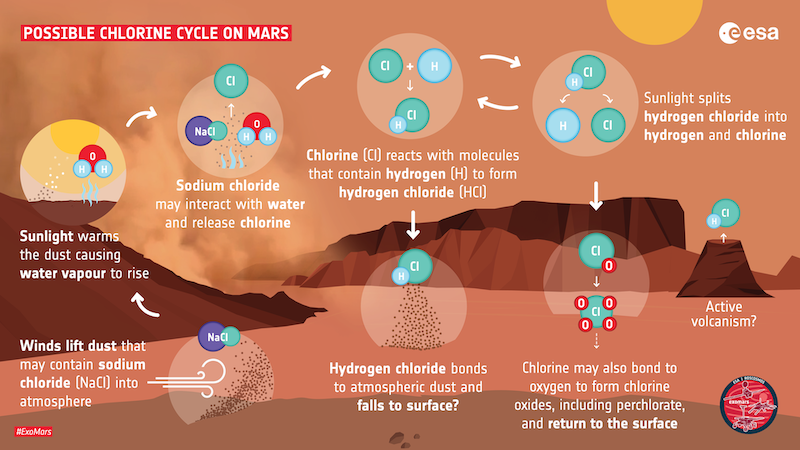
The chlorine cycle
On both Earth and Mars, there was a chlorine cycle initiated by degassing while the planets were still forming. In other words, as molten rock cooled and solidified, it released gases from the planets’ interiors into their atmospheres.The paper states:
On Mars, as on Earth, the chlorine cycle initiated by volcanic degassing from the deep interior upon planetary accretion was fed by the subsequent volcanic eruptions, and, because of its high mobility and solubility, chlorine has been continuously recycled in water, sediments, permafrost, and ice clouds. However, contrary to Earth, the absence of recycling due to plate tectonics probably make the volcanic source the main input to the surface-atmosphere system on Mars. The topic addressed here is volcanism still contributing to this cycle on Mars today?
The more we know about Mars, the more we learn that it’s not as cold and dead as we thought it was. While the surface is a cold desert, there might still be heat deeper down. Heat from flowing magma that just might be able to melt ice and support life.
Habitats for life?
Plus, hot magma deeper down could heat ice and create groundwater. So could there still be active hydrothermal systems, too? If so, they might provide habitable conditions for microbes below the surface. Mège said:
Looking for Martian life in the seeping fissures of the Alba Mons region would make a lot of sense. If hydrothermal systems are active, they could contain the ingredients and energy needed for microorganisms to develop, and shield microorganisms from the hostile and changing environment above the surface.
Bottom line: Are there still active volcanoes on Mars? New detections of hydrogen chloride from below the surface suggest flowing magma.
Source: Enigmatic HCl detections as a potential signature of igneous activity on Mars
Via:
Institute of Space Research Russian Academy of Sciences
Read more:
Did the Viking 2 lander detect marsquakes in 1976?
The most recent volcanoes on Mars were surprisingly active
Huge magma systems on Mars existed below the surface

