
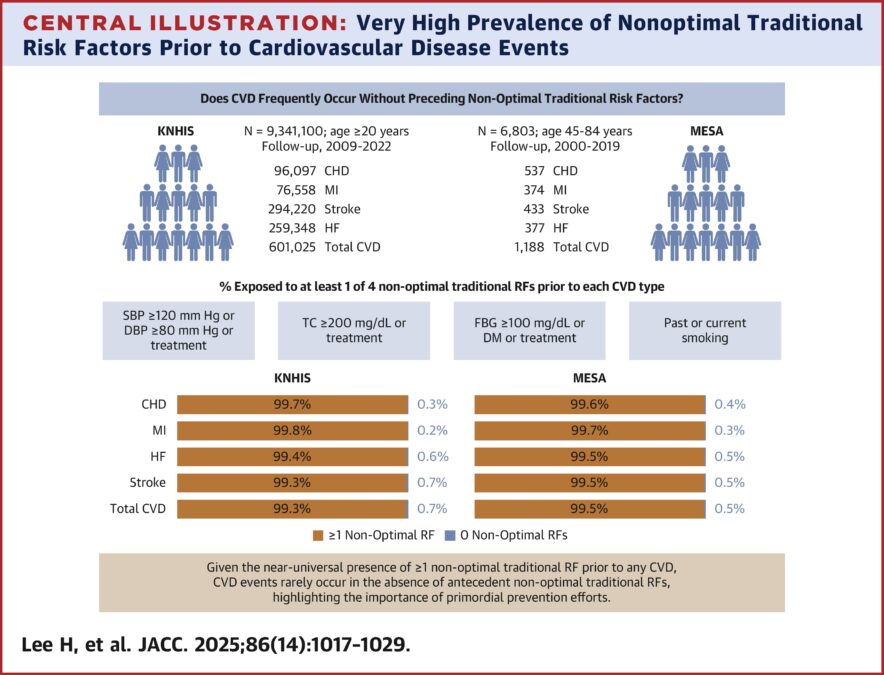
Судалгаагаар зүрх судасны үйл явдлын өмнө даралт, холестерин, цусан дахь сахар хэвийнээс өндөр байх эсвэл тамхи татах эрсдэлт хүчин зүйлсийн аль нэг нь илэрчээ.
АНУ, БНСУ-ын 9 сая хүнийг хамруулсан 2025 оны судалгаанд зүрх судасны үйл явдлын 99 хувийн өмнө дээрх дөрвөн хүчин зүйлийн аль нэг байсан гэж мэдээлжээ. Артерийн даралт ихсэх нь хамгийн түгээмэл бөгөөд зүрхний шигдээс, харвалт, зүрхний дутагдлын тохиолдлын 93 хувийн өмнө ажиглагдсан байна.
51 туршилтын үр дүнг нэгтгэсэн мета-анализад даралт бууруулах эмчилгээ зүрх судасны ашиг тусыг эрт үзүүлж, цаашид хадгалдаг гэж дүгнэжээ. 350,000 гаруй оролцогчийн мэдээллээр систолын даралтыг 5 мм.муб-аар бууруулах бүр эхний жилийн хугацаанд харвалт, зүрхний ишемийн өвчин, зүрхний дутагдлын эрсдэл ойролцоогоор 12 хувиар буурсантай холбоотой байв; энэ хамаарал даралт бууруулах таван үндсэн бүлгийн эмд нийтлэг байжээ.
Холестериныг бууруулах статин зэрэг эмийн зүрх судасны эрсдэлд үзүүлэх нөлөөг олон жилийн туршилтууд харуулсан. 2022 оны шинжилгээнд дурдсан генетикийн судалгаагаар “муу” холестерины түвшнийг амьдралын турш 1 ммоль/л-ээр бууруулах нь зүрх судасны өвчний эрсдэл 50 хувиас илүү буурахтай холбоотой байв; Австралийн 10,000 орчим ахмад хүнийг хамарсан туршилтад статин хэрэглэсэн хүмүүс зургаан жилийн дараа зүрх судасны үйл явдалд өртөх магадлал 30 хувиар бага байжээ.
Цусан дахь сахарын хяналтыг сайжруулах эмчилгээ ч боломжит урьдчилан сэргийлэх арга гэж үзэж байна. GLP-1 бүлгийн эмүүд голлох зүрх судасны үйл явдал буурсантай холбоотой боловч өдөр бүр семаглутид уусан 2-р хэлбэрийн чихрийн шижин, өмнө нь зүрхний дутагдалтай хүмүүст ажиглагдсан 22 хувийн ашиг зүрхний дутагдлын түүхгүй хүмүүст илрээгүй; эдгээр эмийн хамгаалах нөлөөг бататгахад нэмэлт судалгаа шаардлагатай.
Тамхинаас гарах нь мөн эрүүл мэндэд тустай: зарим судалгаагаар 10 жил тамхи татахгүй байж чадсан хүн хэзээ ч тамхи татаж байгаагүй хүнтэй ойролцоо наслалттай болох боломжтой бөгөөд 75 настайд ч гарах нь эрүүл мэндийн илүү сайн үр дүнтэй холбоотой байжээ. American Heart Association-ийн тооцоогоор эмэгтэйчүүдийн даралт, холестерин, чихрийн шижин, таргалалт зэрэг эрсдэлийг 10 хувиар бууруулж, даралт, сахар, холестерины хяналтыг 20 хувиар сайжруулбал зүрх судасны өвчин болон харвалтын тохиолдлыг 23 хүртэл хувиар бууруулах боломжтой.
Дэлгэрэнгүйг эх сурвалжаас харах
↓Эх сурвалжийг нээх ↓
The onset of a heart attack or stroke can take many by surprise – but most cases do not appear out of nowhere.
Nearly everyone who suffers a major cardiovascular event has at least one of four risk factors in the lead-up, according to recent research.
In a 2025 study of 9 million people from the US and South Korea, 99 percent of all cardiovascular events were preceded by either above-optimal blood pressure, cholesterol, or blood sugar levels, or tobacco smoking.
Raised blood pressure was the leading culprit.
It was present before 93 percent of heart attacks, strokes, or heart failure events.
The findings suggest that staying on top of certain health risks, like blood pressure, can help patients avoid serious, potentially fatal outcomes later in life.
This year, we got more evidence of just that.
A new meta-analysis of 51 trials has shown that treating hypertension can lead to rapid and lasting cardiovascular benefits.
The video below has a summary:
Across more than 350,000 participants, every 5 mmHg reduction in systolic blood pressure was associated with a roughly 12 percent lower risk of stroke, ischemic heart disease, or heart failure during the first year of treatment.
What’s more, this pattern was broadly consistent across five major classes of blood pressure drugs: ACE inhibitors, angiotensin II receptor blockers, beta-blockers, calcium channel blockers, and diuretics.
All of these medications seemed to help.
“Our findings show that antihypertensive therapy provides substantial cardiovascular benefits early, which are maintained over time without progressive amplification,” the authors of the meta-analysis conclude.
“These findings have potentially major implications for cardiovascular prevention and clinical decision-making.”
Historically, many heart attacks are blamed on clogged arteries, but the reality is more complicated, especially for younger people and women.
Recent evidence, for example, has found that more than half of heart attacks in women aged 65 or younger are triggered by causes other than clogged arteries.
If doctors and patients had a clearer idea of which health factors to monitor, some risks to the heart might be managed, potentially preventing future cardiovascular events.
Decades of randomized trials show, for instance, that cholesterol-lowering medications, like statins, can significantly reduce the relative risk of a future cardiovascular event.
According to a 2022 analysis, genetic studies suggest that for every single mmol/l decrease in ‘bad cholesterol’ levels sustained over a lifetime, the risk of cardiovascular disease drops by more than 50 percent.
What’s more, a recent randomized trial from Australia, including nearly 10,000 older adults, found that after roughly six years, those taking statins were 30 percent less likely to suffer a cardiovascular event.
Treating hypertension and cholesterol levels seems to improve cardiovascular outcomes, but improving blood glucose control also shows promise as a potential preventive target.
Large randomized trials consistently show that GLP-1 mimics, like Ozempic, are associated with reduced major cardiovascular events, including myocardial infarction, stroke, cardiovascular death, and heart failure.
Earlier this year, an analysis of data from a randomized trial found that among people with type 2 diabetes and a history of heart failure, those taking a daily semaglutide pill were 22 percent less likely than those on a placebo to be hospitalized or need urgent care for heart failure, or to die of cardiovascular causes.
That benefit wasn’t seen in those without a history of heart failure, though.
“Collectively,” the authors of a 2026 review in Circulation conclude, “these findings suggest that GLP-1 RAs influence multiple cardiometabolic pathways and may shift the underlying metabolic milieu toward a more favorable physiological state.”
More studies are needed to confirm how drugs for blood glucose, hypertension, and cholesterol might work to protect the heart, but evidence increasingly suggests that they are doing something positive.
It’s possible that the sooner health factors like hypertension, cholesterol, and glucose levels are managed or treated, the less likely poor cardiovascular outcomes might be.
For tobacco smoking, that is particularly apparent.
This one lifestyle factor is linked to numerous negative health outcomes, like heart failure, and quitting this addictive substance, while notoriously difficult for some, can add years to a person’s life expectancy.
Some recent studies suggest that if a smoker can stay away from cigarettes for a decade, they can hope to live nearly as long as someone who has never picked up a cigarette in their life.
Even at the age of 75, quitting is tied to better health outcomes.
Earlier this year, the former president of the American College of Cardiology, Edward Fry, argued that the US healthcare system needs to treat health concerns like tobacco smoking or hypertension before they become more serious.
“We spend twice as much as other industrialized countries and achieve worse outcomes because we focus on fixing the car after it’s broken down rather than providing preventive maintenance,” Fry said.
If patients and doctors know which health factors raise the risk of cardiovascular events, they can take preventive action before a serious health event occurs.
Even small changes can add up.
Related: US Cardiologists Issued New Guidelines For How to Manage Cholesterol
According to the American Heart Association (AHA), a 10 percent reduction in health factors, such as high blood pressure, high cholesterol, diabetes, and obesity– combined with a 20 percent improvement in the control of blood pressure, blood sugar, and cholesterol – could reduce cardiovascular and stroke events among women by up to 23 percent.
That’s nothing to scoff at.
“These projections emphasize how critical it is that we start focusing on how to help all people stay healthy,” said cardiologist Karen Joynt Maddox earlier this year.
“Know your numbers, listen to your body, and be an advocate for your health.”
You are more in control than you might think.
The study on the four risk factors preceding cardiovascular events was published in the Journal of the American College of Cardiology.
This article was fact-checked by Rebecca Dyer and edited by Rebecca Dyer. While we pride ourselves on our process, we are only human. If you spot a mistake, please let us know.

