Франц, Германы хамтарсан ирээдүйн байлдааны танк боловсруулах төсөл хугацаа алдаж байгаа тул KNDS компани Францын армид зориулсан CAPINT шинэ танкийг танилцууллаа.
Франц-Германы хамтарсан “Main Ground Combat System” (MGCS) төсөл 2040-өөд оны дунд үе хүртэл хойшлогдоод байгаа нь Европын орнуудын зэвсэглэлд цоорхой үүсгэж байна. Франц улс өөрийн Leclerc танкуудыг 2038 он гэхэд ашиглалтаас гаргах төлөвтэй байгаа тул энэхүү “CAPINT” (Interim Capability) буюу шилжилтийн үеийн танк нь түр зуурын шийдэл болох юм. Энэхүү танкийн загвар нь Германы Leopard 2 танкны их бие дээр Францын KNDS компанийн 120 мм-ийн ASCALON их буу бүхий жолоочгүй цамхгийг суурилуулсан шийдэлтэй.
KNDS компани CAPINT танкийн анхны загварыг 2030 онд бэлэн болгож, 2037 он гэхэд цэргийн ангиудад нийлүүлэх боломжтой гэж мэдэгдлээ. Энэхүү танк нь хиймэл оюун ухаан, идэвхтэй хамгаалалтын систем, нисгэгчгүй онгоцны эсрэг зэвсэг зэрэг ирээдүйн MGCS төслийн дэвшилтэт технологиудыг өөртөө багтаах юм. Мөн танкийг дагалдан явах жижиг оврын робот машин буюу “UGV”-г хамтад нь хөгжүүлэхээр төлөвлөж байна.
ОХУ-ын зүгээс ирж буй аюул заналхийлэл болон Украины мөргөлдөөний сургамжаас үүдэн Европ даяар хуягт техникийн хэрэгцээ эрс нэмэгдэж байна. Гэвч Франц, Герман улсууд өөрсдийн түр зуурын танкийн хөтөлбөрүүдийг хэрэгжүүлж эхэлснээр хамтарсан MGCS төслийн ирээдүй бүрхэг болж байна. Германы засгийн газрын төлөөлөгч тус төслийн хүрээнд хамтарсан танк бүтээх эсэх нь тодорхойгүй байгааг дурдсан нь Европын батлан хамгаалах салбар дахь хамтын ажиллагааны хүндрэлийг харуулж байна.
Дэлгэрэнгүйг эх сурвалжаас харах
↓Эх сурвалжийг нээх ↓
The Franco-German KNDS company has presented a new main battle tank, which it is offering to France as an interim replacement for its Leclerc fleet. The development comes as France recognizes that it will need a Leclerc successor before the next-generation Main Ground Combat System (MGCS) becomes available. This joint French and German program is complicated and already delayed, while Europe at large is increasingly alert to the need for capable tanks and other armored vehicles as the threat from Russia grows, and trust around U.S. military backing diminishes.
The proposed CAPINT tank was unveiled at the Eurosatory defense show on the outskirts of Paris this week.
Europe currently has four major lines of development effort for future main battle tanks (excluding the United Kingdom), ranging from multinational programs to national developments. The landscape has become much more fragmented over the past two years, as nations have increasingly understood the urgency of fielding new-generation armored vehicles.
Arguably the most ambitious of these programs is the now-delayed Franco-German MGCS, which began in 2017 and is now expected to arrive in service some time in the mid-2040s. With the MGCS delayed by roughly a decade, both France and Germany have a looming capability gap. In the case of France, its Leclerc tanks are due to be taken out of service by 2038.
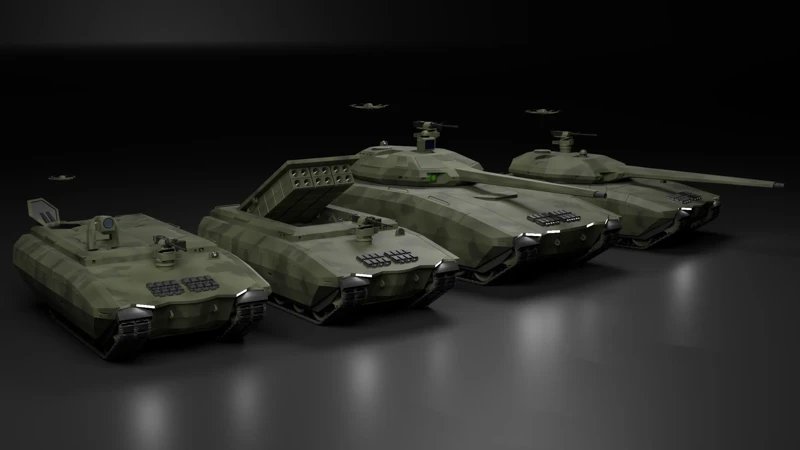
As well as the main battle tank that is supposed to be its centerpiece, the MGCS program, as a ‘system of systems,’ is expected to field other crewed and uncrewed vehicles. These will likely be tasked with electronic warfare, air defense, or as platforms from which to launch drones or loitering munitions or fire directed-energy weapons.
Alongside this effort, around a dozen European nations (excluding France) are currently working on research and development under the MARTE (Main ARmored Tank of Europe) program, which is looking at tank requirements for the post-2040 period.
Against this complicated backdrop, France and Germany have both come to the realization that they will need new tanks before the MGCS arrives in service.
As a result, Germany is now working on the Leopard 3, also known as the Leopard 2AX, expected to provide a service-ready fighting vehicle around the early 2030s.
Back in April of this year, French Armed Forces Minister Catherine Vautrin told parliament that Paris had decided to launch an “intermediate” tank program to mitigate delays affecting MGCS.
To meet the French requirement for a stopgap tank, KNDS is now proposing its CAPINT (CAPacité INTérmédiaire, or Interim Capability).
This will combine a French turret and main gun on the hull of a German Leopard 2, a tank that is already in production for a variety of customers. Should this solution be chosen, a new Leopard 2 would likely be set up in France to manage the demand.
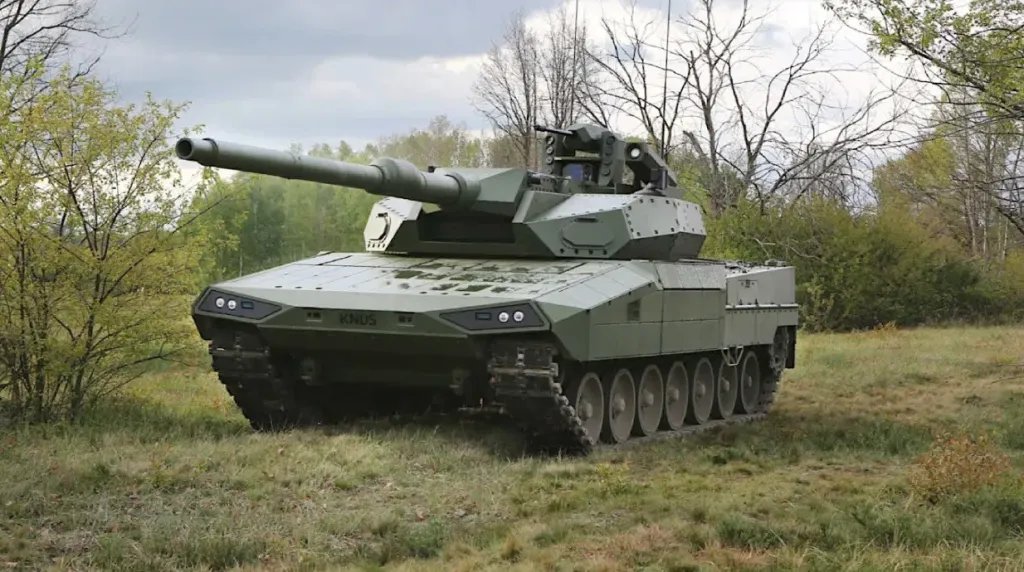
Interestingly, another new tank on show in Paris this week, the New Main Battle Tank (NMBT) concept demonstrator, from the Leonardo Rheinmetall Military Vehicles (LRMV) joint venture, also uses a Leopard 2 hull as its starting point, although that may change in the future. Derived from the Rheinmetall Panther KF51, the new tank is being offered to the Italian Army, which is also looking for a successor to its current Ariete main battle tank.
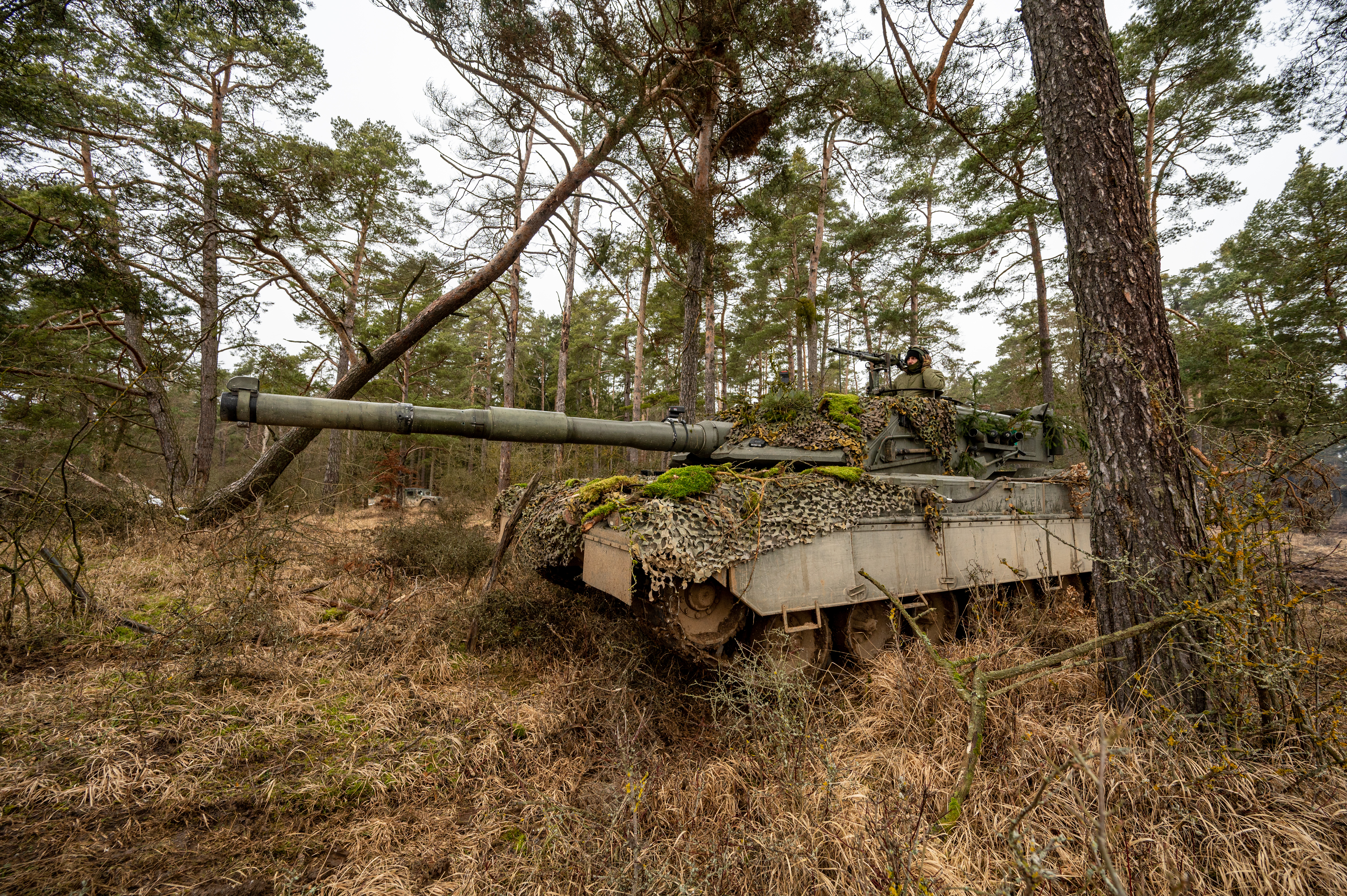
Returning to the CAPINT tank, the turret will be uncrewed and armed with the 120mm ASCALON smoothbore gun from KNDS France. The plan is to have the turret able to accommodate a 140mm cannon in the future. The 120mm ASCALON has already undergone firing trials using an uncrewed turret on a moving vehicle. Meanwhile, the 140mm version of the ASCALON is planned for the MGCS.
Unlike larger-caliber guns that have been proposed for future tank programs in the past, the 120 mm ASCALON offers the advantage of being fully compatible with all NATO-standard 120 mm ammunition. This means operators can maintain and leverage their existing ammo stockpiles.
The three crew of the CAPINT will be carried in an “armored citadel” at the front of the vehicle, which will be defended by passive composite armor as well as reactive and active protection systems.
The active protection system will be developed by KNDS and will be distributed around the turret and hull, so its defensive effectors provide more complete coverage.
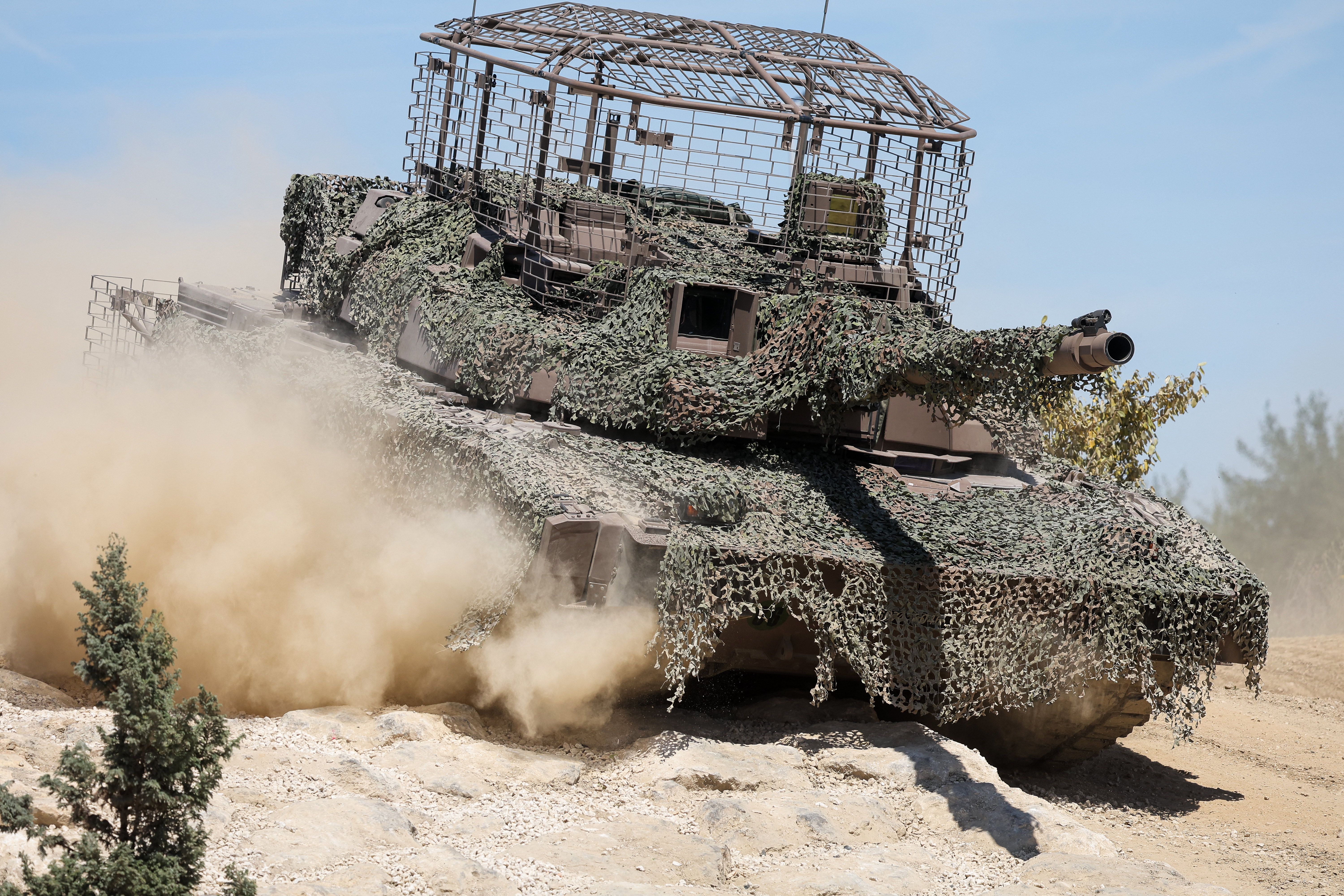
In the meantime, it is interesting to note that a Leclerc outfitted with an anti-drone “cope cage” on top of its turret is part of the dynamic demonstration of military equipment at Eurosatory this week.
KNDS says it will complete a CAPINT demonstrator tank as early as 2030 and, should France choose to go wth it, it could deliver the first series-production examples in 2035, leading to frontline deployment in 2037.
There is also a plan to incorporate into the CAPINT some of the advanced systems that are intended for the MGCS.
These elements are likely to include fully integrated AI, the aforementioned passive/reactive/active protection systems, counter-drone warfare, and beyond-line-of-sight engagement capability.
Another feature of the MGCS program that would likely be brought forward for the CAPINT tank is accompanying uncrewed ground vehicles (UGVs). According to MGCS, one or two types of “robotic wingmen” are planned for the interim tank. These UGVs will be able to keep up with the tank, but will be small enough to be affordable. Their cost will also be governed by offering different levels of passive protection.
The renewed focus on tank programs reflects a broader resurgence of armored warfare across Europe, driven largely by lessons from Russia’s full-scale invasion of Ukraine. While that conflict has highlighted the vulnerability of tanks to drones, loitering munitions, and precision anti-tank weapons, it has also underscored that heavily protected, mobile firepower remains indispensable for combined-arms operations. As a result, European militaries that once downsized or delayed armored modernization are now investing heavily in new main battle tanks and upgrades.
While the need for interim tanks in both France and Germany is becoming increasingly urgent, the current push for the CAPINT and for the German Leopard 3/Leopard 2AX does risk putting the MGCS program under threat.
“We are already working to create what will be the combat of tomorrow,” KNDS CEO Jean-Paul Alary said during a press conference at Eurosatory yesterday. “Maybe the combat of tomorrow, the ambition of MGCS, will come a little bit earlier than the project itself.”
Meanwhile, according to Reuters, a German government spokesperson raised doubts about the future of MGCS, saying that the project would be focused on “platform-independent” technologies, adding that it was not clear whether a joint tank would still be built.
Depending on how capable these stopgap tanks prove to be, the decision of France and/or Germany to walk away from the more complex MGCS program could become easier. Much will likely also depend on the path that the MARTE program takes, with the possibility that MGCS requirements could be superseded. Meanwhile, recent experience with the Franco-German-led pan-EuropeanFuture Combat Air System(FCAS)has highlighted just how difficult it can be to keep programs like these on track, regardless of how badly they may be needed.
Contact the author: thomas@thewarzone.com
The post Interim Main Battle Tank Unveiled As Future European Tank Project Slips appeared first on The War Zone.