
Эрдэмтэд Андромеда галактикийг тойрон эргэх, маш бүдэг гэрэлтэлттэй шинэ одой галактикийг нээсэн нь сансар огторгуйн харанхуй материйн судалгаанд чухал ач холбогдолтой юм.
Испанийн Канарийн арлуудад байрлах 10.4 метрийн голчтой Gran Telescopio Canarias дуран болон OSIRIS спектрометрийг ашиглан Андромеда XXXVI хэмээх одой галактикийг илрүүлжээ. Андалусийн Астрофизикийн хүрээлэнгийн судлаач Жоанна Саковскаар ахлуулсан баг тус галактикийг Pan-Andromeda археологийн судалгааны өгөгдлүүдэд хийсэн нарийвчилсан шинжилгээгээр олж нээсэн байна. Энэхүү одой галактик нь 12.5 тэрбум орчим жилийн настай, хүнд элементийн агууламж маш багатай гэдгээрээ онцлог юм.
Уг нээлт нь Андромеда галактикийн дагуул одой галактикуудын тоог нэмэгдүүлж, харанхуй материйн тархалт болон галактикийн хувьслын онол болох Lambda-Cold Dark Matter (Lambda-CDM) загварыг батлахад чухал хувь нэмэр оруулна. Одоогийн байдлаар Андромеда галактикийг тойрон эргэдэг 92 одой галактик байх боломжтой гэж үздэг ч ердөө 40 орчмыг нь л баталгаажуулаад байна. Андромеда XXXVI нь маш бүдэг, ердөө 46 од л тодорхойлогдсон нь одон орон судлаачдад огторгуйн хамгийн жижиг, бүдэг биетүүдийг судлах боломжийг олгож байна.
Одон орон судлаачид эдгээр “хэт бүдэг” одой галактикуудыг эртний орчлон ертөнцийн үлдэгдэл буюу “чулуужсан олдвор” гэж үздэг. Эдгээр биет нь харанхуй материйн нөлөөгөөр үүссэн байх магадлалтай бөгөөд оддын үүсэл нь маш хязгаарлагдмал байдаг тул гэрэлтэлт нь эрс бага байна. Цаашид Жэймс Вэбб зэрэг сансрын дурангуудыг ашиглан Андромеда XXXVI-ийн алслалт, химийн найрлага болон оддын үүслийн түүхийг нарийвчлан тогтоох шаардлагатай байгаа юм.
https://www.aanda.org/articles/aa/full_html/2026/06/aa60151-26/aa60151-26.html#S5
https://www.aip.de/en/news/galaxy-around-andromeda/
Дэлгэрэнгүйг эх сурвалжаас харах
Эх сурвалжийг нээх ↓
Humans have known about Andromeda since they first gazed skyward, because it’s visible with the naked eye as a little grey smudge. In written accounts from a millennia ago it was described as a little cloud. Over the following centuries, as telescopes grew in power, they showed us that what looked like little nebulous smudges in the night sky, including Andromeda, were actually galaxies filled with individual stars.
It was Edwin Hubble who finally proved that the smudges were galaxies, and Andromeda played a central role in that development.
Now we know that spirals like the Milky Way and Andromeda also have retinues of dwarf galaxies. But even though our telescopes are enormously powerful now, and even though some of them do their work from a superior vantage point in space, finding all of these dim satellites is still challenging. They’re important, because these dwarf galaxies are a critical part of understanding the growth and evolution of galaxies like Andromeda.
Ultra-faint dwarf galaxies are an important sub-type of dwarf galaxies. They have extremely low masses and extremely low luminosities. UFDGs are the most dark matter-dominated objects that we know of, and that makes them important probes of dark matter .
Astronomers estimate that Andromeda hosts about 92 dwarf galaxies, and only about 40 of them have been detected and confirmed. Of those 40, 15 are ultra-faint. But astronomers have just found another one.
It’s called Andromeda XXXVI (And XXXVI) and its discovery was presented in new research in Astronomy and Astrophysics. The study is titled “Andromeda XXXVI: Discovery of a new ultra-faint dwarf galaxy towards M31,” and the lead author is Joanna Sakowska, researcher at the Instituto de Astrofísica de Andalucía.
“We present deep imaging of Andromeda XXXVI (And XXXVI), a dwarf galaxy discovered through visual inspection of the Pan-Andromeda Archaeological Survey using observations obtained with the OSIRIS+@GTC instrument,” the authors write. OSIRIS is an optical spectrometer attached to the Gran Telescopio Canarias, a 10.4 meter telescope in Spain’s Canary Islands. OSIRIS specializes in observing very faint and distant emission line objects. “The discovery of And XXXVI adds to the faint end of M31’s satellite luminosity function, suggesting the presence of an even larger population of very faint satellites,” the authors write.
“Our study suggests that And XXXVI is an extremely old galaxy, around 12.5 billion years old, and remarkably poor in heavy elements,” lead author Sakowska said in a press release. “However, observations with space telescopes such as Hubble will be needed to determine its distance, age and chemical composition with greater precision.”
Astronomers are especially interested in UFDGs like this one because of their connection to dark matter.
The Lambda-Cold Dark Matter (Lambda-CDM) model is the current standard cosmological model of the Universe. It predicts that massive galaxies like the Milky Way and Andromeda, which form in dark matter halos, should be surrounded by hundreds of smaller DM halos. But we struggle to find luminous satellites that should occupy these halos, and that’s been called the missing satellites problem, or the dwarf galaxy problem.
They’re missing because inside such small DM sub-halos, star formation is suppressed, making these dwarf galaxies are extremely dim. Astrophysicists consider UFDGs to be the missing key in understanding the dwarf galaxy problem. They have extreme mass-to-light ratios and that confirms that they’re situated in DM halos that are much more massive than their stellar content suggests. The more UFDGs astronomers find, the more the satellite count agrees with Lambda-CDM. As a result, the dwarf galaxy problem has shrank in importance over time.
And 35 was discovered as an overdensity of stars situated between two bright foreground stars. While previous surveys hinted at its existence, these observations with the GTC show it clearly. “The advent of wide-field photometric surveys, such as the Sloan Digital Sky Survey (SDSS), the Panoramic Survey Telescope and Rapid Response System (PanSTARRS), the DESI Legacy Imaging Survey (DESI LS), and UNIONS, has greatly accelerated the discovery of dwarf galaxies within and beyond the M31 halo,” the authors write.
As an indicator of how small and dim And XXXVI is, the researchers were only able to identify 46 of its stars. Most known dwarfs contain thousands of stars, even many more.
These panels show And XXXVI from four different surveys. From left to right: SDSS DR9, PanSTARRS DR1, CFHT (PAndAS), and GTC. “The overdensity is almost invisible in SDSS and PanSTARRS, and it only becomes apparent with in CFHT and GTC,” the authors write. Image Credit: Sakowska et al. 2026. A&A.
The more UFDGs astronomers discover, the more the Lambda-CDM model can be tested. They serve as probes that test our understanding of DM itself. Is it cold and collisionless as Lambda-CDM says? Or is it it something else, like WIMPs?
“The discovery of Andromeda XXXVI offers a new perspective on the smallest galaxies in the universe,” said study co-author Isabel Santos Santos from the Leibniz Institute for Astrophysics Potsdam (AIP). “Within the framework of the standard cosmological model, the so-called Lambda Cold Dark Matter model (ΛCDM), we expect galaxies like Andromeda to be surrounded by hundreds of such small companions—yet many of them have remained hidden until now due to their low luminosity. Each newly discovered ultra-faint dwarf galaxy helps us explore the limits of galaxy formation and put our cosmological models to the test.”
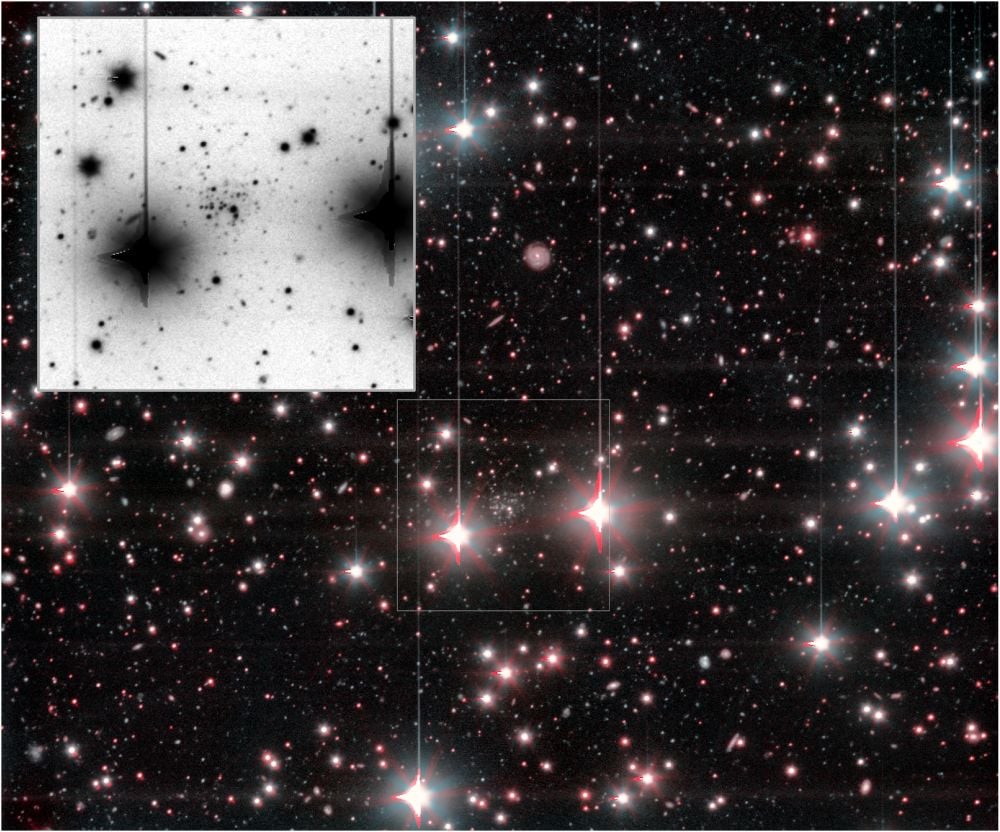 This is a stacked OSIRIS+ image of And XXXVI. The inset shows a negative colour zoom-in. The stellar overdensity is clear between the two foreground stars. Image Credit: Sakowska et al. 2026. A&A.
“Each new discovery, such as Andromeda XXXVI, is important because it suggests that we may still be seeing only the tip of the iceberg of a much larger population of extremely faint galaxies,” said lead author Sakowska.
UFDGs are considered fossils from the early Universe. Their stars are old and have low metallicity. They could also be fossils from the Universe’s reionization. To understand And 36 better, astronomers need deeper imaging from space telescopes, and better spectroscopic observations.
“Combined with a detailed star formation history, such data would help determine whether And XXXVI’s old metal-poor stellar population indicates early quenching, which would be similar to the trends seen in Milky Way satellites, and whether And XXXVI could be considered a reionisation fossil,” the authors explain.


