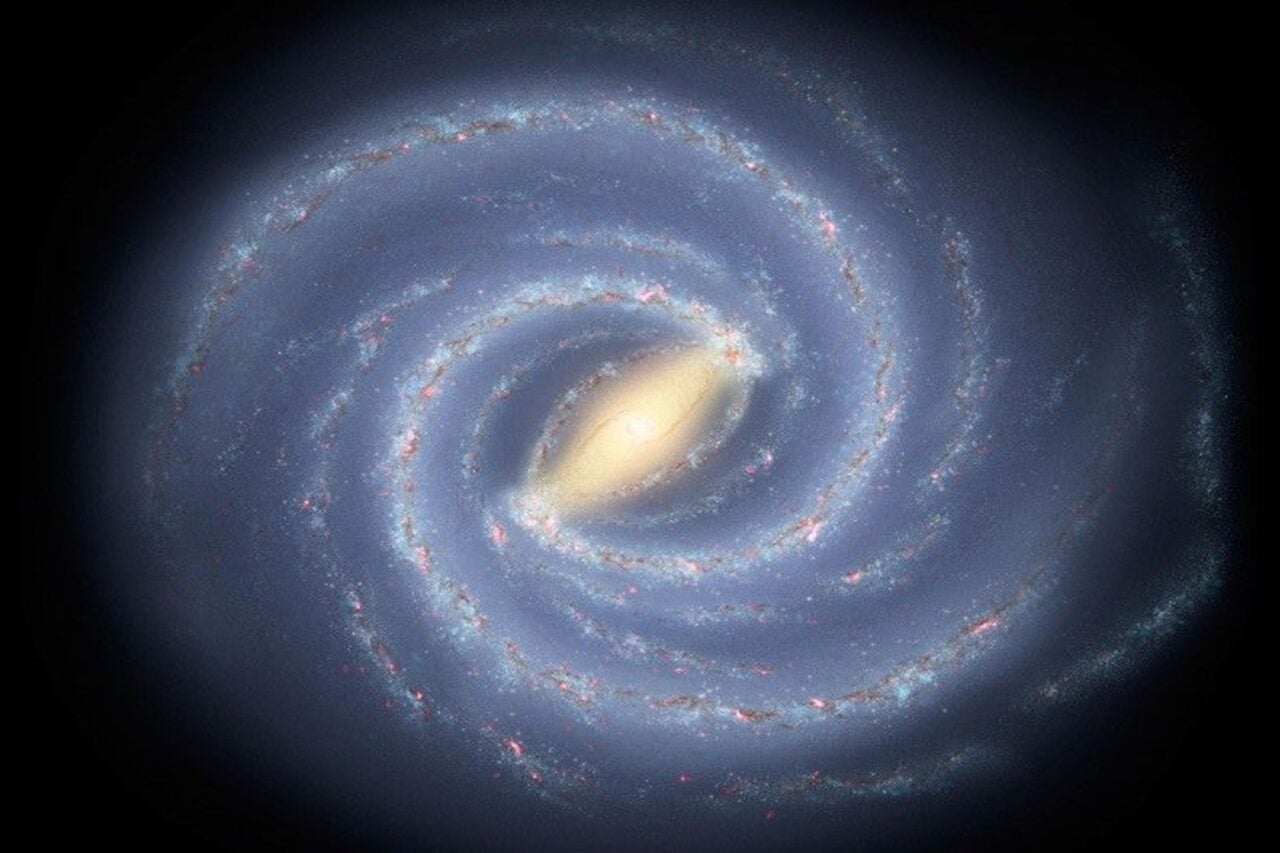
Одон орон судлаачид манай галактикийн гаднах спираль гарнууд өмнө нь тооцоолж байснаас 10 хувиар илүү алсад оршдогийг тогтоожээ.
NASA-гийн “Chandra” рентген дуран болон ESA-гийн “XMM-Newton” дурангийн өгөгдлийг ашиглан судлаачид Сүүн замын спираль гарнууд дахь тоосны үүл хүртэлх зайг нарийвчлан хэмжсэн байна. “Astronomy & Astrophysics” сэтгүүлд нийтлэгдсэн уг судалгаагаар галактикийн бүтэц, масс болон хэмжээний талаарх өмнөх тооцооллыг өөрчлөх шаардлагатай болж байна. Италийн Pavia-гийн их сургууль болон Trento-гийн их сургуулийн хамтарсан хөтөлбөрийн судлаач Илариа Форназиерогийн хэлснээр, эдгээр өөрчлөлт нь галактикийн үндсэн бүтцийг ойлгоход чухал ач холбогдолтой юм.
Судлаачид гамма цацрагийн тэсрэлтүүдийн үед үүсдэг “гэрлийн цуурай” хэмээх үзэгдлийг ашиглан зайг хэмжжээ. Гамма цацрагийн хүчтэй тэсрэлтээс ялгарсан гэрэл галактикийн тоосны үүлнээс ойж ирэхэд, рентген туяаны цагирагийн диаметрийг ашиглан Дэлхий хүртэлх зайг геометрийн аргаар тодорхойлсон байна. Энэхүү арга нь галактикийн эргэлтийн загвараас хамаардаг бусад аргуудаас илүү нарийвчлалтай болохыг судалгааг ахлагч Беатриче Вайя онцолжээ.
https://ui.adsabs.harvard.edu/abs/2026arXiv260424617V/abstract
https://science.nasa.gov/missions/chandra/nasas-chandra-examines-milky-way-at-arms-length/
Энэхүү аргачлалаар Персей, Гадна талын гар, болон Гадна талын Скутум-Центаврын гэсэн гурван спираль гарын зайг хэмжсэн бөгөөд сүүлийн хоёр гар нь таамаглаж байснаас илүү алсад байрлаж байгаа нь тогтоогджээ. Энэхүү нээлт нь галактикийн нийт масс болон түүний гарнуудын тархалтын хэмжээг дахин тооцоолоход хүргэж болзошгүй юм. Судалгааны багийн гишүүн Андреа Тиенгогийн тайлбарласнаар, 25 жилийн хугацаанд ийм төрлийн хэмжилт хийхэд тохиромжтой хэдхэн л тохиолдол бүртгэгдсэн тул цаашид илүү олон сансрын тэсрэлтийг ажиглах шаардлагатай байна.
Дэлгэрэнгүйг эх сурвалжаас харах
Эх сурвалжийг нээх ↓
By observing light from the most powerful explosions in the universe bouncing off dust clouds in the Milky Way’s spiral arms, astronomers have found that our galaxy may extend farther than previously thought, potentially changing estimates of its mass and structure.
Using data from NASA’s Chandra X-ray Observatory and the European Space Agency’s XMM-Newton, a team of researchers made precise measurements of distances to dust clouds in the Milky Way’s spiral arms. The results, published in the Astronomy & Astrophysics journal, revealed that the outer spiral arms in the Milky Way are about 10% more distant than astronomers previously thought.
“The differences are small, but any revision of these distances is important because they are so fundamental for understanding our galaxy,” Ilaria Fornasiero, a PhD student in a joint program between Scuola Universitaria Superiore IUSS Pavia and the University of Trento in Italy and co-author of the new study, said in a statement.
Arms stretched wide
The Milky Way stretches about 100,000 light-years wide, containing 100 to 400 billion stars. Its spiral structure is dominated by whimsical arms wrapping off the ends of a central bar of stars at its heart. Our solar system is located on one of the galaxy’s spiral arms about halfway from the center.
Scientists are still working on determining the exact structure of the Milky Way and a more precise characterization of its arms. Our view of our home galaxy is hindered by Earth’s position within one of its arms, as well as gas and dust that get in the way of telescopic images.
For the new study, the researchers studied rings around gamma ray bursts. These powerful explosions take place in the aftermath of a collapse of a massive star or the merger of two neutron stars, resulting in the brightest bursts of light in the universe.
The researchers relied on the phenomenon of light echoes, whereby the light from the gamma-ray burst bounced off dust clouds in the galaxy’s spiral arms. In doing so, they were able to measure the distance to Earth using the diameters of the rings shown in X-ray light, with larger rings being generated by dust clouds closer to us.
“This is a very direct way – relying only on geometry – to precisely measure distances to the Milky Way’s spiral arms,” Beatrice Vaia, a PhD student at the same program who led the study, said in a statement. “Most other methods rely on assumptions about how the Milky Way rotates, which become increasingly uncertain in the outer regions of our galaxy.”
Going the distance
The researchers used three different gamma-ray bursts to measure the distance from Earth to three of the Milky Way’s spiral arms: the Perseus, the Outer, and the Outer Scutum-Centaurus arms. They found that both the Outer and Outer Scutum-Centaurus arms are about 10% more distant than astronomers previously thought.
“This could mean that astronomers have to revise estimates of the mass of the galaxy, because that affects how wide the arms stretch,” Fornasiero said.
The team behind the study also estimated that the dust cloud in the most distant arm is about 3,500 light-years wide. This showed that their measurements apply to the full thickness of the spiral arm, rather than a random, isolated dust cloud that may not fully be representative of the arm’s location.
The light from gamma-ray bursts may provide an accurate way to measure distances in the galaxy, but these cosmic explosions are rarely visible through the plane of the Milky Way. “We’re relying on the universe to provide us with these events, and so far, over 25 years, we’ve only found a handful that we can use,” Andrea Tiengo, a researcher at Scuola Universitaria Superiore IUSS Pavia and co-author of the study, said in a statement. “That said, we will continue to be on the lookout for more.”


