
Их Британи болон Энэтхэгийн эрдэмтдийн бүтээсэн уг оношилгооны арга нь өвчнийг эрт үе шатанд нь инвазив бус, хялбар аргаар илрүүлэх боломжийг бүрдүүлжээ.
Амны хөндийн хорт хавдрыг илрүүлэхэд ихэвчлэн эдийн шинжилгээ (биопси) хийдэг нь өвчтөнд өвдөлттэй, таагүй мэдрэмж төрүүлдэг байна. Харин “Quantitative Malignancy Index Diagnostic System” (qMIDS) хэмээх шинэ систем нь амны хөндийн сэжигтэй хэсгээс сойзоор арчдас авч, тухайн эсэд илэрч буй хорт хавдартай холбоотой дөрвөн төрлийн мРНХ-ийн илрэлийг шинжилдэг. Энэхүү шинжилгээ нь нэг цагийн дотор хариу гаргадгаараа онцлогтой.
Queen Mary University of London-ийн амны хөндийн хавдар судлаач Муй-Тек Те (Muy-Teck Teh)-ийн тайлбарласнаар, уг арга нь эмч нарт өвчтөнийг хурдан бөгөөд үнэн зөв ангилан оношлох, тогтмол хяналт тавих боломжийг олгоно. Судалгаанд хамрагдсан 545 өвчтөний сорьцод хийсэн туршилтаар уг шинжилгээ 95.5 хувийн нарийвчлалтай болох нь тогтоогджээ. Шинжилгээний худал эерэг болон худал сөрөг гарах магадлал таван хувиас бага байна.
Дэлхий дахинд амны хөндийн хорт хавдрын тохиолдол 1990 оноос хойш хоёр дахин нэмэгдсэн бөгөөд үүнд тамхи, архи, чихэрлэг ундааны хэрэглээ болон хүний папиллома вирус (HPV) нөлөөлдөг гэж үздэг. Судлаачид уг аргыг арилжааны зориулалтаар нэвтрүүлэхээр ажиллаж байгаа бөгөөд ойрын хоёр жилийн дотор эмнэлзүйн практикт ашиглах боломжтой болно хэмээн тооцоолж байна. Уг судалгааны үр дүнг “Biomarker Research” сэтгүүлд нийтэлжээ.
Дэлгэрэнгүйг эх сурвалжаас харах
↓Эх сурвалжийг нээх ↓
Oral cancer might not be one that many people think to look out for, but its prevalence is rising and it can be deadly.
As with many cancers, catching it early is key to the best outcomes – but diagnosis is tricky and invasive.
Now, scientists from the UK and India have demonstrated an effective and non-invasive new kind of test that can accurately detect the presence of cancer in the early stages.
Best of all, the results are in within an hour.
“[This test] gives clinicians a rapid, accurate, and non-invasive way to triage patients, and crucially, it can be repeated,” says Muy-Teck Teh, an oral oncologist at Queen Mary University of London.
“That means we can now monitor patients with persistent pre-malignant lesions regularly and systematically – and pick up cancers much earlier than we would have been able to before.”
Oral cancers usually manifest as persistent sores or discolored patches on the lips, gums, tongue, or inner cheeks.
Many of these are benign, but it pays to check. Unfortunately, checking usually involves taking a biopsy of the affected tissue with a scalpel, which can be painful in such a sensitive part of the body.
Worse still, multiple biopsies can be needed over time to monitor how a benign lesion might progress into cancer. But because it’s so invasive, many patients opt out of follow-ups.
Thankfully, there could soon be a painless alternative. Scientists have tested a new diagnostic tool that requires nothing more than a quick brush of the mouth.
The quantitative Malignancy Index Diagnostic System (qMIDS), as it’s known, involves using a brush to swab the suspect lesion, and then analyzing it for signs of mRNA expression from four specific genes linked to oral cancer.
At the same time, a control sample, swabbed from an unaffected part of the mouth, is also analyzed.
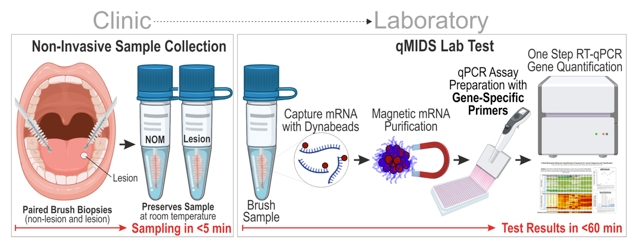
Earlier versions of the qMIDS test have shown promise in large-scale trials, so for this study, the researchers set out to investigate how effective a third version of qMIDS might be at distinguishing oral cancer from benign lesions.
Brush biopsies were collected from the mouths of 545 patients with lesions that could potentially be cancerous.
And sure enough, the test was found to have an overall accuracy of 95.5 percent, with false-positive and false-negative rates of less than 5 percent. The results were available within an hour.
“We were genuinely astonished by the fact that the brush swab test performance is comparable to a microbiopsy,” says Teh.
“It suggests that the biological signal captured by these four genes is sufficiently strong and consistent that it can be detected even from the superficial exfoliated cells collected by a brush biopsy.”

As well as sparing low-risk patients from unnecessary discomfort, the test could also help high-risk patients monitor their health over time. Since it’s easy to administer over and over again, qMIDS could help detect when and if a lesion turns nasty, at an early enough stage to do something about it.
Related: New Blood Test Detects Deadly Brain Cancers in Just One Hour
This is important, as worldwide cases of oral cancer have more than doubled since 1990, as have deaths. It’s thought that lifestyle factors like smoking, alcohol, and sugary drinks are linked to it, as well as human papillomavirus (HPV) infections.
The researchers are currently looking to commercialize the test, saying that it could be available for clinical use in as little as two years.
The research was published in the journal Biomarker Research.
This article was fact-checked by Rachel Garner and edited by Peter Dockrill. While we pride ourselves on our process, we are only human. If you spot a mistake, please let us know.


