
Насанд хүрэгчдийн тимус булчирхайн эрүүл мэнд нь хүний урт наслалт, хавдар болон зүрх судасны өвчний эрсдэлтэй шууд холбоотой болохыг эрдэмтэд тогтоожээ.
Harvard University-ийн онкологич Hugo Aerts болон түүний баг Framingham Heart Study болон National Lung Screening Trial судалгааны 27,000 гаруй хүний эрүүл мэндийн мэдээлэлд дүн шинжилгээ хийсэн байна. Судлаачид компьютер томографийн (CT) сканы тусламжтайгаар тимус булчирхайн хэмжээ, хэлбэр, бүтцийг хэмжиж, гүнзгийрүүлсэн сургалтын систем ашиглан хүний бие дэх уг булчирхайн үйл ажиллагааны эрүүл мэндийг үнэлжээ. Судалгааны үр дүнгээс харахад тимус булчирхайн эрүүл мэнд өндөртэй оролцогчдын хувьд бусадтай харьцуулахад насрах эрсдэл 50 хүртэл хувиар бага байж, уушгины хавдраар өвчлөх болон уг өвчний улмаас эрсдэлд орох магадлал мөн мэдэгдэхүйц буурсан байна. Мөн зүрх судасны өвчний улмаас эрсдэх магадлал 63-аас 92 хүртэл хувиар бага байгаа нь тогтоогджээ.
Уг судалгаа нь зөвхөн хамаарал бүхий үр дүнг харуулж байгаа бөгөөд илүү өргөн хүрээний судалгаагаар баталгаажуулах шаардлагатайг эрдэмтэд онцолжээ. Тамхи татах, таргалалт, архаг үрэвсэл зэрэг эрүүл бус амьдралын хэв маяг нь тимус булчирхайн эрүүл мэндэд сөргөөр нөлөөлдөг болохыг судалгаагаар илрүүлсэн байна. Тусдаа хийгдсэн өөр нэгэн судалгаагаар тимус булчирхайн эрүүл мэнд нь уушгины хавдар, меланома, хөхний хавдар зэрэг төрөл бүрийн хорт хавдрын дархлаа эмчилгээний үр дүнд мөн нөлөөлдөг болохыг тогтоожээ. Уг судалгааны үр дүнг Nature сэтгүүлд нийтэлсэн байна.
Дэлгэрэнгүйг эх сурвалжаас харах
↓Эх сурвалжийг нээх ↓
A small organ located in the upper chest has been plagued by an identity crisis for decades now.
The thymus, which plays a crucial role in early life in helping to develop children’s immune systems, is known to decay and shrink with age, leading to it often being considered a relatively useless or defunct organ in adults.
But research is showing this maligned “immune cell graveyard” doesn’t actually lose its purpose when we grow up, as many had thought.
In fact, recent research published in Nature suggests the thymus could have a persistent and profound impact on health and longevity throughout people’s lifetimes, helping the body counter disease risk, including cancer.
“We suspected the adult thymus might still matter, but we were surprised,” oncologist Hugo Aerts from Harvard University, director of the Artificial Intelligence in Medicine (AIM) Program at Mass General Brigham, told ScienceAlert.
“We did not expect these differences to be so strongly and consistently associated with longevity, cancer incidence, cardiovascular disease, and cancer therapy response across multiple large, independent cohorts. That suggested the adult thymus is far more important than previously appreciated.”
In their study, Aerts and his team analyzed health data from over 27,000 people, collected in two separate cohorts, the Framingham Heart Study (FHS) and the National Lung Screening Trial (NLST).
In each study, people had taken part in computed tomography (CT) scans, which measured the size, shape, and composition of their thymus.
This data was fed into a deep learning system that was able to quantify the health of their thymus, based on these differing characteristics.
The AI could then generate a thymic health score – a kind of proxy for how functional the thymus was in adulthood – classifying each person as having either low, average, or high thymic health.
Follow-up data from each cohort showed that thymic health was linked with dramatically altered health outcomes in the years following the CT scans.
After adjusting for age, sex, smoking, and comorbidities, the researchers found that participants in the NLST with high thymic health had a roughly 50 percent lower relative risk of death by 12 years later, when compared with individuals with low thymic health from the study.
Similarly, people with high thymic health were about 36 percent less likely to develop lung cancer, and about 50 percent less likely to die from lung cancer compared to the low thymic health group.
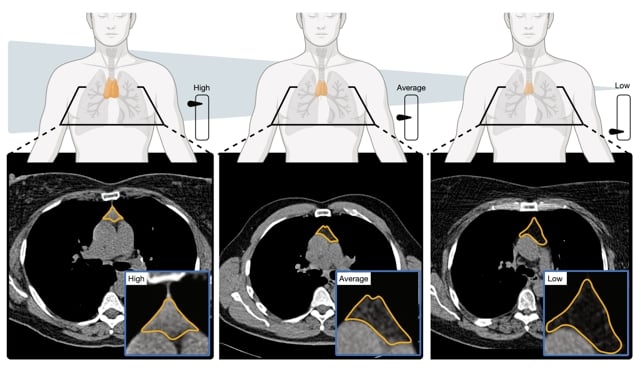
Cardiovascular disease also showed considerable relative risk reductions, with high thymic health corresponding to 63 percent lower risk of cardiovascular death in the NLST, and up to 92 percent lower risk in the FHS, compared to those with low thymic health.
The findings warrant replication in future research, and only show correlations in the data; they can’t definitively prove that having a healthier thymus leads to these gains in health.
But the results still go a long way to suggesting that we need to update our understanding of how the thymus may be contributing to adult health and lifespan.
“These findings change how we think about the immune system in medicine,” Aerts told ScienceAlert.
“Our work suggests that thymic health is a fundamental component of that immune fitness and that it can now be measured using routine medical imaging. This opens the possibility of identifying patients who are most likely to benefit from certain therapies, tailoring treatments to preserve immune health, and developing new strategies to maintain immune function as we age.”
In a separate but related Nature study led by Aerts and published alongside the first paper in March, the researchers found that thymic health was also linked to immunotherapy responses across several types of cancer, including lung cancer, melanoma, breast cancer, and others.
One takeaway is that the thymus might not only be an unappreciated factor boosting people’s health and longevity – it could also help us develop and target new kinds of treatments.
“The first turning point came when we discovered that patients with healthier thymuses responded much better to immunotherapy and survived longer,” Aerts said.
“That finding was surprising because the thymus has long been considered largely irrelevant in adults. Initially, we wondered whether this was something unique to cancer treatment.
“But as we expanded the research into large population cohorts, we found that thymic health was also strongly associated with overall survival, cancer risk, cardiovascular disease, and other major health outcomes. At that point, it became clear that we weren’t just discovering a new cancer biomarker, we were uncovering a much broader measure of adult immune health.”
But what is it about the thymus that may have such a marked influence on people’s health in adult life?

We don’t know for sure, but the new findings echo a landmark study published in 2023, which discovered that people who had their thymus surgically removed faced an increased risk of death from any cause in the five years following their operation.
In contrast to the established view that the importance of the thymus diminishes with age, those findings supported “a role for the thymus contributing to new T-cell production in adulthood and to the maintenance of adult human health,” the research team – led by Harvard University oncologist David Scadden – wrote in their paper.
The newer research arrives at a similar conclusion, suggesting that just because the thymus may shrink with age, that doesn’t mean its gradual disappearance is a harmless vanishing act.
Aerts’ team found that several lifestyle and health factors were linked to having poorer thymic health, including smoking, obesity, and chronic inflammation.
Related: Scientists May Have Discovered a Way to Rejuvenate The Immune System
Putting it all together, it’s suggestive of a two-way relationship.
A healthier thymus appears to help protect the body by producing better immune function through adulthood, but also inflammation, harmful habits, and disease can in turn hurt the organ, which may then proceed to weaken and shrink as people get older.
Those developments, once considered inevitable and normal, could instead be actionable – and longer, healthier lives may hang in the balance.
“I’m excited because this is more than the discovery of a new biomarker,” Aerts said.
“It suggests that we’ve overlooked a major aspect of human biology for decades. If these findings continue to be confirmed, preserving and measuring immune health could become a new principle of medicine, much like we currently monitor heart or kidney function.
“The thymus may be one of the first organs that allows us to do that in a practical way.”
The findings are reported in Nature here and here.
This article was fact-checked by Rebecca Dyer and edited by Rebecca Dyer. While we pride ourselves on our process, we are only human. If you spot a mistake, please let us know.


