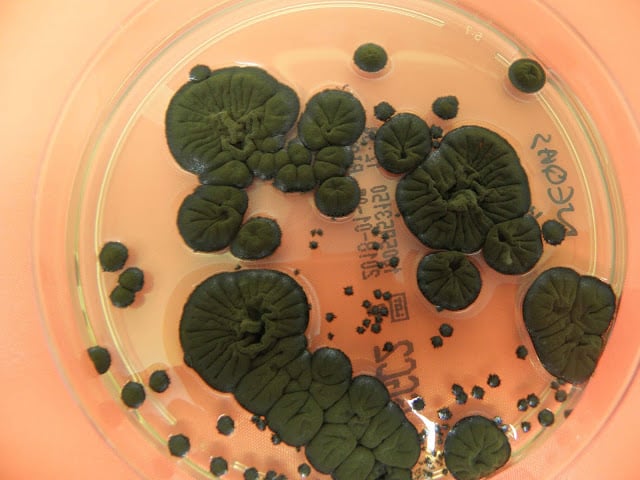
Эрдэмтэд Чернобылийн сүйдсэн реактор доторх цацраг идэвхт орчинд өсөж үрждэг хар өнгийн мөөгний онцгой чадварыг судалж байна.
1986 оны ослын дараа Чернобылийн дөрөвдүгээр реакторын орчмоос судлаачид 37 зүйлийн мөөг илрүүлсэн бөгөөд тэдгээр нь меланин ихээр агуулсан хар өнгөтэй байв. Украйны Шинжлэх ухааны үндэсний академийн эрдэмтэн Нелли Жданова тэргүүтэй судлаачдын баг эдгээр мөөг нь цацраг идэвхт бодистой өвөрмөц хамааралтай болохыг тогтоожээ. Эдгээрээс Cladosporium sphaerospermum хэмээх зүйл нь цацраг идэвхт бодисын өндөр агууламжтай орчинд илүү идэвхтэй өсөж байгаа нь ажиглагдсан байна.
Альберт Эйнштейний нэрэмжит Анагаах ухааны коллежийн эрдэмтэд болох Екатерина Дадачова, Артуро Касадевалл нарын хийсэн туршилтаар энэхүү мөөг нь цацрагийг тэсвэрлэхээс гадна түүний нөлөөгөөр илүү хурдан ургадаг болохыг олж мэджээ. Үүнтэй холбогдуулан 2008 онд судлаачид меланин нь ургамлын хлорофиллын нэгэн адил цацрагийг энерги болгон хувиргадаг “радиосинтез” хэмээх механизмыг ашигладаг байж болзошгүй гэсэн таамаглалыг дэвшүүлсэн юм.
Гэсэн хэдий ч энэхүү таамаглал нь одоогоор эцсийн байдлаар нотлогдоогүй байна. Стэнфордын их сургуулийн судлаач Нильс Аверес болон түүний хамтран зүтгэгчид 2022 онд хэвлүүлсэн судалгаандаа мөөг нь цацрагийг бодитойгоор энерги болгон хувиргаж буйг харуулах метаболизмын замчлал эсвэл нүүрстөрөгчийн шингээлт одоогоор бүрэн тогтоогдоогүй байгааг онцолжээ. Зарим мөөгний зүйл цацрагт өртөхөд зөвхөн меланины ялгаруулалт нь нэмэгдэж, өсөлтөд нь өөрчлөлт гардаггүй тул үзэгдлийн мөн чанар тодорхойгүй хэвээр байна.
Энэхүү мөөгний чадавхийг судлах зорилгоор Олон улсын сансрын станц руу илгээж, цацраг идэвхт туяанаас хамгаалах биологийн бамбай болж чадах эсэхийг туршсан байна. PLOS ONE сэтгүүлд нийтлэгдсэн судалгаагаар, мөөг бүхий савны доорх мэдрэгчүүд нь хяналтын сорьцтой харьцуулахад цацрагийн хэмжээг бага илрүүлжээ. Энэ нь мөөгний бүтэц цацрагийн нөлөөг бууруулах чадвартайг харуулж байгаа боловч үүнийг “радиосинтез” буюу цацрагаар хооллох үйл явц гэж үзэхэд хангалттай нотолгоо хараахан дутагдалтай байна.
Дэлгэрэнгүйг эх сурвалжаас харах
↓Эх сурвалжийг нээх ↓
A black fungus found inside Chernobyl has an unusual relationship with something that is dangerous to humans: ionizing radiation. Cladosporium sphaerospermum can grow better when exposed to it, although scientists still cannot say whether the fungus is actually turning radiation into energy.
The story goes back to the late 1990s, when researchers began looking closely at the organisms living around the destroyed Unit Four reactor. Nearly four decades after the 1986 disaster, Chernobyl remains a striking example of how life can persist in places where humans face serious risks from radiation.
One discovery was especially puzzling. A team led by microbiologist Nelli Zhdanova, from the Ukrainian National Academy of Sciences, found 37 species of fungi around the reactor shelter. Many were dark or black and contained large amounts of melanin. Among them, C. sphaerospermum dominated the samples and showed some of the highest radioactive contamination.
Radiation Does Something Unusual To This Fungus
Ionizing radiation is powerful enough to knock electrons away from atoms. In living organisms, it can damage molecules, disrupt biological reactions and even break DNA. That makes what researchers saw in C. sphaerospermum all the more interesting. As showed by the experiments led by Ekaterina Dadachova and Arturo Casadevall, both associated with the Albert Einstein College of Medicine, the fungus did not simply tolerate ionizing radiation, it actually showed enhanced growth when exposed to it. The basic idea is that these fungi may somehow benefit from ionizing radiation, with melanin also acting as a protective shield.
Researchers also found that radiation changed the behavior of the fungus’s melanin. That led the researchers to suggest in 2008 that something more unusual could be happening. They proposed a mechanism loosely similar to photosynthesis, with melanin potentially playing a role comparable to the one chlorophyll plays in plants. The proposed process became known as radiosynthesis.
What scientists still do not know is perhaps the most interesting part: whether this strange black fungus is actually harvesting radiation, or whether it has simply become very good at surviving it. But there’s one big unknown: scientists still haven’t shown that the fungus really uses radiation this way.
Does This Fungus Really Feed On Radiation?
The idea that a fungus can feed on radiation makes for a great headline, but the scientific picture is more complicated. Researchers have not demonstrated carbon fixation powered by ionizing radiation. Nor have they identified a complete metabolic pathway showing that C. sphaerospermum captures radiation and turns it into usable biological energy. As Nils Averesch of Stanford University and colleagues wrote in a 2022 paper:
“Actual radiosynthesis, however, remains to be shown, let alone the reduction of carbon compounds into forms with higher energy content or fixation of inorganic carbon driven by ionizing radiation.” And other dark fungi don’t necessarily react to radiation the same way.

The black yeast Wangiella dermatitidis has also shown enhanced growth under ionizing radiation. But Cladosporium cladosporioides reacted differently. Exposure to gamma or ultraviolet radiation increased its melanin production without boosting its growth.
So scientists are left with a basic question: Is C. sphaerospermum somehow taking advantage of radiation, or is what they are seeing simply an unusually effective stress response? For now, the evidence cannot settle it.
The Fungus That Went To Space
The fungus eventually made its way to a very different environment: the International Space Station. Researchers exposed C. sphaerospermum to space radiation to see whether it could act as a kind of biological radiation shield.
As explained in a study featured in PLOS ONE, sensors placed beneath a petri dish containing the fungus detected less radiation than those beneath an agar-only control. The experiment was to explore whether the fungus could help provide radiation shielding during space missions.

That leaves C. sphaerospermum in an intriguing scientific gray area. Researchers know that it can thrive under radiation exposure, that radiation affects its melanin, and that fungal material can reduce some of the radiation passing through it.
Enjoyed this article? Subscribe to our free newsletter for engaging stories, exclusive content, and the latest news.


