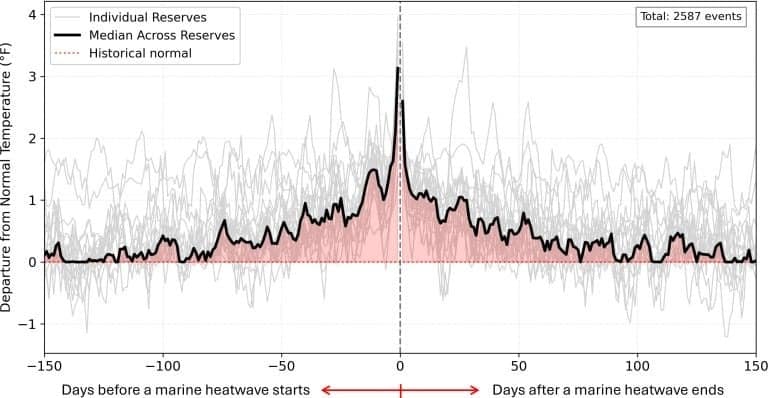
Эрдэмтэд далайн дулааны давлагаа нь албан ёсны хэмжигдэхүүнээс илүү урт хугацаанд үргэлжилж, эрэг орчмын экосистемд илүү их дулааны ачаалал үзүүлдэг болохыг илрүүлжээ.
William & Mary сургуулийн Виржиниагийн Далай судлалын хүрээлэн (VIMS) болон Batten-ы нэрэмжит Эрэг ба далай судлалын сургуулийн судлаачид АНУ-ын 20 эрэг орчмын усан сангийн сүүлийн 20 жилийн температурын мэдээлэлд дүн шинжилгээ хийжээ. Communications Earth & Environment сэтгүүлд нийтлэгдсэн уг судалгаагаар далайн дулааны давлагаа нь зөвхөн тодорхой хугацаанд үргэлжлээд зогсохгүй, түүний өмнө болон дараах дулаарлын үеүүдтэй хамт экосистемд хүчтэй нөлөөлдөг болохыг тогтоосон байна. Эрдэмтэд нийт 2,580 гаруй дулааны давлагааг судалсны үндсэн дээр дулааны нийт хуримтлалыг хэмжих шинэ аргачлалыг боловсруулжээ.
Судалгааны багийн ахлагч Рикардо Утциг Нардигийн тайлбарласнаар, өмнөх судалгаанууд зөвхөн албан ёсны дулааны давлагааны цонхыг авч үздэг байсан нь бодит байдлыг бүрэн дүүрэн илэрхийлдэггүй байв. Судлаачид дулааны давлагааг нарны илчинд удаан хугацаагаар өртөхтэй зүйрлэсэн бөгөөд далайн организмууд зөвхөн хамгийн өндөр температурт төдийгүй, дулаан нөхцөл хэр удаан үргэлжилж байгаагаас хамааран стресст ордог болохыг онцолжээ.
Судалгаагаар дулааны давлагааг хоёр ангилалд хуваасан байна. Үүнд ойролцоогоор 60 хоног үргэлжилдэг “бие даасан” давлагаа болон 90 орчим хоногийн турш дулаан нөхцөл дагалддаг “нийлмэл” давлагаанууд багтаж байгаа юм. Эдгээр нийлмэл үзэгдлийн үед экосистемд хуримтлагдах дулааны хэмжээ нь зөвхөн дулааны давлагааны үеийнхээс гурав дахин их байж болохыг тогтоожээ.
Энэхүү шинэ аргачлал нь далайн экосистемийн дулааны нөлөөллийг үнэлэхэд илүү нарийвчлалтай мэдээлэл өгөх боломжтой юм. Цаашид лабораторийн туршилтуудыг байгалийн бодит нөхцөлтэй нийцүүлэхэд энэхүү судалгааны үр дүн чухал ач холбогдолтой гэж судлаачид үзэж байна.
Дэлгэрэнгүйг эх сурвалжаас харах
↓Эх сурвалжийг нээх ↓
Marine heatwaves could be exposing coastal ecosystems to much more accumulated heat than scientists previously thought. A new study shows that the unusually warm conditions surrounding these events can continue for weeks or even months, extending the impact far beyond the official heatwave period.
Researchers from William & Mary’s Virginia Institute of Marine Science (VIMS) and the Batten School of Coastal & Marine Sciences looked at long-term temperature data from 20 U.S. estuaries to better understand how marine life experiences rising temperatures. Published in Communications Earth & Environment, the study introduces a new way of measuring heat exposure by looking not only at marine heatwaves themselves but also at the warmer periods that come before and after them.
Marine heatwaves are usually defined by specific temperature limits and clear start and end dates. But the researchers found that the water around these events often stays unusually warm even after the official heatwave has ended.
Heatwaves Last Longer Than Expected
Marine heatwaves do not always appear as isolated bursts of extreme temperatures. Instead, they are often part of much larger warming periods that continue beyond the dates scientists use to define them.
“We started to notice these warm-water anomalies on either side of marine heatwaves and realized that they’re actually embedded within larger periods of warm water,” explained lead author Ricardo Utzig Nardi. “It sounds obvious, but studies usually focus only on the marine heatwave window, and that’s not an accurate representation of real-world conditions.”
The researchers analyzed more than 2,580 marine heatwaves recorded over 20 years across 20 U.S. estuaries. They found that traditional measurements often miss a large part of the heat exposure because they only consider the official heatwave period.
As explained by the study team, these surrounding warm periods can add as much heat exposure as the marine heatwave itself, and sometimes even more.
“We can no longer look at marine heatwaves in isolation when assessing the impact of warming events on coastal and oceanic ecosystems,” said Piero Mazzini. “We must acknowledge the larger framework in which they exist, and this research provides a way to do just that.”
How Heat Builds Ecosystem Stress?
The researchers developed a method that measures the total heat experienced by ecosystems by combining the marine heatwave period with surrounding temperature anomalies. Ricardo Utzig Nardi explained the importance of cumulative exposure by comparing marine warming to time spent under sunlight.
“Consider spending time in the sun,” he said. “Your risk of sunburn depends on both sunlight intensity and how long you’re exposed to it. A few minutes may cause little harm, but hours of exposure can take a toll.”
The study indicates that marine organisms respond not only to the maximum temperature reached but also to the length of time those temperatures remain elevated. Longer exposure periods can create additional pressure, particularly when warmer conditions occur alongside other environmental stress factors.
The researchers also determined that the warm periods before and after marine heatwaves were largely independent of the heatwave events themselves. Because of this, measuring only the official heatwave window can leave out important parts of the temperature conditions experienced by ecosystems.
As reported by the Virginia Institute of Marine Science, the research relied on long-term temperature observations from NOAA’s National Estuarine Research Reserve System. These records allowed scientists to examine broader warming patterns that might not appear in shorter monitoring periods.
Marine Heatwaves Follow Two Patterns
The researchers identified two categories of marine heatwaves based on how long surrounding warming conditions lasted. Around two-thirds of the events were classified as “individual” heatwaves, meaning they occurred within a shorter period of elevated temperatures that extended beyond the official heatwave window by about 60 days.
The remaining events were classified as “compound” heatwaves because they developed within much longer warming periods. These episodes involved elevated temperatures lasting approximately 90 days before and after the marine heatwave, producing more than three times the cumulative heat exposure generated by the heatwave alone.
“As you can see, these are remarkably long periods of thermal exposure,” explained Mazzini. “Many laboratory experiments simulate marine heatwaves by increasing temperatures for a few days or weeks in total. Our findings demonstrate that while these experiments hold value, they often fail to capture the prolonged thermal exposure organisms experience in nature.”

The researchers said that accounting for longer warming periods can help scientists design experiments that better represent natural marine conditions. A broader measurement of heat exposure may also improve assessments of how ecosystems respond to prolonged temperature changes.
Enjoyed this article? Subscribe to our free newsletter for engaging stories, exclusive content, and the latest news.

