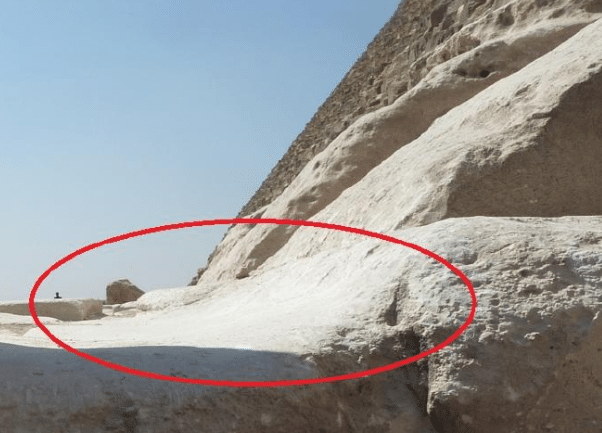
Италийн Болоньягийн их сургуулийн инженер Альберто Донини пирамидын гадаргуугийн элэгдэлд үндэслэн баригдсан хугацааг тодорхойлох шинэ судалгааг танилцууллаа.
Болонгийн их сургуулийн инженер Альберто Донини Гизагийн их пирамидын суурийн чулуунуудын элэгдлийн түвшинг харьцуулах замаар уг байгууламжийн насыг тогтоох туршилт хийжээ. Тэрээр “Харьцангуй элэгдлийн арга” (REM)-ыг ашиглан дундад зууны үе хүртэл элсэнд булаатай байсан чулуу болон баригдсан цагаасаа хойш агаарт ил байсан чулуунуудын элэгдлийн ялгааг хэмжсэн байна. 2026 оны нэгдүгээр сард нийтлэгдсэн урьдчилсан тайланд дурдсанаар, уг аргаар тооцоолсон дундаж хугацаа нь МЭӨ 22,941 он болон гарчээ.
Судалгааны үр дүнд пирамид МЭӨ 8,954-36,878 оны хооронд баригдсан байх 68.2 хувийн магадлалтай гэж дүгнэсэн нь уламжлалт түүхэн он цагаас эрс зөрж байна. Энэхүү таамаглалаар бол фараон Хүфү нь өөрөөс нь хамаагүй өмнө баригдсан байгууламжийг зүгээр л сэргээн засварлаж, өөрийн нэр дээр бүртгүүлсэн байх боломжтой юм. Гэсэн хэдий ч энэхүү тайлан нь одоогоор хөндлөнгийн шинжээчдийн хяналтад ороогүй бөгөөд зөвхөн магадлалын хүрээг тодорхойлсон судалгаа гэдгийг зохиогч нь онцолжээ.
Элэгдлийн загварчлалын гол хүндрэл нь шохойн чулууны элэгдэх хурдыг тогтмол гэж үзсэн таамаглалд оршиж байна. Египетийн уур амьсгал, тухайлбал “Африкийн чийглэг үе”-ийн хур тунадас, салхи болон бичил биетний нөлөөлөл нь чулууны элэгдэлд эрс өөрчлөлт оруулдаг тул үр дүнг нарийвчлалтай гэж үзэхэд учир дутагдалтай юм.
Египет судлаачид пирамидын насыг тогтоохдоо зөвхөн нэг аргад бус, харин археологийн олдвор, керамик эдлэл, нүүрстөрөгчийн шинжилгээ болон түүхэн бичээсүүдийг цогцоор нь авч үздэг. Оксфордын их сургуулийн эрдэмтэд Тутанхамуны булш болон бусад эртний байгууламжуудаас олдсон ургамлын үлдэгдэл, нүүрстөрөгчийн шинжилгээнд үндэслэн пирамидыг Хүфү хааны үетэй холбоотой болохыг баталдаг. Энэхүү аргачлал нь хүрээлэн буй орчны нөлөөнд бага өртдөг тул эрдэм шинжилгээний хувьд илүү найдвартайд тооцогддог байна.
Дэлгэрэнгүйг эх сурвалжаас харах
↓Эх сурвалжийг нээх ↓
The limestone foundation of the Great Pyramid of Giza remained hidden for almost all of its history. Thousands of years ago the polished casing stones that surrounded the core structure provided the Great Pyramid’s initial and original smooth surface. However, as time went by, many of these casing stones were removed from the site to be used for building purposes in Cairo. A 1303 Earthquake helped speed this removal process along.
The remaining casing stones were preserved due to one simple reason – they had been buried under sand before they could be removed from the site.
Using a combination of historical information (including a specific date when a portion of the Great Pyramid was uncovered) to develop a basis for his research experiment, University of Bologna Engineer Alberto Donini developed a plan to determine the age of some surfaces within the Great Pyramid based upon the amount of erosion each surface would have experienced since being uncovered in 1303, and comparing that number to the amount of erosion each surface may experience if exposed since the construction of the Great Pyramid.
What the Erosion Model Found
In January 2026, Donini uploaded a report to ResearchGate based on measurements of surface loss across twelve points along the pyramid’s base. His approach, called the Relative Erosion Method (REM), compares two neighboring kinds of surface: stone protected by casing until the medieval period and stone exposed to the atmosphere since construction.
The results were enormous. The model produced exposure durations ranging from 5,700 to more than 54,000 years, with a mean estimated construction date of 22,941 BC.
A statistical confidence interval puts the probable range between 8,954 BC and 36,878 BC. Donini concluded there was a 68.2 percent chance the pyramid was built somewhere inside that span, far outside the conventional date of around 2560 BC, and the report presents as plausible the idea that pharaoh Khufu merely renovated a much older structure and attributed its construction to himself.
Donini is explicit about the method’s limits. REM does not provide a definitive date. Instead, it establishes a probabilistic window, described in the study as a tool for estimating the order of magnitude of exposure rather than an exact chronology. The report has not been peer reviewed.
Where the Method Runs Into Trouble
At the heart of REM is a difficult assumption: that limestone weathers at a steady, predictable rate. Egypt’s climate has changed significantly over the millennia, particularly during the African Humid Period, when rainfall was substantially higher than it is today.
More humidity during those periods could have sped up the degradation of exposed stone surfaces.

And rainfall is only part of the problem. Wind exposure, periods of sand burial, and microbial activity muddy the picture further, while the surge in tourism at the pyramid over recent centuries also contributes to its physical deterioration. The method assumes, too, that the composition and condition of the surfaces being compared are equivalent. That has not been independently verified.
What Established Dating Shows
Mainstream Egyptology does not depend on one method to pin down the pyramid’s age. Egyptologist and archaeologist Mark Lehner explained to PBS that the pyramids are dated primarily through their place in the long development of Egyptian architecture and material culture over roughly 3,000 years.
Pottery found at Giza matches the ceramic styles of the reigns of Khufu, Khafre, and Menkaure.
Radiocarbon dating points to the same timeframe. Thomas Higham, then of the School of Archaeology at the University of Oxford, described to the BBC how researchers used seeds from Tutankhamun’s precisely dated tomb and plant material from beneath the Saqqara step pyramid, tied to a specific year of King Djoser’s reign, to calibrate the dating of Egyptian monuments. Inscriptions in nearby tombs and quarries attribute the project to Khufu. They line up with records from Egypt’s Fourth Dynasty.
Those approaches are less exposed to the sort of environmental variability that complicates erosion-based models. A shift in ancient rainfall patterns would not change a radiocarbon date derived from charcoal in construction mortar.
Enjoyed this article? Subscribe to our free newsletter for engaging stories, exclusive content, and the latest news.

