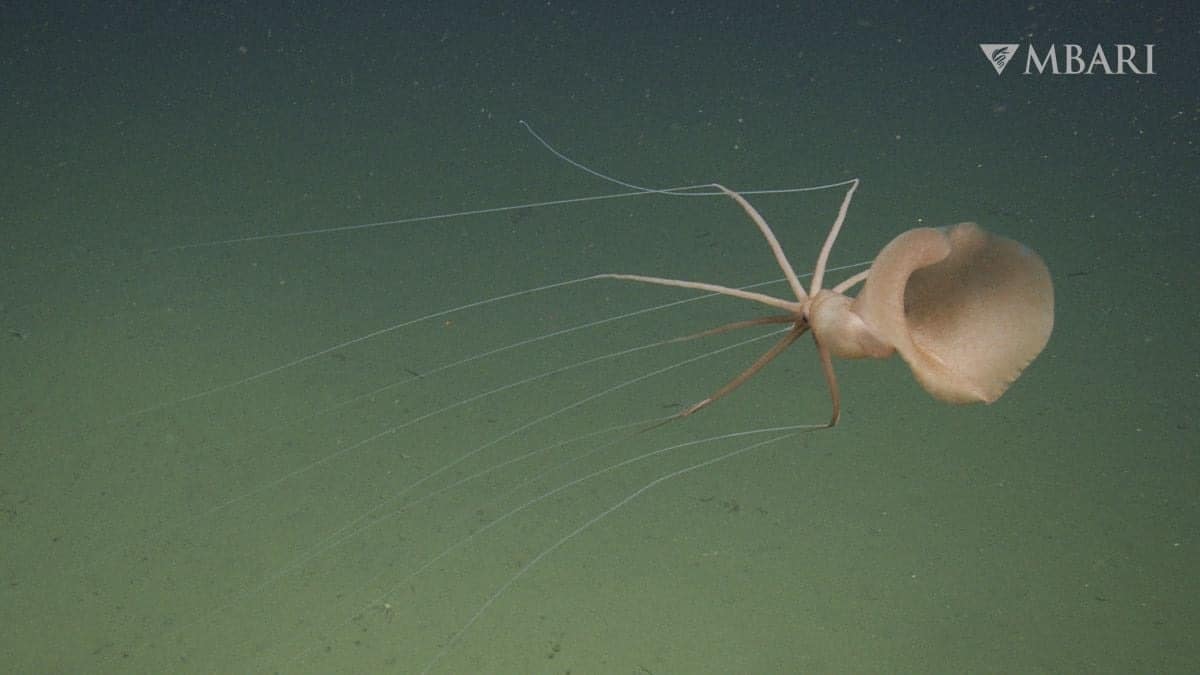
Монтерейн булангийн аквариумын судалгааны хүрээлэнгийн эрдэмтэд Калифорнийн эрэг орчмын далайн гүнээс нэн ховор төрлийн наймаалжийг илрүүлэн судалсан байна.
Калифорнийн төв эрэг орчмын Дэвидсон далайн уулын ойролцоо судалгаа хийж байсан MBARI хүрээлэнгийн судлаачид 3,277 метрийн гүнээс Magnapinna төрлийн наймаалжийг олж илрүүлжээ. Энэхүү амьтныг Doc Ricketts алсын удирдлагатай хөлгөөр ажигласан бөгөөд Хойд Номхон далайн бүсэд хийсэн анхны албан ёсны баримтжуулалт болсон юм. Уг наймаалж нь биеийн урт болон тэмтрүүлүүдээ оролцуулан ойролцоогоор 1.25 метр хэмжээтэй байв.
Magnapinna төрлийн наймаалж нь маш урт, нарийн тэмтрүүлүүдтэй бөгөөд тэдгээрээ тохой мэт нугалж чаддаг өвөрмөц бүтэцтэй. Эрдэмтэн Оливия Соарес Перейрагийн тайлбарласнаар, уг амьтан тэмтрүүлүүдээ биедээ перпендикуляр байрлуулж, “тохой” хэлбэрт оруулах нь хоол тэжээлээ идэвхгүй аргаар барихад зориулагдсан байж болзошгүй гэсэн таамаг дэвшүүлж байна. Гэсэн хэдий ч энэ төрлийн наймаалжийн хооллолт, нөхөн үржихүй болон популяцийн талаарх мэдээлэл одоогоор тун хомс хэвээр байна.
Дэлхийн далай тэнгисийн гүнд маш цөөн тохиолддог тул Magnapinna-г ховор амьтдын тоонд оруулдаг. Судалгааны багийнхан энэ амьтан үнэхээр цөөн тоотой юу, эсвэл далайн уудам орон зайд олж харахад хүндрэлтэй байдаг уу гэдгийг тогтооход одоогоор бэрхшээлтэй байгааг онцолжээ. Энэхүү ажиглалт нь далайн гүний экосистемийн олон янз байдлыг ойлгоход чухал ач холбогдолтой юм.
Дэлгэрэнгүйг эх сурвалжаас харах
↓Эх сурвалжийг нээх ↓
A rare bigfin squid has been recorded nearly 3,300 meters beneath the Pacific Ocean, offering scientists an unusual glimpse of one of the deep sea’s most mysterious animals. The encounter, filmed by researchers from the Monterey Bay Aquarium Research Institute (MBARI), captured the strange movements of a creature known for its enormous fins and extremely long, delicate appendages.
Living in the permanent darkness of the deep ocean, Magnapinna, commonly known as the bigfin squid, remains one of the least understood cephalopods on Earth. Fewer than 70 individuals have ever been observed or collected worldwide.
During an expedition near Davidson Seamount, an underwater mountain off the coast of Central California, researchers unexpectedly encountered the unusual squid. The team was not searching for a bigfin squid, but the observation provided valuable information about a species rarely seen alive in its natural environment.
A First Confirmed Observation In The Northeastern Pacific
According to ScienceAlert, MBARI scientists documented the encounter on 7 August while using the remotely operated vehicle Doc Ricketts to explore the deep seafloor near Davidson Seamount. The squid was observed at a depth of 3,277 meters (10,751 feet), hovering above the muddy bottom while its large fins moved slowly through the water. The animal displayed the unusual characteristics that have made Magnapinna famous among deep-sea researchers. Its two enormous fins extended from a relatively small body, while its eight arms and two tentacles stretched downward in long, thin filaments.
Using the ROV’s laser measuring system, scientists estimated that the squid measured approximately 1.25 meters from the top of its body to the ends of its arms. The observation marked the first confirmed sighting of this elusive creature in the Northeastern Pacific Ocean. For MBARI deep-sea ecologist Olívia Soares Pereira, the first moments of the encounter were difficult to interpret.
“At first, I could only see the tips of what looked like fine tentacles, so I thought it was a jelly, but when the ‘elbows’ showed up on the screen, I knew this was something really special,” stated Pereira.
The researcher explained that the squid stands apart from other deep-sea species because of the unusual structure of its arms and tentacles.
“Magnapinna is one of the few, if not the only, deep-sea squid with such fine, long arms and tentacles that can bend like that.”
Why the Bigfin Squid Looks So Unusual?
Beyond its size and appearance, the bigfin squid’s behavior is what continues to intrigue scientists. The animal is known for positioning its long appendages almost perpendicular to its body before bending them sharply, creating what researchers call the “elbow” pose.
The purpose of this posture remains uncertain. Scientists believe it could be linked to feeding because the extended arms and tentacles may allow the squid to passively capture prey in the deep ocean environment.
“There is actually so little that we know about bigfin squid,” Soares Pereira said.

Researchers still lack basic information about the species, including what it eats, how it captures prey, and how it reproduces. Even its population remains difficult to evaluate because sightings are scattered across enormous areas of the ocean.
The species has been recorded at extreme depths, including one observation at 6,212 meters, nearly four miles below the ocean surface. These encounters have shown scientists that bigfin squid are among the deepest-dwelling squid known.
A Rare Creature With A Potentially Vast Ocean Range
Across the Atlantic, Pacific, and Indian oceans, bigfin squid sightings have been recorded in several regions, including near Australia, Hawai’i, the Philippines, Micronesia, and the Cook Islands. Although encounters remain uncommon, the available observations indicate that Magnapinna may inhabit a much wider area than the number of sightings suggests.
The recent global analysis of Magnapinna records cited in the report said that suitable habitat for the squid could cover up to 62% of the world’s ocean area and 70% of its volume. However, scientists still cannot determine whether the animal is naturally rare or simply difficult to find in such a vast underwater environment.
“These scattered sightings make me believe they might be genuinely rare,” Pereira said. “But in a space so big as the global ocean, I think it’s hard for us to say for sure if they are genuinely rare or instead rarely encountered, or perhaps even a combination of both. That is why these encounters are always so special!”
Such observations reinforce just how valuable locations like Davidson Seamount are, given that the deep-sea habitats there support a broad diversity of species. The seamount has long been recognized for its ancient coral gardens as well as a deep-sea octopus breeding ground.
Enjoyed this article? Subscribe to our free newsletter for engaging stories, exclusive content, and the latest news.

