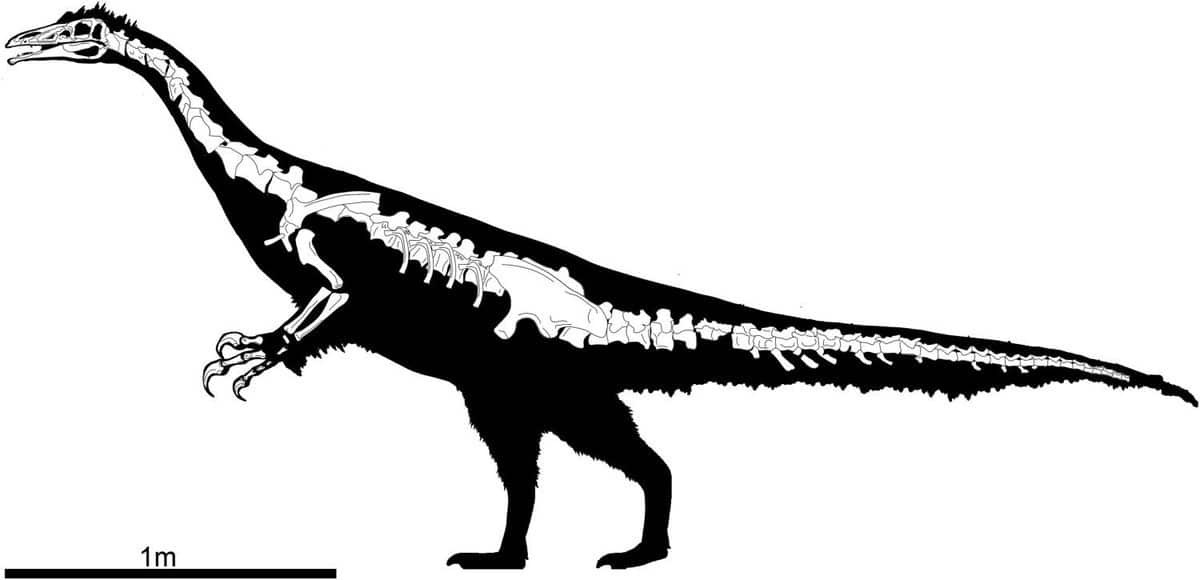
Палеонтологчид өвөрмөц бүтэцтэй, ургамлаар хооллодог үлэг гүрвэлийн шинэ зүйл болох Kayrasaurus changliensis-ийг илрүүлжээ.
Хятадын Шинжлэх ухааны академийн Вертебрат палеонтологи ба палеоантропологийн хүрээлэн болон Юньнаний их сургуулийн судлаачид Хятадын баруун хэсэгт орших Ляонин мужийн Ишиан тогтоцоос уг олдворыг малтан гаргажээ. Жэхо бүс нутгаас олдсон теризинозаврын төрлийн үлэг гүрвэлүүдээс хамгийн томд тооцогдох энэхүү олдвор нь гавлын яс бүрэн бүтэн хадгалагдсанаараа шинжлэх ухааны өндөр ач холбогдолтой юм. Судлаачдын тогтоосноор уг үлэг гүрвэл нь 3.6 гаруй метр урттай, 117-274 кг жинтэй байсан бөгөөд олдвор нь бүрэн нас бие гүйцээгүй бодгаль байж болзошгүй байна.
Kayrasaurus changliensis нь жижиг толгой, урт хүзүү, навч хэлбэрийн шүд болон том хэмжээний сарвуу зэрэг ер бусын шинж чанаруудыг өөртөө агуулдаг. Ялангуяа доод эрүүндээ 45 гаруй шүдтэй байгаа нь теризинозавруудын дунд хамгийн өндөр үзүүлэлт бөгөөд хүзүүний нугалам нь нурууны нугаламаасаа урт байгаа нь түүнийг газрын ургамлаас илүү өндөрт байрлах ургамлаар хооллодог байсныг илтгэж байна. Мөн сарвууны бүтцэд нь бусад төрөл зүйлд ховор тохиолддог дээш чиглэсэн ирмэг бүхий онцлог шинж ажиглагджээ.
Journal of Systematic Palaeontology сэтгүүлд нийтлэгдсэн судалгаагаар уг үлэг гүрвэл нь Жэхо бүс нутагт амьдарч байсан теризинозавруудын экологийн хоёр өөр стратегийг илэрхийлж байна. Kayrasaurus болон Beipiaosaurus нь илүү бадриун бие бялдартай, хүчтэй хазах чадвартай байсан бол Jianchangosaurus болон Lingyuanosaurus нь хурд, шаламгай байдалдаа түшиглэсэн амьдралын хэв маягтай байжээ. Гэсэн хэдий ч судлаачид эдгээр дүгнэлтийг одоогоор урьдчилсан таамаглал гэж үзэж байгаа бөгөөд илүү бүрэн гүйцэд олдворууд олдсоны дараа л эдгээр үлэг гүрвэлүүдийн амьдрах орчны хуваарилалтын талаар эцсийн дүгнэлт хийх боломжтой юм.
Дэлгэрэнгүйг эх сурвалжаас харах
↓Эх сурвалжийг нээх ↓
Paleontologists have unveiled a newly identified species of therizinosaur, a bizarre plant-eating dinosaur group known for its oversized claws, unearthed from a fossil-rich region in northeastern China. Named Kayrasaurus changliensis, the dinosaur is now recognized as the largest therizinosaurian ever recovered from the Jehol Biota, one of the world’s richest sources of feathered dinosaur fossils.
Therizinosaurs occupy an odd place within the theropod family tree, the same broad lineage that produced Tyrannosaurus rex, yet many of them abandoned meat-eating altogether in favor of plants or a mixed diet. Their skeletons combine features that seem almost contradictory: small heads, long necks, leaf-shaped teeth, and enormous hand claws attached to what is otherwise a fairly typical predatory dinosaur frame.
According to the researchers, led by Dr. Xing Xu of the Institute of Vertebrate Paleontology and Paleoanthropology at the Chinese Academy of Sciences and Yunnan University, this strange mix of traits has made classifying the group notoriously difficult over the years.
A Skeleton That Fills in the Gaps
The fossil was recovered from the Yixian Formation in western Liaoning province, a geological layer that forms part of the broader Jehol Biota and has already yielded numerous feathered dinosaur specimens over the decades.
The full findings published in the Journal of Systematic Palaeontology, stated that what makes this find particularly valuable is its completeness. The specimen’s skeleton includes a largely intact skull, a rarity for therizinosaurs, whose remains are often fragmentary. Researchers estimate the individual measured more than 3.6 meters (about 11 feet) in length, at least 1.6 times longer than Beipiaosaurus, previously the largest known therizinosaur from Jehol.
Its estimated body mass ranges from roughly 117 to 274 kg (260 to 600 pounds). The specimen is believed to have been a subadult, meaning a fully mature individual could have grown even larger than these figures suggest.
The Feature That Set This Species Apart
Beyond its size, Kayrasaurus changliensis stands out for a few unusual anatomical quirks. Its jaws housed an unusually dense set of small teeth, more than 45 in the lower jaw alone, the highest count recorded for any known therizinosaur. Its neck vertebrae were also longer than those found in its back, a proportion that hints at feeding habits suited to browsing rather than grazing at ground level.

One of its hand claws, meanwhile, carried a distinctive upward-projecting “lip,” a feature not typically seen in related species. These traits, as the study’s authors describe them:
“As the largest therizinosaurian yet known from the Jehol Biota, Kayrasaurus changliensis bridges morphological gaps between previously described taxa.”
Two Different Ways of Life
Perhaps the most intriguing part of the study is its comparison between Kayrasaurus changliensis and three other Jehol therizinosaurs, Beipiaosaurus, Jianchangosaurus, and Lingyuanosaurus. The analysis found that Kayrasaurus and Beipiaosaurus shared sturdier, heavier-set bodies along with jaws built for stronger bites, while Jianchangosaurus and Lingyuanosaurus appear more lightly built, with skeletal features suggesting greater speed and agility. As the paper’s authors put it:
“The integration of morphological, biomechanical and body size data suggests the presence of at least two distinct ecological strategies among Jehol therizinosaurians: one favoring oral processing and robust body builds, and the other emphasizing agility,”

They’re careful to flag this interpretation as provisional, however, stressing that more complete fossils will be needed before firmer conclusions can be drawn about how these dinosaurs divided up their shared environment.
Enjoyed this article? Subscribe to our free newsletter for engaging stories, exclusive content, and the latest news.

