Америкийн иргэний дайны үеийн Белмонтын тулалдаан нь цэргийн тактикийн хувьд тодорхойгүй үр дүнтэй байсан хэдий ч Холбооны армийн цаашдын стратегийн амжилтад чухал нөлөө үзүүлсэн юм.
Белмонтын тулалдаан нь эцэстээ тодорхойгүй үр дүнтэй гэж үнэлэгддэг. Учир нь Холбооны армийн генерал Улисс С. Грант өөрийн довтолсон Холбоотон улсуудын (Confederate) байрлалыг эзлэн авч чадаагүй бол, нөгөө талаас Гидеон Ж. Пиллоугийн удирдсан хүчин Грантыг болон түүний цэргийг олзлон авч чадаагүй юм. Холбоотон улсууд Холбооны армийг талбараас зугтаасан хэмээн үзэж үүнийг өөрсдийн ялалт хэмээн зарлажээ. Гэсэн хэдий ч Грант өөрийн тавьсан хоёр зорилго болох Кентакки мужийн Колумбус хотын доор байрлах Холбоотон улсуудын хуаранг устгах, мөн генерал Полкийг бусад байрлалаа бэхжүүлэх боломжгүй болгож, хүчээ Колумбус хотод төвлөрүүлэхэд хүргэх гэсэн зорилгодоо хүрсэн тул үүнийг Холбооны талын ялалт гэж үзэх нь илүү үндэслэлтэй юм.
Тулалдааны дараа Полк Белмонтыг Грантын Колумбусыг эзлэх анхны оролдлого гэж эмээсэндээ бусад байрлал руу нэмэлт хүч илгээхээс татгалзсан нь Альберт Сидни Жонстоны Хенри болон Донелсон цайз дахь хамгаалалтын шугамыг сулруулахад хүргэжээ. Энэ нь хожим 1862 оны хоёрдугаар сарын 6-нд болсон Форт Хенрийн тулалдаан болон 1862 оны хоёрдугаар сарын 11-16-ны хооронд болсон Форт Донелсоны тулалдаанд Грантын ялалт байгуулахад нөлөөлсөн юм. Эдгээр ялалт нь Теннесси болон Камберленд мөрнийг Холбооны армийн хяналтад оруулж, Нэшвилл хот дахь Холбоотон улсуудын аж үйлдвэрийн төв унахад хүргэж, эцэст нь Полкийг Колумбусаас ухрахаас өөр аргагүй болгосон билээ. Ийнхүү 1861 оны арваннэгдүгээр сарын эхээр болсон Белмонтын тулалдаан нь бодит байдал дээр Холбооны талын ялалт байсан гэж дүгнэж болно.
Энэхүү тулалдаанд оролцогчдын нэг нь 1861 оны зургадугаар сард сайн дураараа цэрэгт элсэж, Алабамагийн 10-р хорооны K компанийг өөрийн зардлаар тоноглосон Бенжамин Франклин Сойер (1833-1901) байв. Тэрээр Белмонтоос эхлэн дайн дуустал тулалдаанд оролцож, 1865 онд дэд хурандаа цолтойгоор цэргийн албанаас халагдсан юм. Дайны дараа тэрээр Алабама мужийн Оксанна хотын захирагчаар ажиллаж, сэтгүүлч, зохиолчийн хувиар “Philadelphia Weekly Times” зэрэг хэд хэдэн сонинд ажиллаж байв. Сойер 1879 онд Маргарет Э. Найтын зохион бүтээсэн цаасан уутны машиныг сайжруулж байсан бөгөөд 1901 оны долдугаар сарын 19-нд таалал төгсжээ. Түүний 1884 онд хэвлүүлсэн Белмонтын тулалдааны тухай дурсамж нь Холбоотон улсуудын энгийн цэргийн үүднээс бичигдсэн чухал анхдагч эх сурвалж юм.
Сойерын дурсамжид тэмдэглэснээр, Грант 11 дүгээр сарын 6-нд Иллинойс мужийн Кайро хотоос хөлөг онгоцнуудтайгаа хөдөлж, 7-ны өглөө Миссури мужийн Белмонтод хүрэлцэн ирснээр тулалдаан эхэлжээ.
Тэрээр тулалдааныг “дайнд анх удаа хөл тавьсан хүмүүсийн хувьд мартагдашгүй үйл явдал” хэмээн тодорхойлж, 10,000 орчим хүн анх удаа үхэлтэй нүүр тулсан гэж бичжээ. Сойерын үзэж буйгаар тулалдаан нь цэргийн стратегийн хувьд ямар ч ач холбогдолгүй, ердөө л цэргүүдийн ур чадварыг сорих зорилготой “хоосон тоглоом” мэт байв. Тэрээр Грант болон Пиллоу нарын аль аль нь ямар ч стратеги боловсруулаагүй гэж үзсэн бөгөөд Колумбусын бэхлэлтүүдээс хамгаалагдсан байрлалыг эзлэх нь ямар ч үр дүнгүй байсныг тэмдэглэжээ.
Тулалдааны үеэр Холбоотон улсуудын хуаранд үүссэн самууныг Сойер тод дүрсэлсэн байдаг. Тэдний хороо янз бүрийн зэвсэгтэй байсан тул сумны хангамж, хуваарилалт маш эмх замбараагүй байжээ. Гэсэн хэдий ч тулалдаан эхлэхэд тэд эгнээгээ эмхэлж, Пиллоугийн цэргүүд дайсанд шахагдаж эхлэхэд тэдний тусламжаар яаралтай хөдөлгөөнд орсон байна. Сойерын хороо гол руу хөдөлж, усан онгоцон дээрээс тулалдааны талбарыг харахад Пиллоугийн цэргүүд ялагдаж, майхнууд нь шатаж байсан нь тэднийг сэтгэл зүйн хувьд хүнд байдалд оруулжээ.
Гэвч тэд газар дээр буунгуут “Dixie” дууг эгшиглүүлэн дайралтад орж, Колумбусын бэхлэлтүүдээс ирсэн их бууны дэмжлэгтэйгээр Холбооны армийг ухрааж чадсан юм. Холбооны цэргүүд эмх замбараагүйгээр зугтаж, зэвсэг хэрэгслээ хаясан бөгөөд Холбоотон улсууд тэднийг хөөж, усан онгоц руу нь буцаасан байна. Тулалдааны дараа Сойерын хороо олз олж, 10 цагийн орчимд хуарандаа эргэн иржээ. Маргааш нь тэд шархадсан хүмүүсээ асарч, нас барагсдаа оршуулах ажлыг Грантын хүсэлтээр байгуулсан түр эвлэрлийн хүрээнд хамтран гүйцэтгэсэн юм. Энэхүү үйл явдал нь хэдэн сарын да
Дэлгэрэнгүйг эх сурвалжаас харах
↓Эх сурвалжийг нээх ↓
The battle is considered inconclusive, as Grant failed to take and hold the Confederate position he had attacked, and the forces under Pillow failed to capture Grant and his forces. The Confederates claimed it as a victory because the Union army fled the field in a rout.
Grant also claimed victory, however, because he had achieved his two objectives: destroy the Confederate camp below Columbus, Kentucky, and frighten Polk into keeping his forces close in the city instead of reinforcing other positions. Grant’s claim carries more weight.
After the battle, Polk, afraid that Belmont was only Grant’s first attempt to take Columbus, refused to send reinforcements elsewhere, contributing to the weakened center of Confederate General Albert Sidney Johnston‘s defensive line at forts Henry and Donelson.
This, then, contributed to the Union victories under Grant at the Battle of Fort Henry (6 February 1862) and the Battle of Fort Donelson (11-16 February 1862), which opened the Tennessee River and Cumberland River to Union traffic, led to the fall of the Confederate industrial center at Nashville and, eventually, to Polk’s withdrawal from Columbus. Seen in this light, the Battle of Belmont was, indeed, a Union victory, even if it hardly seemed so in early November 1861.
One of the Confederate defenders at Belmont was then-private Benjamin Franklin Sawyer (1833-1901), who had enlisted in June 1861, raising and equipping Company K, Tenth Alabama, at his own expense. Sawyer would participate in battles from Belmont on throughout the war, leaving service in 1865 as a lieutenant colonel.
Sawyer’s account of the Battle of Belmont is given from a Confederate private’s perspective.
After the war, he served as mayor of the town of Oxanna in Anniston, Alabama, and became an author and journalist, editing and contributing to several newspapers, including the Philadelphia Weekly Times. In 1879, he improved upon the machine invented by Margaret E. Knight (patented in 1871) for the manufacture of square-bottomed paper bags and died after an illness on 19 July 1901.
Like many of his contemporaries who had fought in the American Civil War, Sawyer also wrote about his combat experiences and, in 1884, published his account of the Battle of Belmont, which has since become a significant primary source on the engagement – especially so as the narrative is given from a Confederate private’s perspective.
The following excerpt is taken from The New Annals of the Civil War, edited by Peter Cozzens and Robert I. Gerardi, pp. 18-24. The original article, The Battle of Belmont, by Colonel Benjamin Franklin Sawyer, was first published in the Philadelphia Weekly Times, 9 August 1884. Ellipses indicate text omitted for considerations of space and word count.
Sawyer gives the date of the beginning of the engagement as 6 November – which was when Grant left Cairo, Illinois, with his gunboats and arrived off Belmont, Missouri – the battle began on the morning of the 7th.
In the combats that followed in such rapid succession, electrifying the continent and astounding the world, the comparatively insignificant battle of Belmont was forgotten. In the roll of mightier events, it is hardly to be counted in the lists of battles. It is only to those who were engaged, the beginners who were that day matriculated in war, that its scenes were made memorable as long as life shall last.
Some ten thousand men were, for the first time, brought face to face with danger and with death; for the first time realized the horrible work to which they had dedicated their lives. It is not likely that one of those, so engaged, will ever forget the experience of that day.
In itself, so far as any material results were effected, the battle was almost a sham, a tactical exercise gotten up by the opposing generals to test the efficiency and pluck of their troops. Perhaps it was; it seems difficult now, as it did then, hard as one may try, to conceive any other reason why it should have been fought.
There was no strategy displayed by either general; there was no chance for any. [Brigadier General Gideon J.] Pillow’s outlying camps on the Missouri side of the river were too well protected by the over-ranging batteries of Columbus to permit their occupation, if once captured. This [Brigadier General Ulysses S.] Grant must have known, for he had come down under a flag of truce a few days before and taken in the possibilities of the situation.
The position being untenable, why sacrifice the life of even one man to capture it? Surely it was not for the triumph of capturing a few straggling tents, the only possible damage that could be inflicted, that he came down in all the pomp and circumstance of war, with drums beating and banners flying, to hazard the die of battle. The game was hardly worth the candle.
But perhaps Grant thought better. He may have attached a more important value to canvas and straw than did the extravagant Confederates. Doubtless he did and, as he stood on the deck of the saucy little tug (the Grampus) that brought him in the Confederate lines a few days before…he may, in the inspiration of his genius, have evolved a brilliant strategic movement whereby the destruction of the tents might be compassed.
At any rate, he came in a martial array, with a fizz and a flourish, putting his brave troops in the heart of the battle, holding them there for a while, and then turning in utter abandonment of all order and discipline and, scurrying back to his gunboats, leaving his dead to be buried and his wounded to be cared for by his enemy.
[Major General Leonidas] Polk’s Corps, constituting the then Army of the Mississippi, was occupying the strong position of Columbus, Kentucky. Its naturally strong points were further strengthened by a series of skillfully designed and well-constructed forts, connected by a triple line of earthworks.
The beetling bluffs that overlooked the town below, the river and the plains of Belmont opposite, were crowned with heavy batteries, while a tier of casemented guns below raked every foot of water in sight and made its water approach impossible.
The camp, which so temptingly invited the assault of the enemy, was occupied by General Pillow’s Brigade…it was against this camp, protected by the formidable batteries of Columbus, that Grant, then a newly fledged and curly brigadier, hurled his eager troops.
It was a sharp frosty morning in November (the sixth). We were still busied in strengthening our works and constructing quarters for the coming winter when he came.
Our regiment (the Blythe Mississippi) had started out on fatigue duty, when we were met by our comrades of the 154th Senior Tennessee coming in at a double-quick and giving us the first intimation of the approaching danger. I happened to be in command of the fatigue party for that day and, without waiting for orders, I about-faced my command and started back to camp, also at a double-quick.
We had proceeded but a short distance before we were met by a courier confirming the news and ordering me to hurry back to quarters and prepare for battle.
Arriving at camp, a wild scene of excitement and confusion was presented. Officers flurried with the new and strange perturbations were hurrying to and fro, awkwardly dangling their swords between their legs; men hunting up mislaid accoutrements and burnishing too-long neglected guns; ordnance officers confusedly distributing ammunition, issuing Enfield cartridges for muskets, ball and buckshot for rifles.
For be it known, at that early stage of the conflict, our regiment, as were many others, was armed with an incongruous variety of guns, no two companies being armed alike – one company, A, having Sharp’s rifles, another, Company C, being armed with double-barreled shotguns, and still another, my own, Company I, having long-barreled rifles, caliber .32, while the others were armed with old picked up army muskets.
To supply the diverse needs of the regiment would have puzzled a general of ordnance himself in an hour of cool deliberation. No wonder, then, that poor Lieutenant Brownrigg, flushed with the surprise of his maiden fight, lost his head in frantic confusion and handed out the ammunition in reckless disregard of service.
The company commanders, however, were not so flurried and, by swapping around, soon managed to supply their respective companies with suitable cartridges, and when the regiment was formed for hasty inspection, each man was found amply served with ball and powder for the emergency. The morning’s lesson was a valuable one, however, and care was taken, as soon thereafter as possible, to arm the regiment with guns of uniform caliber.
We had formed our lines and were resting on our arms, nervously awaiting developments, when the booming of Belthoover’s guns and a desultory popping of musketry far across the river told that it was no false alarm we had to meet. Soon, the firing became more rapid and distinct as the battle drew nearer. We could tell by the shifting direction of the firing that Pillow was hotly engaged and getting pushed, yet still we remained idle, impatiently waiting orders to move forward to the fight.
There is hardly any position more trying to one’s nerves, and especially the nerves of a raw recruit, than to stand in sight and sound of a battle waiting one’s turn to be put into it. We felt it keenly that morning and, when the first enthusiasm of excitement began to wear off, and the battle roared louder and nearer, we could feel our valor oozing out, as it were, at our fingers’ ends; but still we had to stand and no orders came, but instead the rumor that the main Union army, under [Brigadier General Charles F.] Smith, was advancing from Paducah and the attack on Pillow was only a feint to divert Polk’s attention to that point.
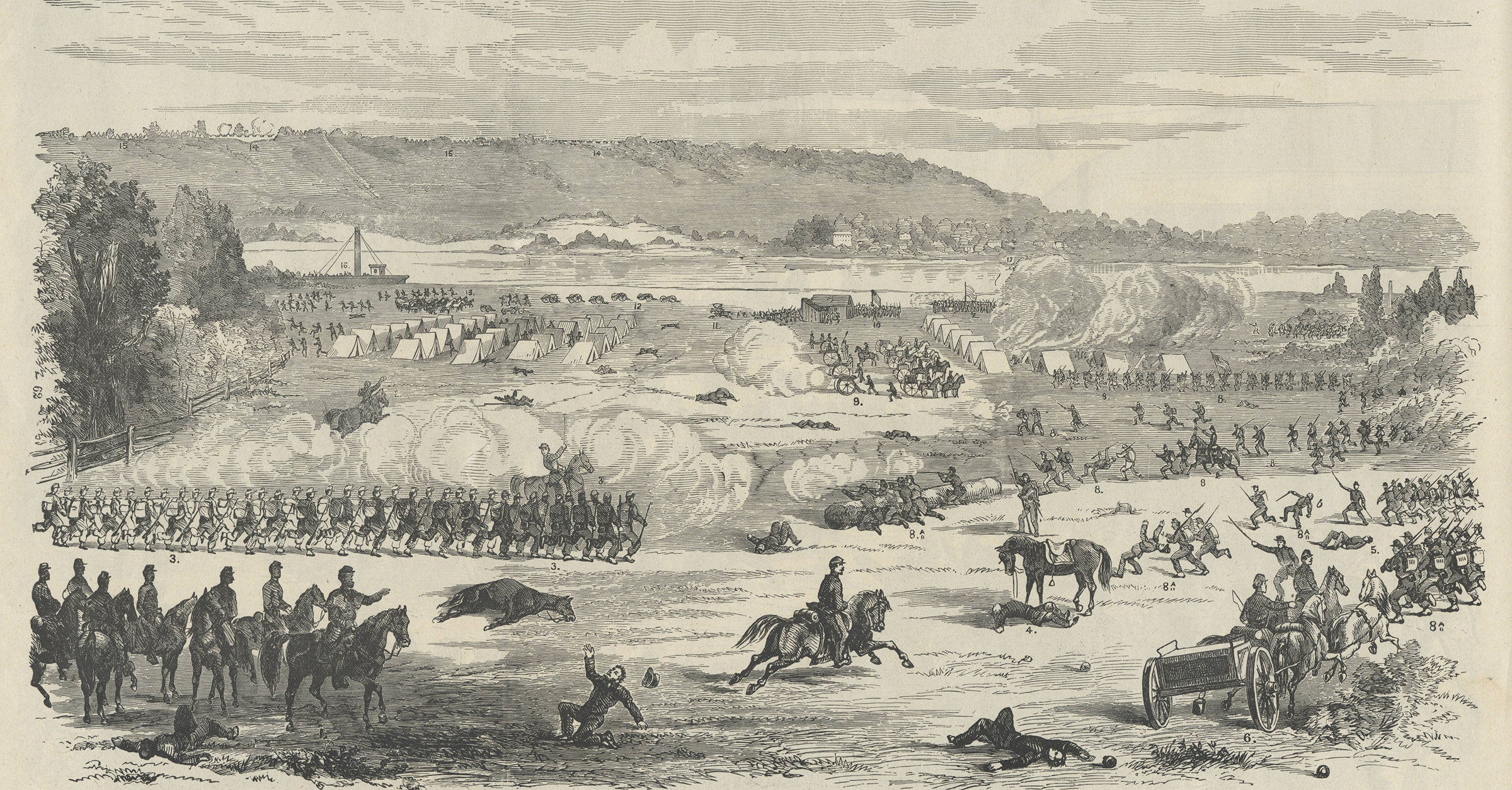
At length, however, toward noon, the pressure upon Pillow became too heavy to be longer withstood…At a double-quick we started and were marched to the river, reaching the overlooking bank in time to see Pillow’s hard-fought troops broken in disorder, his battery captured and turned upon him, and his camps in a blaze of destruction.
It was not an encouraging sight to beginners, but we had little time to contemplate it, for, having caught our range, as in close column we crowded down to the landing, Belthoover’s captured guns were turned upon us, chilling us to the marrow with a nameless dread. A more demoralizing position I do not remember in my four-years’ experience of battle. I shudder even now to think of it.
Two transports, large side-wheel steamers, lay at the wharf ready for us. Aboard one of these, the Prince, we hurriedly embarked and, in the face of the fire, crossed over, four solid shots crashing through the boat during the transit, carrying away the cabin steps, but happily doing no other damage.
Company G, Captain Faulkner, with my own Company I, was crowded upon the hurricane deck, which elevated position, while exposing us to an unpleasant share of the enemy’s attention, gave us a comparative view of the field. It was a sad and discouraging sight we saw.
Pillow’s men, powder-begrimed and bleeding, were utterly demoralized, cowering under the river’s sheltering bank like gangs of hogs that had been badgered by dogs in a cornfield, his tents all aflame and an exultant enemy defiantly daring us on.
In an incredibly short time, the landing was effected and we as quickly debarked; the band bravely trying to enthuse our flagging spirits by striking up Dixie. Forming in line of battle as we landed, and hurriedly loading, we were ready for action.
The gallant Cheatham was there ready to lead us. “Men, forward, and give them the devil!” was his curt command, and forward we moved.
Mounting the bank under which we had formed, and by an oblique movement to avoid the impenetrable brush of fallen timber, we struck the exultant enemy on his right flank, delivering an unexpected fire.
At this moment, as if just awakened from a paralysis of fright, the heavy batteries on the bluff of Columbus opened a well-directed fire of shot and shell, dealing death and carrying consternation in the opposing ranks. It is surprising to see the magic transition from defeat to victory, from a deliberate courage to a demoralized cowardice. All men are subject to the weakness.
It is no derogation then to the bravery of the gallant Illinois troops, who had fought so hard all morning and, but an instant before, stood willed with the proud sense of victory, that they should now stand for a moment in seeming wonder at our sudden onslaught and then begin to give back – at first slowly and in order and then the retreat became a run and from a run it broke into a disorderly rout. Guns were thrown away, bayonets, cartridge boxes, and even haversacks, and all order was forgotten in the wild race for life.
With little less demoralization, we followed after, helter-skelter, over fields and through woods, loading and firing as we ran, every now and then bringing down a poor fellow with a cruelty little less than murder. The whole affair was so different from our preconceived ideas of a battle that we could hardly realize its tragic actuality. The pursuit was as disorderly and inglorious as was the flight. Had we no officers, and had each man been filled with liquor, we could scarcely have made a wilder, more reckless, undisciplined mob than we were.
Had General Grant held one single company cool in hand, he could have captured every man of the two regiments that followed him through that Missouri swamp to his gunboats, six miles away. But he had no such company; his entire army fled before that straggling rabble, not even stopping to throw out a skirmish line to protect the embarkation of his fugitive troops, but hurried about his transports pell-mell and the devil take the hindmost.
So closely did we follow that the steamboat, City of Memphis, had to cut its lines and back out in the stream, leaving a number on the bank to surrender as prisoners. Forming as we came up, a vigorous fire was opened on the retreating transports, doing considerable execution. But they soon withdrew beyond our range and the gunboats Essex and Lexington, interposing between us, in turn opened fire upon us.
Fortunately for us, the river was so low in its banks that the range had to be so elevated that the shells went shrieking high over our heads through the treetops, bursting in the woods far in the rear. By lying on the ground, we were perfectly safe, where we remained until, seeing the transports out of any further danger from us, the gunboats withdrew and left us free to return to our quarters…
It was nearly sundown when, the gunboats having entirely disappeared, we began our return down the river. Tired as the men were, they could not refrain from loading themselves with trophies of the battle as we passed over the field on our way…By 10:00 pm, we recrossed the river and wearily returned to our quarters, too tired to eat the supper the day’s exciting fast so urgently demanded…The remainder of the night was spent in watching and longing for the morning to come…
After breakfast, I accompanied a detail to the battlefield for the purpose of removing the wounded and burying the dead. I was surprised to find so many wounded scattered in the woods and hidden under the brushwood, still uncared for. They had dragged themselves thither for safety and had there moaned the wretched night away.
We had scarcely begun our sad task, treating friend and foe alike, when a flag of truce came in from General Grant asking permission to look after his wounded and to bury his dead. The request was readily granted, and soon we were joined by an ambulance corps and fatigue party and, together in friendly sympathy, we finished the melancholy work…
Our duty to the dead being finished, the usual routine of camp life was resumed, not to be disturbed again until, nearly four months later, the triumphant salvos of artillery at Cairo, twelve miles distant, told us of the disaster of Fort Donelson and warned us of the wrath to come.

