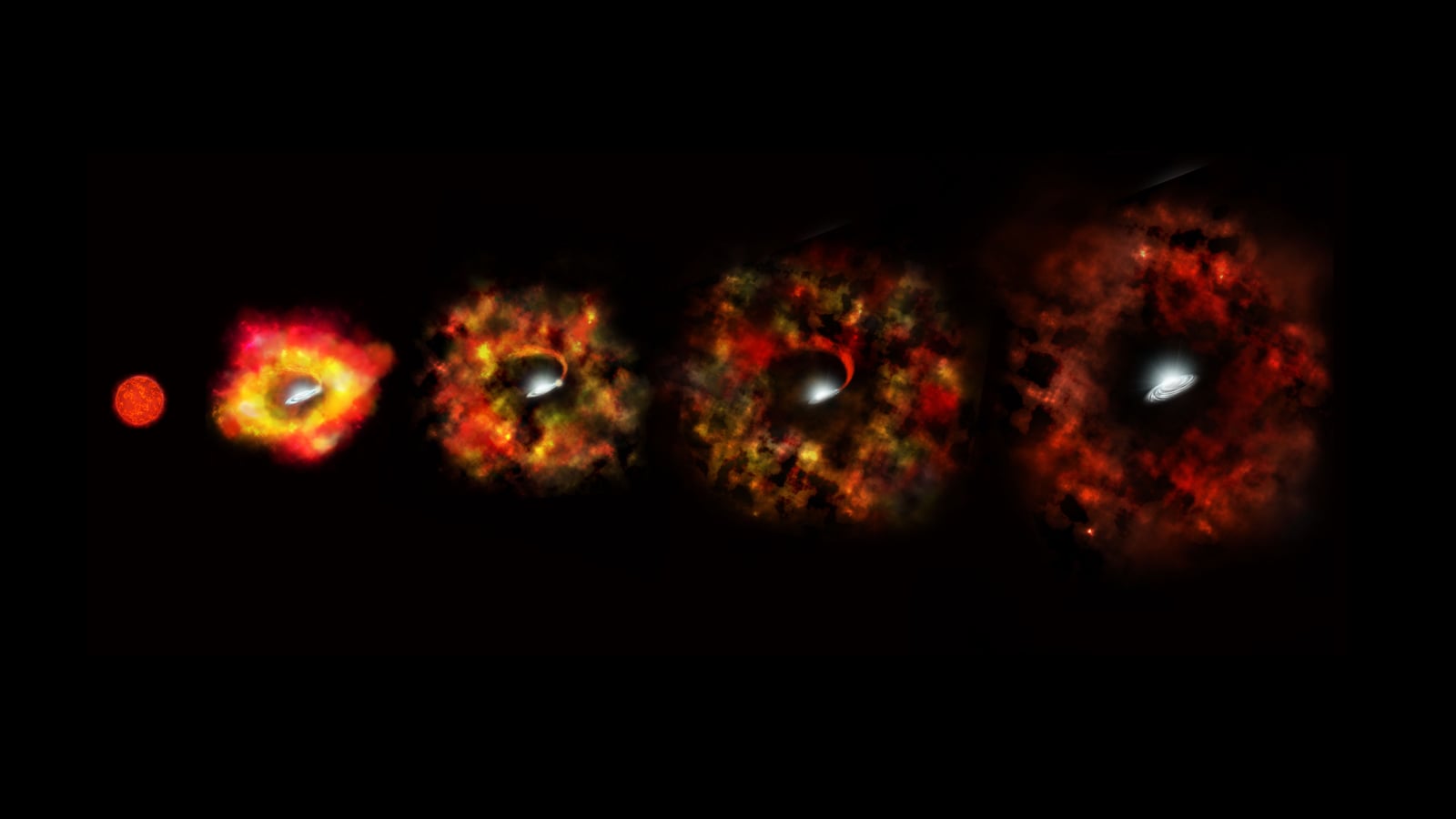
Нейтриногийн хувиралт нь зарим од дэлбэрч супернова болох, эсвэл шууд хар нүх болон мөхөхийн хоорондох гол хүчин зүйл байж болохыг шинэ судалгаа харууллаа.
Аварга оддын амьдралын төгсгөл нь цөм нь нурж сүйрэх үйл явцаар тодорхойлогддог. Ихэнх тохиолдолд энэ үйл явц асар хүчтэй супернова дэлбэрэлтээр төгсдөг ч зарим од дэлбэрэлт үүсгэлгүйгээр шууд хар нүх болон хувирдаг байна. Физикч Мариам Гогилашвили болон Ирэн Тамборра нарын хийсэн шинэ судалгаагаар энэхүү ялгаа нь нейтрино хэмээх жижиг бөөмсийн “төлөв” (flavor)-ийн өөрчлөлтөөс хамааралтай байж болзошгүйг тогтоожээ.
Электрон, мюон, тауон гэсэн гурван төрлийн төлөвтэй нейтрино нь маш бага масстай бөгөөд нэг төлөвөөс нөгөө рүү хувирах чадвартай байдаг. Судлаачид 9-өөс 120 нарны масстай 195 одны цөм нурах үйл явцыг загварчлахдаа нейтриногийн төлөвийн өөрчлөлтийн түвшинг өөр өөрөөр тооцсон байна. Үр дүнд нь нейтриногийн төлөвийн өөрчлөлт нь 16-30 нарны масстай оддод хамгийн хүчтэй нөлөөлж, ихэнх нь шууд хар нүх болон хувирдаг болохыг илрүүлжээ.
Энэхүү судалгаа нь галактик дахь од үүсэлтийн хурдтай харьцуулахад ажиглагддаг супернова дэлбэрэлтийн тоо яагаад цөөн байдгийг тайлбарлаж магадгүй юм. Нейтриногийн төлөвийн хувиралт нь одны мөхлийн эцсийн үр дүнд шийдвэрлэх үүрэгтэй байж болох ч үүнийг батлахын тулд ирээдүйд илүү нарийвчилсан ажиглалтууд шаардлагатай. Сансрын уудмыг судлах томоохон хөтөлбөрүүд эхэлснээр эрдэмтэд оддыг дэлбэрэхээс өмнөх болон шилжилтийн үе шатанд нь илүү олноор ажиглах боломжтой болно.
Дэлгэрэнгүйг эх сурвалжаас харах
Эх сурвалжийг нээх ↓
A core-collapse supernova occurs when a massive star reaches the end of its life. After running out of hydrogen and other light elements to burn, the star makes a last ditch effort to counter gravity, fusing ever heavier elements at an ever faster pace. Eventually it reaches the point where heavy fusion extracts energy from the core rather than adds it. The core rapidly contracts, then recoils. The resulting explosion rips the star apart and briefly outshines an entire galaxy. But not all giant stars end with a bang. Some of them experience a core collapse so quick and dense that the core squeezes itself into a black hole. These stars end with a whimper rather than a bang.
So what exactly causes this difference? Why do some stars explode and others not? What key features distinguish between the two? The answer could lie in an aspect of neutrinos known as flavor.
Neutrinos are the chargeless, low-mass cousins to charged leptons such as the electron. The electron is the lightest charged lepton, with the muon and tauon as the heavier versions. For each of these leptons there is a corresponding neutrino. So there’s the electron, muon, and tauon neutrino, each known as a neutrino flavor. For a long time physicists thought neutrinos were massless, which meant that the flavor of a neutrino was unique. But we later found that neutrinos have a tiny mass that allows neutrinos to flip from one flavor to another.
When a massive star undergoes a core collapse, a tremendous amount of neutrinos are produced. Since neutrinos don’t interact strongly with other matter, most of the neutrinos escape the core with little effort. In fact, one way to know a star’s core is collapsing would be to observe a spike of neutrinos just before the star explodes.
Most simulations of a star’s core collapse don’t worry about these neutrinos. They don’t have a great deal of mass, and since they flee the scene early on, you wouldn’t expect them to play a major role. But different flavors of neutrinos have different mass, so flavor changing states might mean the difference between having enough mass to collapse directly into a black hole. This is the focus of a new study.
Simulations show how different flavor thresholds determine a collapse state. Credit: Gogilashvili & Tamborra
Flavor changing is a complex process, so the team used a simplified approach to include them in model simulations. Rather than worrying about the details, they assumed different levels of flavor changes. This way they could determine how the level of flavor change might affect the outcome. The authors then ran simulations of stellar core collapse for 195 progenitor stars with masses ranging from 9 solar masses to 120 solar masses. Each of these was run with different flavor-changing ratios to determine whether the core exploded or fully collapsed.
What they found was that even a small amount of flavor changing can flip the outcome for a star. The effect is strongest for stars in the 16-30 solar mass range, meaning that most stars in this mass range collapse directly into black holes. Smaller stars and the largest stars become supernovae unless the neutrino flavor changing is particularly strong. This result suggests that neutrinos play a critical role in the outcome of a dying star. This could also help explain why we seem to observe fewer supernovae than we expect given the rate of star formation in galaxies.
Now that we know neutrino flavor changing can be the difference between a star becoming a supernova or black hole, the next challenge will be to determine if they are the key player. One way to do this is to observe more stellar progenitors of supernovae. As large sky surveys come online, we will capture images of stars before they explode and even while they are in the critical transition stage.
One of the great mysteries of stellar evolution could just be solved by the elementary particles with the smallest mass.
Reference: Gogilashvili, Mariam, and Irene Tamborra. “Neutrino flavor conversion shapes the rate of failed core-collapse supernovae.” Physical Review D 114.6 (2026): L061304.

