Сансрын гүнд аялж буй Hera хөлгийн удирдлагын баг хөлгийг эх дэлхийгээс хэдэн сая километрийн зайд байхад нь програм хангамжийг амжилттай шинэчилж, дараагийн үе шатанд бэлэн болголоо.
Одоогоор Дэлхийгээс 140 сая км-ийн зайд орших Hera хөлөг Dimorphos астероид руу чиглэн аялж байна. Хөлөг рүү илгээсэн дохио гэрлийн хурдаар 8 минут орчим хугацаанд аялдаг тул хариу ирэх хүртэл нийт 16 минут орчим хугацаа зарцуулагддаг. Удирдлагын баг хөлгийн хоёр процессор дээр суурилсан үйлдлийн системийг ээлжлэн дахин ачаалж, алдаагүй ажиллагааг баталгаажуулсан байна.
Энэхүү шинэчлэлтийг хийхээс өмнө багийнхан 18 сарын турш “The Bench” хэмээх бүрэн ажиллагаатай хуулбар дээр 50 өдрийн турш туршилт хийжээ. Хөлгийг 2024 оны 10 дугаар сард хөөргөх үед эцсийн програм хангамж суулгаагүй байсан бөгөөд Ангараг гаригийн хажуугаар өнгөрөх боломжит цонхыг ашиглахын тулд аяллын явцад програмчлалыг үргэлжлүүлэн боловсруулсан байна.
Hera хөлөг ирэх намар Dimorphos астероид дээр очиж, 2022 оны 9 дүгээр сард NASA-гийн DART хөлгийн мөргөлтөөс үүдэлтэй өөрчлөлтийг нарийвчлан судлах юм. Энэхүү судалгаа нь ирээдүйд аюултай астероидуудын чиглэлийг өөрчлөх шаардлага гарвал ашиглах чухал мэдлэгийг хүн төрөлхтөнд олгох зорилготой.
https://www.esa.int/Space_Safety/Hera/Deep_space_software_upgrade_for_Hera_s_asteroid_visit
Дэлгэрэнгүйг эх сурвалжаас харах
Эх сурвалжийг нээх ↓
How do you install new software onto a computer you can never touch, hurtling through deep space at more than twelve kilometres every second? That was the challenge facing the control team behind ESA’s Hera mission, who have just pulled off exactly that feat, leaving the spacecraft ready to begin the most important phase of its journey yet. It’s a smug nod from the team back to the days of trying to reinstall Windows from 24 disks back in the day!
Hera is currently around 140 million kilometres from Earth, heading toward the asteroid Dimorphos, which orbits the larger Didymos. Any instruction sent to it has to travel via a giant 35 metre dish aimed precisely at the right patch of sky, and even moving at the speed of light, that signal takes nearly eight minutes just to arrive, then another eight minutes for a reply to come back. There is no popping out to fix something if it goes wrong, and no second chance to plug in a cable.
Hera, alongside the two small CubeSats it will release next year, approaching the Didymos and Dimorphos asteroid pair, its ultimate destination (Credit : ESA)
Having successfully uploaded the new software, the team then faced an even more nerve wracking step, rebooting the entire spacecraft, not once but twice. Hera’s onboard computer runs on two parallel processing streams for redundancy, so each one needed its own careful reboot and evaluation in turn. The seven strong core team sat ready in their control room, prepared for the possibility that the spacecraft might simply fail to check back in on schedule. Both times, it rebooted exactly as planned.
Before a single command was sent to the real spacecraft, the software was tested for a year and a half, across fifty separate ground test days, using a fully functional replica of Hera at its prime contractor OHB in Bremen, nicknamed simply “the Bench.” Engineers rehearsed every piece of autonomous behaviour Hera will need once it reaches its target, including how it will communicate with the two small CubeSats it plans to release early next year.
The reason Hera launched without its final software already installed comes down to timing. The mission had to leave Earth in October 2024 to take advantage of a flyby past Mars the following spring, since missing that window would have added years onto the journey. Rather than delay launch, the team chose to keep working throughout the long cruise phase instead, catching up piece by piece as Hera sailed onward.
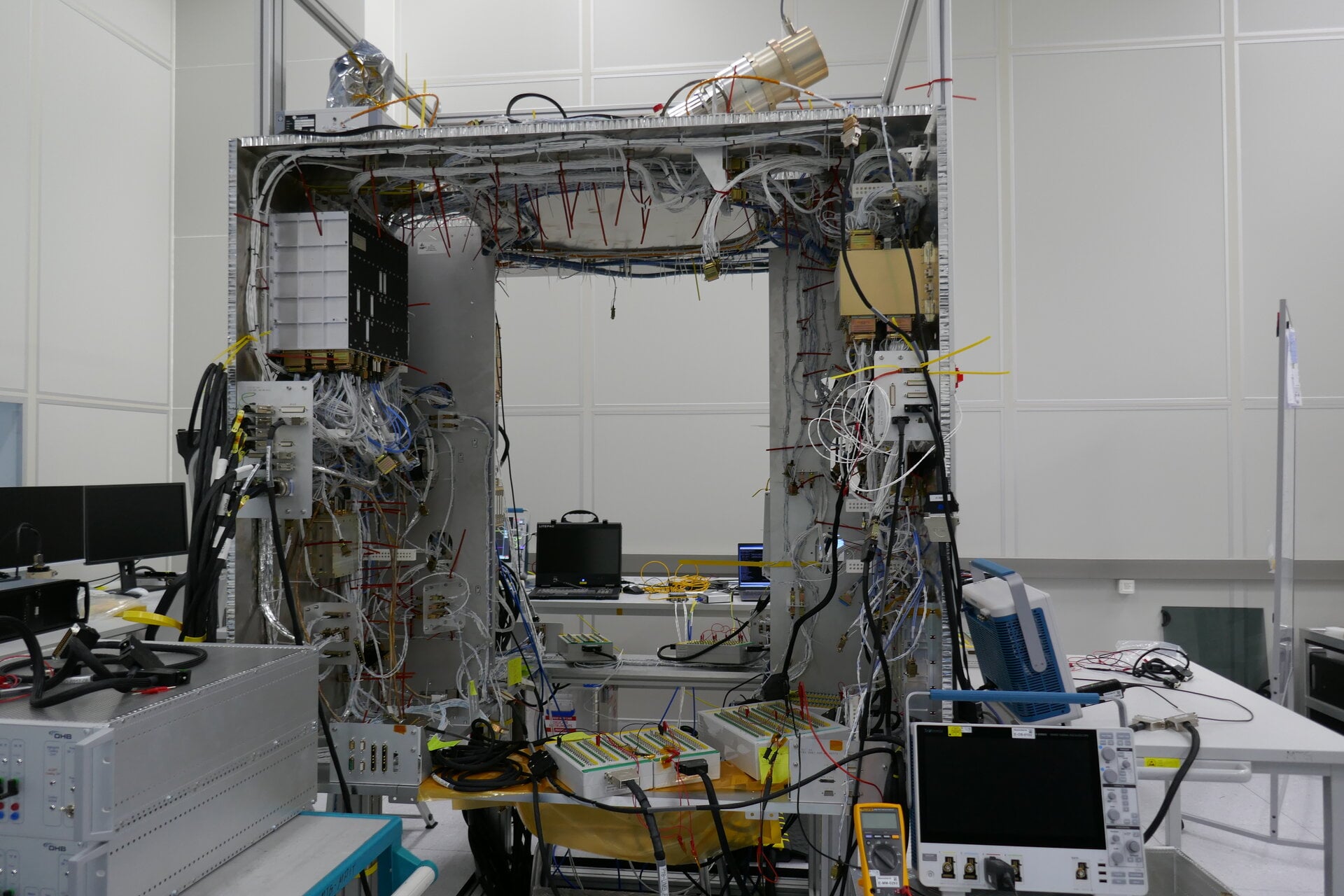
OHB’s Hera Avionics Test Bench, nicknamed ‘the Bench,’ a full working replica of Hera used to rehearse the software upgrade for eighteen months before it was ever sent to the real spacecraft (Credit : ESA/OHB)
Dimorphos already holds a place in history as the first object in the Solar System ever to have had its orbit deliberately altered by human action, struck by NASA’s DART spacecraft back in September 2022. That impact was bright enough to be seen from telescopes on Earth, but exactly what it did to the asteroid up close has remained a mystery ever since. Hera is now on its way to find out, arriving this autumn to carry out a detailed survey of the impact site, turning one of humanity’s boldest experiments into knowledge we can actually rely on, should we ever need to nudge a genuinely dangerous asteroid off course for real.
Source : Deep space software upgrade for Hera’s asteroid visit