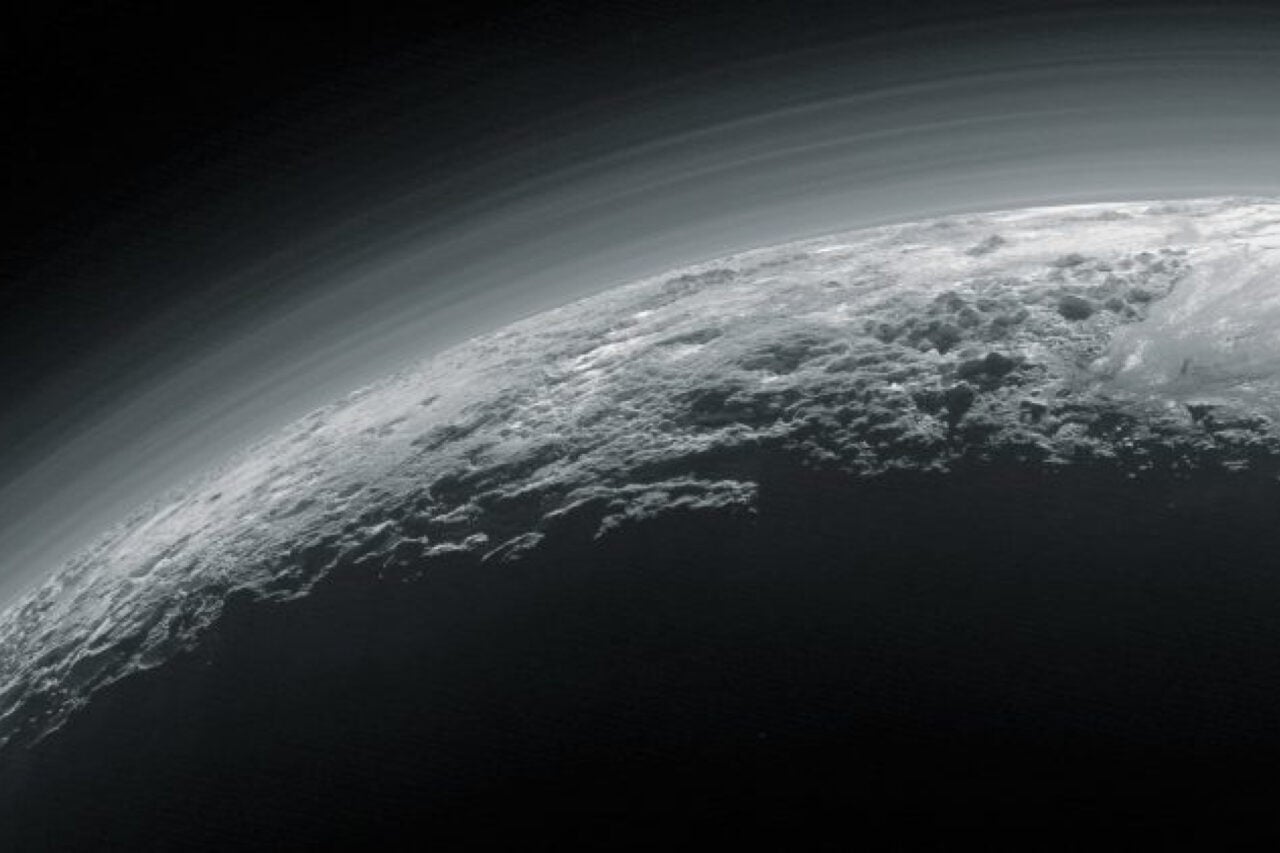
Натнаас холдох тусам одой гарагийн агаар мандал аажмаар өөрчлөгдөж, анхны уналтын шинж тэмдэг илэрч магадгүй байна.
Дэлхийгээс 248 жилийн хугацаатайгаар Нарыг тойрон эргэдэг Плутон гараг манай эх одоос улам бүр холдож байгаа бөгөөд үүнийг дагаад түүний агаар мандал бага зэргээр өөрчлөгдөж эхэлснийг шинэ судалгаа харууллаа. Planetary Science Journal сэтгүүлд нийтлэгдсэн уг судалгаанд 2015 онд New Horizons сансрын хөлгийн цуглуулсан агаар маврын даралтын өгөгдлийг одод Плутоныг халхлах үзэгдлийн үеийн ажиглалттай харьцуулан судалжээ. Судлаачид 2021 оны дунд үеэс эхлэн Плутоны агаар мандал мэдэгдэхүйц хэмжээгээр буурсныг илрүүлсэн нь 1996 онд таамаглаж байсан үзэгдэл одоо л бодит байдал дээр ажиглагдаж эхэлснийг харуулж байна.
Planetary Science Institute-ийн эрдэмтэн Аманда Сикафоус тэргүүтэй багийнхан энэхүү өөрчлөлт нь Плутоны агаар мандал нуран унах анхны шинж тэмдэг байж болзошгүйг тэмдэглэжээ. Одод Плутоныг халхлах үзэгдэл буюу occultation арга нь алс холын системийг хэдхэн километрт хүрэх нарийвчлалтайгаар судлах боломжийг эрдэмтдэд олгодог бөгөөд энэ нь Дэлхий дээрх хамгийн хүчирхэг телескопоор харахад жижиг толбо шиг харагддаг Плутоны агаар мандлын даралтын хэлбэлзлийг 1989 оноос хойш харьцуулан судлах үндэс болжээ.
Судалгааны багийнхан 2017-2023 оны хооронд Плутон одыг халхлах 10 өөр тохиолдлыг бүртгэж авсан бөгөөд тэдгээрийн дөрөв нь Дэлхийн олон өнцгөөс нэгэн зэрэг ажиглагдсан байна. Плутон нь үндсэндээ азот болон нүүрстөрөгчийн нэгдлүүдээс тогтсон нил ягаан туяа бүхий сийрэг агаар мандалтай аж. Тус одой гарагийн мөсөн гадаргуу болон агаар мандлын даралт буурч байгаа нь мананцаршилт болон агаар мандлын хэмжээг багасгаж байгааг уг шинжилгээ харуулжээ.
Плутоны агаар мандлын хэмжээ болон даралт нь 1988-2015 оны хооронд өсөж, улмаар 2021 он хүртэл тогтвортой байсан бол 2022 он гэхэд 16 хувиар буурсан нь тодорхой ажиглагджээ. Энэхүү үзэгдэл нь 2018 оноос хойш Плутоны агаар мандал “хөлдөж” байна гэж таамаглаж байсан эрдэмтдийн дүгнэлттэй нийцэж байна. Плутон Нарнаас хамгийн хол цэгтээ хүрэх замдаа явж байгаа бөгөөд 2114 он хүртэл Наранд ойртохгүй тул ирэх жилүүдэд түүний агаар мандал цаашид хэрхэн өөрчлөгдөхийг илүү олон мэдээллээр баталгаажуулах боломжтой юм.
Дэлгэрэнгүйг эх сурвалжаас харах
Эх сурвалжийг нээх ↓
Pluto’s orbit around the Sun is a long, elliptical journey that lasts 248 Earth years. Right now, Pluto is gradually traveling farther and farther away from our host star. And as it does so, its atmosphere seems to be changing slowly, new findings suggest.
When New Horizons made its flyby of Pluto in 2015, the spacecraft captured its key physical properties, including atmospheric pressure. For a new study published in The Planetary Science Journal, researchers compared this dataset with information gathered from stellar occultations of Pluto, an observational method that uses Pluto’s shadow cast on Earth when a star passes behind the dwarf planet. The team found that, from mid-2021, Pluto’s atmosphere experienced a sizeable decline. This phenomenon was predicted as early as 1996, but only now is this decline starting to take hold, the research suggests.
This could even be the “first signs of Pluto’s atmospheric collapse,” according to a statement by the Planetary Science Institute. The institute’s senior scientist Amanda Sickafoose led the latest work.
When the stars align
Stellar occultations occur when something like a planet, moon, ring, or asteroid blocks the light from a star, which might sound really trivial as far as eclipses are concerned. But occultations actually allow researchers to study these foreign systems with “spatial resolutions of a few kilometers—several orders of magnitude better than the resolution of any other Earth-based method,” according to an explainer by the MIT Planetary Astronomy Lab.
Other than New Horizons’s flyby, Pluto, being as far away as it is, appears to be “nothing more than a tiny blob” for humanity’s best telescopes, the statement explained. That said, occultations have allowed astronomers to successfully compare and contrast fluctuations of Pluto’s atmospheric pressure since as early as 1989, the paper noted.
“I’m constantly amazed at how the simple technique of watching starlight dim and reappear allows us to study a thin atmosphere—a few millionths of the Earth’s—on a world two-thirds the size of our Moon and 30 times farther from the Sun,” Sickafoose said in the statement.
Comparing transit notes
For the study, the team recorded 10 different occultations of Pluto between 2017 and 2023, four of which were the same event captured from multiple locations on Earth. Pluto has a primarily nitrogen atmosphere with a few carbon-based compounds, which combine to form a thin haze encircling the dwarf planet. Sickafoose explained that scientists have yet to fully understand Pluto’s atmospheric physics.
However, Pluto’s icy surface strongly suggests that decreased atmospheric pressure should drive the haze thinner and to lower altitudes, the team wrote in the paper. In the context of occultations, haze particles scatter light like fog, which astronomers can observe as Pluto’s atmosphere bends the star’s light. Then, the researchers tried fitting their observations to atmospheric models.
An ongoing journey
The analysis showed that Pluto’s atmospheric size and pressure increased between 1988 and 2015. Then until about 2021, the atmosphere stayed more or less consistent. These results are consistent with previous research that found a plateau in Pluto’s atmospheric evolution. However, by 2022, there was a clear deflation in Pluto’s atmospheric parameters, by as much as 16%. This was a possibility discussed as early as 1996and more recently in 2021, when another team of astronomers suggested that Pluto’s atmosphere has been “freezing out” since 2018.
“We’re at a particularly interesting point for Pluto,” Sickafoose said. “Our work suggests that the atmosphere has recently started decreasing in pressure. I am hopeful that we’ll be able to get more data in the next years to decades to specifically confirm or refute this trend.”
And astronomers should have more than enough time. Pluto won’t be getting any closer to the Sun until at least the year 2114. So, in the following years we’ll likely see whether Pluto’s atmosphere will literally falter out at its farthest distance from the Sun.
Related article: Mercury Has a Radiation Belt After All—But It’s Super Wonky


