1941-1945 оны Номхон далайн дайн нь далай тэнгис болон хуурай газрын байлдааны ажиллагааг цоо шинэ түвшинд хүргэж, орчин үеийн дайны ажиллагааны арга барил, техник хэрэгслийг эрс өөрчилсөн түүхэн үйл явдал болсон юм.
Нисэх онгоц тээгч хөлөг онгоцны ноёрхол
Дэлхийн хоёрдугаар дайны эхэн үед тэнгисийн цэргийн хүчний гол сүр хүч нь их буугаар зэвсэглэсэн аварга том байлдааны хөлөг онгоцууд байв. Гэвч Номхон далайн дайны үед Япон болон АНУ-ын тэнгисийн цэргийн хүчин нисэх онгоц тээгч хөлөг онгоцны давуу талыг олж харсан юм. Эдгээр хөлөг онгоц нь дайсныг алсаас илрүүлж, агаарын довтолгоо хийх боломжтой “хөдөлгөөнт нисэх зурвас” болон хувирч, байлдааны хөлөг онгоцуудыг түүхэнд үлдээв. Нисэх онгоц тээгч хөлөг онгоц нь өөрийгөө хамгаалах агаарын довтолгооноос эсэргүүцэн хамгаалах зэвсгүүдээс гадна, сөнөөгч онгоцны эскадрилиудаар дамжуулан дайснаа хэдэн зуун милийн зайнаас цохих чадвартай байв.
Байлдааны ажиллагааны үед нисэх онгоц тээгч хөлөг онгоцуудыг тойруулан хөнгөн болон сөнөөгч хөлөг онгоцуудыг байрлуулж, “цохилтын хүч” хэмээх бүлэглэл үүсгэдэг байв. Үүний ар талд шатахуун, засвар үйлчилгээ, эмнэлгийн болон хангамжийн хөлөг онгоцууд бүхий “хөвөгч бааз” ажилладаг байжээ. Нисэх онгоц тээгч хөлөг онгоцны бүрэлдэхүүнд 50-100 орчим бөмбөгдөгч, сөнөөгч онгоцууд багтдаг байсан нь дайны талбарт давуу тал олгож байлаа.
1942 оны тавдугаар сард болсон Шүрэн тэнгисийн тулалдаан нь түүхэнд анх удаа хоёр талын хөлөг онгоцууд бие биеэ харалгүйгээр, зөвхөн агаарын хүчээр тулалдсан анхны тохиолдол болсон юм. Үүний дараа болсон Мидуэйн тулалдаанд АНУ-ын тал Японы дөрвөн нисэх онгоц тээгч хөлөг онгоцыг устгаж, Японы тэнгисийн цэргийн хүчнийг батлан хамгаалах байрлалд шилжихэд хүргэсэн нь дайны эргэлтийн цэг байв. АНУ-ын тал эвдэрсэн хөлөг онгоцуудыг богино хугацаанд засварлаж, дахин ашиглалтад оруулах чадвараараа давуу талтай байсан нь “Эссекс” ангиллын хөлөг онгоцуудыг олноор бүтээн байгуулснаас харагддаг.
Амфиби байлдааны ажиллагааг төгөлдөржүүлсэн нь
Түүхийн туршид далайгаас хуурай газар руу хийх дайралт буюу амфиби байлдаан нь маш эрсдэлтэй ажиллагаа байсаар ирсэн. Монголчуудын Японд хийсэн довтолгоо, Испанийн армада, Дэлхийн нэгдүгээр дайны үеийн Галлиполигийн ажиллагаа зэрэг нь үүнийг баталдаг. Гэвч Номхон далайн арлуудыг эзлэн авахын тулд энэ төрлийн ажиллагааг боловсронгуй болгох шаардлагатай болсон юм.
Гуадалканалын ажиллагаа болон Таравагийн тулалдаанд олж авсан гашуун туршлага нь 1944 оны зургадугаар сарын 6-нд Нормандад хийсэн “D-Day” ажиллагаанд үнэтэй хичээл болсон. Дайралт хийхдээ усан доорх саадыг устгах, удаан хугацааны агаарын болон усан онгоцны их бууны бөмбөгдөлт хийх, хөвөгч хуягт тээвэрлэгч ашиглах зэрэг арга барилыг боловсронгуй болгожээ. Гэсэн хэдий ч Японы цэргүүд бууж өгөхийг гутамшиг гэж үзэн эцсээ хүртэл тулалддаг байсан тул Иво Жима, Окинавагийн тулалдаануудад АНУ-ын цэргүүд асар их хохирол амссан юм.
Логистикийн дээд амжилт
Номхон далайн дайны үед АНУ-ын баримталсан “арлуудыг алгасах” стратеги нь маш нарийн логистикийг шаардаж байв. Энэ нь Европтой харьцуулахад хоёр дахин их тээвэрлэлт шаардсан ажиллагаа байсан бөгөөд “Флийт Трэйн” буюу тэнгисийн цэргийн хангамжийн сүлжээгээр дамжуулан цэргүүдийг хүнс, эмнэлгийн хэрэгсэл, зэр зэвсгээр тасралтгүй хангаж байв. Гуам, Тиниан, Сайпан арлуудыг эзэлснээр АНУ-ын “Boeing B-29 Superfortress” бөмбөгдөгч онгоцууд Японы хотуудыг алсаас цохих боломжтой болсон юм.
Цэргийн салбар хоорондын хамтын ажиллагаа
Дайны цар хүрээ өргөжихийн хэрээр тэнгисийн цэрэг, нисэх хүчин, явган цэрэг, тагнуулын байгууллагуудын нягт уялдаа холбоо чухал болсон. Уинстон Черчиллийн тодорхойлсноор агаар, газар, тэнгисийн хүчийг бүрэн нэгтгэсэн “трифиби” ажиллагаа нь дайны ялалтад хүрэх гол түлхүүр байв.
Цөмийн зэвсгийн үр дагавар
Дайны сүүлийн шатанд энгийн иргэдийн амь насыг үл хайхрах хандлага нэмэгдэж, Окинавагийн тулалдаан болон Токиогийн бөмбөгдөлтөд олон зуун мянган энгийн иргэн амиа алдсан. Улмаар Манхэттэн төслийн хүрээнд бүтээгдсэн атомын бөмбөгийг Хирошима, Нагасаки хотуудад хаясан нь дэлхийн дайны түүхэнд урьд өмнө байгаагүй аймшигт үр дагаврыг авчирсан юм. Энэхүү зэвсэг нь Японыг бууж өгөхөд хүргэсэн хэдий ч 140,000 орчим энгийн иргэний аминд хүрсэн нь өнөөг хүртэл маргаан дагуулсаар байна. Атомын бөмбөгийн бүтээлт нь дэлхий дахинд цөмийн зэвсэглэлээр хөөцөлдөх шинэ эрин үеийг эхлүүлж
Дэлгэрэнгүйг эх сурвалжаас харах
↓Эх сурвалжийг нээх ↓
The Pacific War (1941-45) contributed many lasting innovations and developments to global warfare. This theatre of the Second World War witnessed the end of battleships as the primary mode of naval warfare, replacing them with aircraft carriers that could send their planes to engage an unseen enemy many miles distant. Amphibious warfare was perfected to a high degree of efficiency, as was the integration of large-scale multiservice operations and the refinement of military logistics on a massive scale. Specialised weapons development such as flamethrowers, armoured landing vehicles, and napalm made warfare even more deadly and brutal. Tens of thousands of civilians died in single battles or bombing campaigns, numbers which grew even larger and more incomprehensible with the use of nuclear weapons, a development that still haunts humanity today.
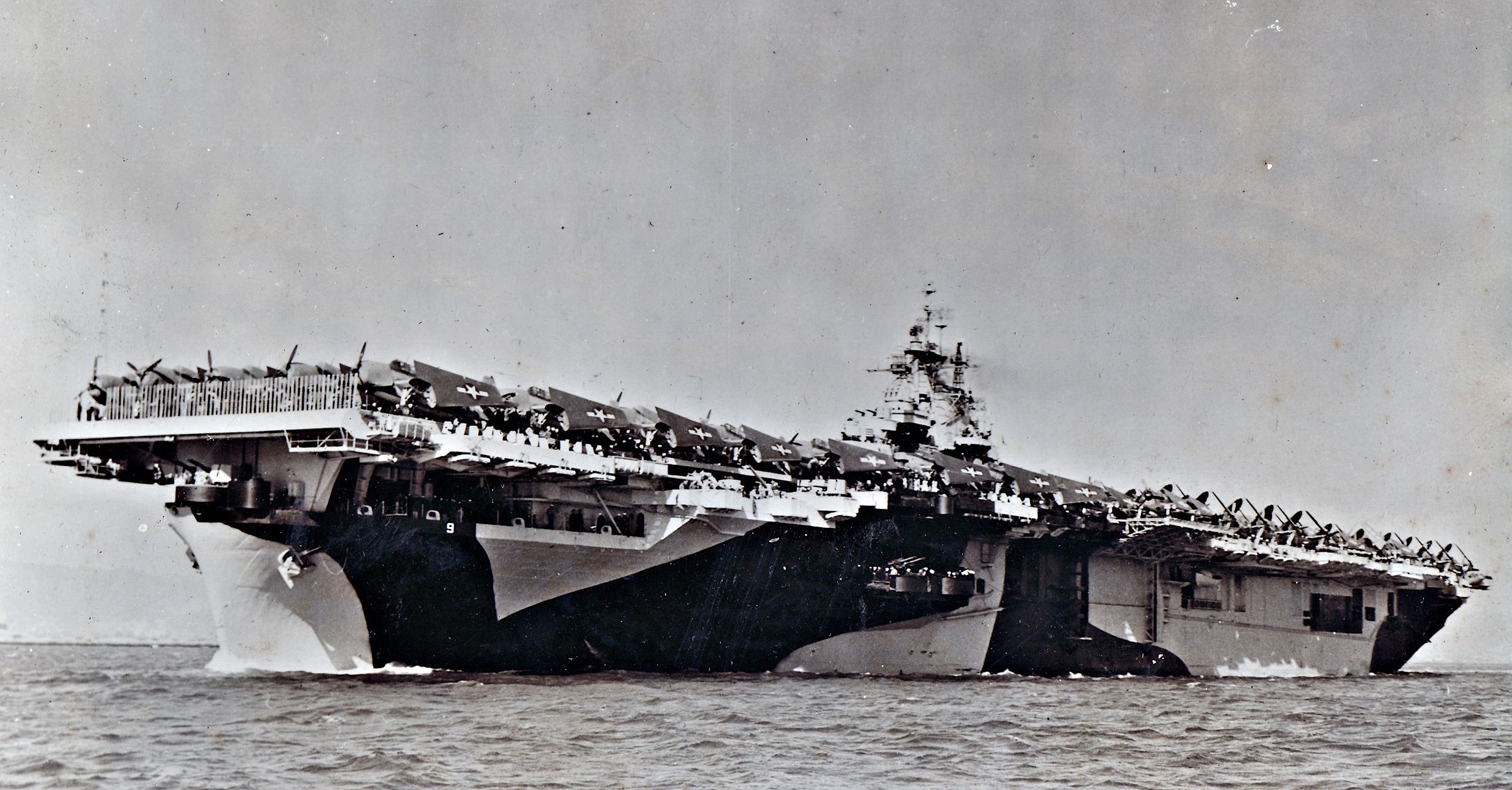
USS Essex, 1944
Aircraft Carriers Dominate
In the early years of WWII, the pride of most navies was their battleships, armour-plated behemoths that could fire their massive guns at the enemy’s battleships. These giants were awesome to see, but they had one great weakness: they could be sunk from the air before they ever got out of port. In the Pacific, both the Japanese and US navies realised that the ship of the future was the aircraft carrier. Known as ‘flat-tops’ by US service personnel, these ships were even bigger than battleships, but they could defend themselves not only with an impressive range of anti-aircraft guns but, much more effectively, by launching their own fighter squadrons. When on the move, aircraft could be more safely stored below decks. An aircraft carrier was, then, in effect, a moveable airstrip that could be mobilised to hit the enemy at their weakest point while the ship itself remained far from the action.
Carriers were not only offensive weapons; they could be used as support vessels for amphibious operations & land-based battles.
A typical aircraft carrier had a protective escort of cruisers and destroyers. This collection of ships was called a carrier group or strike force. They were also accompanied by a number of supply ships such as fuel tankers. These non-fighting ships usually kept well to the rear in a sort of floating base that included tugs, repair ships, supply ships, and hospital ships.
At the same time, operating around the strike group were a number of submarines, flying boats, and the carrier’s own aircraft, all of which could provide reconnaissance of where an enemy was located and provide an early warning of air attacks. The carrier’s radar system (in the case of US ships) performed a similar function.
Carriers usually carried a varied complement of aircraft: dive-bombers and bombers to hit enemy targets and fighters to protect those bombers, strike at enemy ships, and defend the carrier if required. The number of aircraft on board varied greatly, but it was typically somewhere between 50 and 100.
Aircraft on USS Wasp 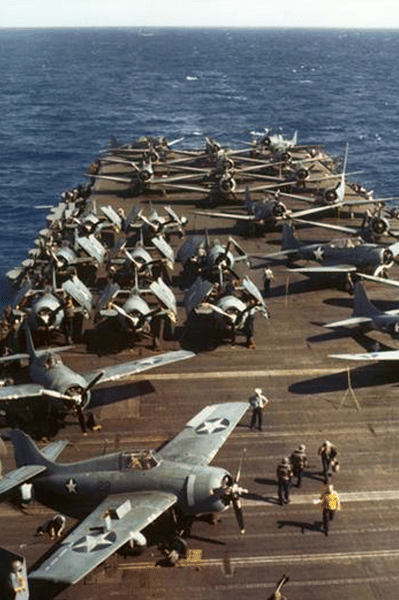
The first battle in history between aircraft carriers came at the Battle of the Coral Sea in May 1942. This was the first sea battle where the protagonists operated without actually seeing each other, since the fighting was between aircraft and ships, not ship-against-ship, as had been typical throughout the long history of naval warfare. The days of capital ships blasting away at each other with fearsome broadsides were over. The battle was a sort of draw, Japan losing 77 aircraft while the US lost 66. Much more decisive was the Battle of Midway the next month.
At Midway, the US Pacific fleet sank four Japanese aircraft carriers for the loss of only one US carrier, the Yorktown, and they destroyed nearly 250 Japanese aircraft. The blow to the Imperial Japanese Navy was a heavy one, and so important were carriers to this new type of naval warfare that, henceforth, Japan went on the defensive. Indeed, the Japanese military government did not inform the Japanese people that four carriers had been lost, such was the magnitude of the defeat.
The Yorktown had actually been badly damaged at the Battle of the Coral Sea, but it was quickly repaired and put back into service. This was another particular feature of the Pacific War and one where the US showed particular skill: speedily repairing battle damage to keep ships in action.
The importance of carriers in this new type of warfare is further illustrated by the US government’s decision to construct 14 Essex-class carriers in 1943. Carriers had become the new stars of any naval force, and they were not only offensive weapons; they could be used as excellent support vessels for amphibious operations and land-based battles.
Japanese Aircraft Carrier Akagi 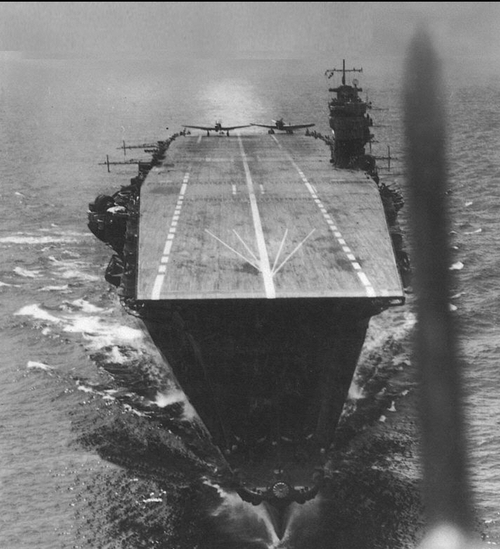
Perfection of Amphibious Warfare
Amphibious warfare has been one of the most hazardous types of military operations right through history. All sorts of plans to attack the land from the sea have met spectacular levels of failure. The risks are evident in such infamous military escapades as the Mongol invasions of Japan in the 13th century, the Spanish Armada, which tried to attack England in 1588, and the Gallipoli Campaign in the First World War (1914-18), when 250,000 Allied casualties were sustained trying to get, but never quite achieving, a foothold on Turkish soil. The nature of the territories occupied by Japan in the Pacific War, however, meant there was often little option but to hazard an amphibious assault.
Operations in the Pacific fully integrated air, land, & sea services.
The first major US amphibious operation was in the Guadalcanal Campaign in the Solomon Islands, which dragged on from August 1942 to February 1943. Many mistakes were made in a campaign which involved around 50 clashes on land and sea. Similar mistakes were made at the gruelling Battle of Tarawa in the Gilbert and Marshall Islands Campaign (November 1943 to February 1944). But lessons were learned, lessons valuable not only for the Pacific War but also for the huge amphibious landing in Normandy on D-Day, 6 June 1944.
Attacking multiple islands at once had proved too big a task to realistically achieve. Heavy naval bombardment and air attacks did not usually wipe out the enemy’s defences. Marines in landing vehicles would still be attacked in the approach shallows and on the beaches. The tides needed to be carefully considered, or landing craft would soon be stuck in the water on the reefs, and men obliged to wade ashore across the lagoon, exposing them to concealed Japanese gunners. Even when inland cover was reached, the fighting typically became even more fierce, as Japanese soldiers, believing surrender dishonourable, often fought to the death.
US Bombardment of Okinawa 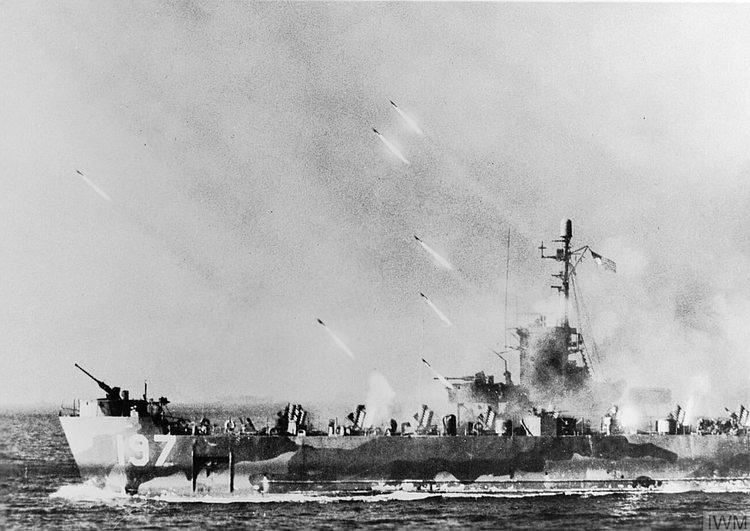
Later amphibious operations addressed these deficiencies. A specialised HQ ship coordinated the entire operation. Underwater demolition experts first blasted channels through the coral and any obstacles laid down by the Japanese defence to allow the landing vehicles to get through. The initial air and naval bombardments were prolonged – the US Air Force bombarded Iwo Jima for 72 days – and it was maintained while the landing craft went in with the Marines. Landing craft were now better protected and fitted with their own machine guns and 75-mm (3-inch) howitzers.
The naval and air bombardment continued even as the Marines progressed across an island, adjusting the targets to stay ahead of the advance. In order to keep the momentum of the attack going, more ships had to keep landing reinforcements on the beaches. Large rafts were used to aid landing vehicles in getting essential supplies ashore such as ammunition, fresh water, radio batteries, blood plasma, and sandbags.
At the same time as supplies came in, the wounded had to be evacuated, and obstructions on the beaches like wrecked tanks had to be removed. Beach masters were given the task of organising this two-way traffic so that logistics kept flowing freely. Finally, the supply ships off the coast required naval and air support to protect them, and so the US Navy’s warships now maintained a presence long after the initial landings.
US LVTs at Okinawa 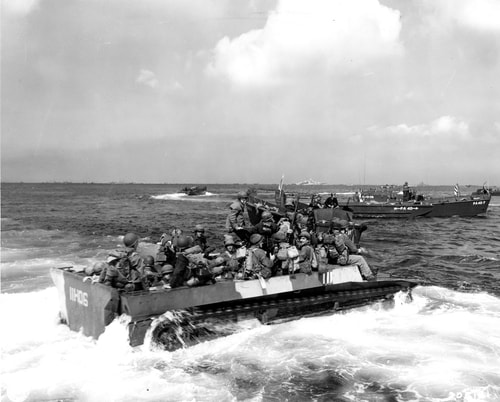
Despite all of these advances in executing the perfect amphibious assault, casualties remained high. After 36 days of intense fighting on Iwo Jima, the worst example, the US forces suffered over 27,000 casualties. From the Japanese garrison of 21,000, only 216 men survived the battle. Nevertheless, that same battle had seen 800 naval ships deposit 110,000 men on the island, a feat comparable to that of D-Day. The Battle of Okinawa was even bigger. Over 500,000 US service personnel were involved, and 1,213 warships, not including the large British Pacific Fleet, which also participated. The US Navy had deployed 40 aircraft carriers and 200 destroyers. These were amongst the largest troop movements in history. The US forces suffered casualties of around 35% (when in other theatres of the war 10% was considered dangerously high). Warfare had become as brutal as it was gigantic.
Supreme Logistics
The US strategy in the Pacific was one of ‘leapfrogging’ islands, that is, using a captured archipelago as a base to launch an attack on the next one but at the same time avoiding the most heavily defended islands where possible. This approach looks simple on a map, but in reality it required a huge logistical effort to make it a success.
Logistics was far more difficult in the Pacific because of a shortage of ships and the vast distances involved. So much so that “It was estimated twice as much shipping was required to move a division of troops in the Pacific theatre as in the European” (Smurthwaite, 93). Finding harbours that could deal with large ships and the skilled dock workers required to load and unload cargoes were other challenges. Larger ships became floating warehouses with smaller vessels relaying between them and the fleets.
Map of the Allied Pacific Counteroffensive, 1942–1945 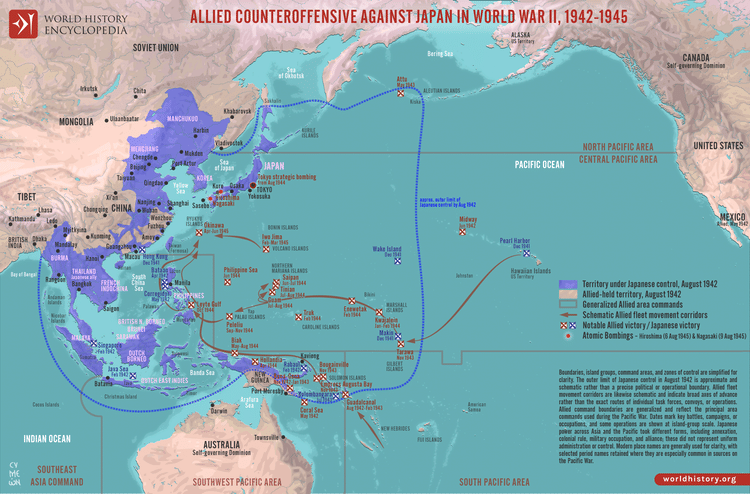
The US operations in the Pacific required a system where supplies came from the western coast of the United States to an intermediary point, and from there to the battle front. This system was called the Fleet Train.
Troops on the ground needed a vast array of weapons and equipment to defeat the enemy in difficult terrain. Every cave and potential hiding place had to be cleared out using a combination of flamethrowers, grenades, mortars, Bangalore torpedoes, TNT explosives, and even bulldozers. Tanks, artillery pieces, rocket-firing trucks, and armoured cars were required in large numbers, or their effectiveness was limited. Food, ammunition, medicine, and even post were delivered wherever the troops made advances. Even dogs were shipped in to sniff out landmines and ferret out snipers and hidden Japanese soldiers determined to extract one more life before the island was captured.
Control of Guam, Tinian, and Saipan in the Mariana Islands meant that long-range Boeing B-29 Superfortress bombers could strike any Japanese city and supplies could be airlifted deeper into the Pacific region. Guam also became an important fuel dump, supporting future operations in the Pacific by filling up and sending out fuel tankers, sometimes as many as three per day.
Fifi B-29 Bomber 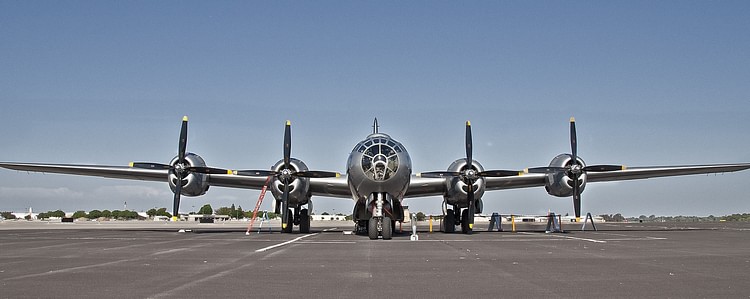
Cooperation Between the Services
As the scale of the fighting in the Pacific grew ever larger, cooperation and coordination became vital watchwords. A weakness, for example, of the US Navy earlier in the war had been the lack of coordination even between flight groups launched from different carriers but sent to the same targets. Commanders on the ground soon came to realise that victory against a tenacious enemy would only come from a fully coordinated effort using the combined services of the navy, naval air force, Marines, army infantry, army air force, and military intelligence. Winston Churchill coined the term “triphibious,” which meant an operation that fully integrated air, land, and sea services. There was also closer cooperation between the services of other Allies, such as the use of Australian Army intelligence on Japanese aircraft movements, which was relayed to the US naval forces the enemy was heading for.
Atomic Weapons
Perhaps the greatest development in global warfare the Pacific War contributed to was the increasing indifference to civilian lives caught up in the war zone. Military commanders on both sides sought victory at almost any cost. The Battle of Okinawa caused 150,000 civilian deaths. This compares to 100,000 Japanese and 12,000 US combatants who died in the same battle. The repeated and indiscriminate bombing of Tokyo used new and terrible incendiary devices packed with highly flammable napalm gel that caused another 100,000 civilian deaths. But then an even more horrifying indifference to human life developed with the arrival of the atomic bomb, a device with an explosive power equivalent to 22 kilotons of TNT.
By 1945, the US’s secret Manhattan Project had developed a new weapon, one so destructive in power that even its inventors were not aware of just how powerful it might be. The atomic bomb could be dropped anywhere from a single aircraft that flew too high for any air defences to seriously threaten. Total destruction could be delivered without risk and without warning.
1946 Nuclear Test, Bikini Atoll 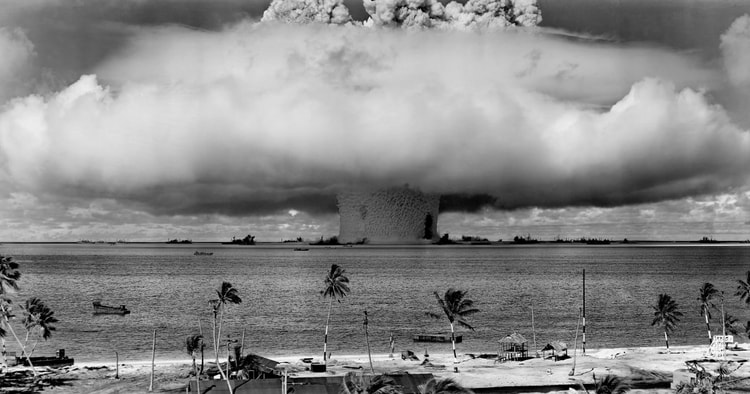
Two atomic bombs were dropped, one on Hiroshima and one on Nagasaki. The intention was that such shocking destruction would force the Japanese government into a surrender and so an amphibious invasion of Japan, one which it was anticipated could lead to 500,000 US casualties, would be avoided. Another consideration was that the bombs would demonstrate the power of the USA to its greatest rival in the post-war world, the USSR.
Japan did indeed surrender in August 1945, but the debate continues as to whether the sudden deaths of 140,000 civilians in Hiroshima and 74,000 in Nagasaki could ever be justified. Overnight, the world had been transformed. Other nations soon developed their own nuclear weapons, and this new technology became even more powerful and more threatening with the development of the hydrogen bomb and nuclear rockets in the 1950s. The spectre of a nuclear holocaust, one that might occur at the mere push of a button, has loomed over humanity ever since.

