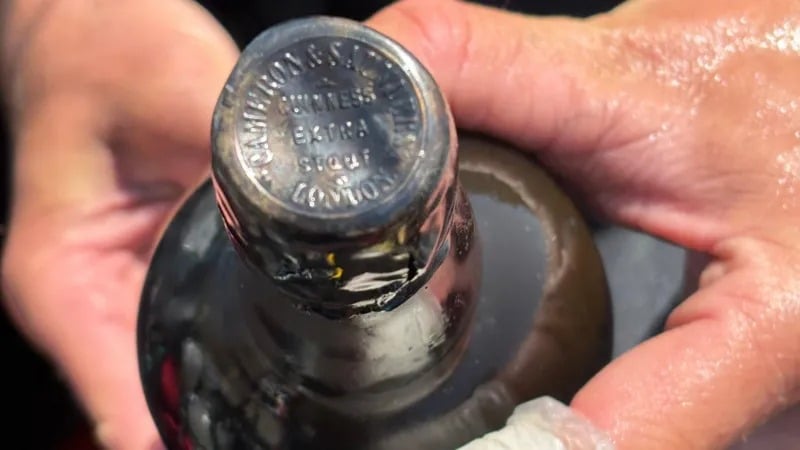
Бельгийн шумбагчид Английн Довер хотын эргээс 1864 онд үйлдвэрлэсэн байж болзошгүй Гиннесс шар айрагны лонхыг илрүүлсэн нь түүхэн болон шинжлэх ухааны ач холбогдолтой олдвор боллоо.
Усан доорх гэрэл зурагчин Стефан Панис болон түүний хамтрагч Эдди Хаззи нар живсэн хөлөг онгоцны үлдэгдлийг судлах явцдаа энэхүү олдворыг олжээ. Далайн ёроолоос гаргаж ирсэн лонхыг угаахад Гиннесс брэндийн тэмдэг тодрон гарч ирсэн бөгөөд ойр орчмоос нь 24 лонх бүхий хайрцагны үлдэгдэл олдсон нь тухайн хөлөг онгоцонд их хэмжээний ачаа байсныг илтгэж байна.
Бельгийн KU Leuven их сургуулийн микробиологичид уг шар айрагны дээжээс шинжилгээ авч, 19-р зууны дунд үеийн шар айраг исгэх технологийг судлахаар ажиллаж байна. Судлаачид шар айрагны доторх элементүүд хадгалагдан үлдсэн эсэхийг тогтоохыг зорьж байгаа бөгөөд шаардлагатай тохиолдолд бүрэн ДНХ-ийн бүтцийг сэргээн тухайн үеийн жороор дахин исгэх боломжийг судалж байна.
Одоогийн байдлаар шар айраг уух боломжтой эсэх нь тодорхойгүй байгаа бөгөөд гол асуудал нь далайн ус бөглөөгөөр дамжин лонх руу нэвтэрсэн эсэхэд оршино. Diageo компанийн архивын баг олдворын нөхцөл байдлыг үнэлэхээр шумбагчидтай хамтран ажиллаж байгаа бөгөөд цаашид тухайн хөлөг онгоцны үлдэгдлээс нэмэлт лонх илрүүлэх магадлалтай байна.
Дэлгэрэнгүйг эх сурвалжаас харах
↓Эх сурвалжийг нээх ↓
A bottle of Guinness that spent more than 160 years underwater has been recovered from a shipwreck off the coast of Dover, England. Found by divers in 2025 and dated to 1864, the bottle is now being examined to discover what remains of the historic stout and whether it could reveal the taste of a beer from another era. The find was made by Belgian underwater photographer Stefan Panis while exploring the wreck with his friend Eddie Huzzey.
Buried among the remains of the ship, the bottle gave no immediate indication of its identity until it was brought back to the surface. After a quick rinse, the familiar Guinness branding appeared. BBC News reported that Panis later contacted Guinness to share details of the discovery. So far, only one bottle has been recovered, but the divers believe more could still be hidden beneath the sand.
A Historic Guinness Bottle Emerges From A Shipwreck
Stefan Panis has spent more than 40 years diving and exploring underwater sites around the world, but he did not know he had found something unusual when he first picked up the bottle. At the time, the object looked like another piece of debris from the shipwreck, until a quick rinse at the surface revealed the unmistakable Guinness branding.
“We lifted the artefact, and then on the surface a quick rinse revealed ‘Guinness’,” Panis said.
The bottle was dated to 1864, making the stout inside 162 years old. The discovery may also be part of a larger shipment lost at sea. Panis believes the case found near the bottle could have originally contained 24 bottles.
“Seeing the size of the case, I think it is definitely a case of 24 bottles,” he said. “But there might be more cases.”
Only one bottle has been brought back so far, but the diver believes other bottles could remain around the wreck site. He plans to continue searching when weather and diving conditions are suitable.
160-Year-Old Beer Finally Opened
The recovered bottle has also attracted interest from scientists studying historic brewing methods. After the discovery, Panis’ colleague Pawel Truszynski contacted a beer microbiologist at KU Leuven University in Belgium. Samples from the bottle have been sent for analysis. Researchers are trying to determine what elements of the original stout have survived after more than a century underwater. BBC News noted that scientists hope the samples could help them understand the characteristics of Guinness brewed in the 1860s.
“There is always a chance that we can recover the complete DNA, and then we can do a small re-brew of the exact beer that was found in the 1860s,” Panis explained.

The bottle could reveal more than just a forgotten flavour. By studying the surviving elements of the stout, researchers hope to understand how it was made and explore whether a recreation of the 1864 beer is possible.
Would A 162-year-old Guinness Still Be Drinkable?
One question quickly followed the discovery: is anyone brave enough to drink a Guinness that has been underwater for more than 160 years? Panis believes there is a possibility, but the condition of the bottle will be key. The main concern is whether seawater entered through the cork during its long time underwater.
“There is a possibility that it’s still drinkable,” he explained. “The question is if the sea water has come into the bottles through the corks.”
If the bottle stayed properly sealed over the decades, the stout could still be suitable for tasting after being examined by experts. Although Panis admitted he is “not that big” of a Guinness fan, he said he would be willing to try it if specialists confirmed it was safe. As reported by the same source material, people in Belfast also reacted with curiosity. Katie White said she would taste it despite not liking Guinness, while Matt McCoppin said he would try the beer “in a heartbeat.”
However, The idea of drinking a centuries-old beer did not appeal to everyone. Margaret Barr, who considers herself a big Guinness drinker, said she would stick with a fresh pint from the tap. Diageo, the company that owns the Guinness brand, also took interest in the discovery. The Guinness Archive team is now working with the divers to learn more about the 1864 bottle and evaluate the condition of the recovered stout.
Enjoyed this article? Subscribe to our free newsletter for engaging stories, exclusive content, and the latest news.


