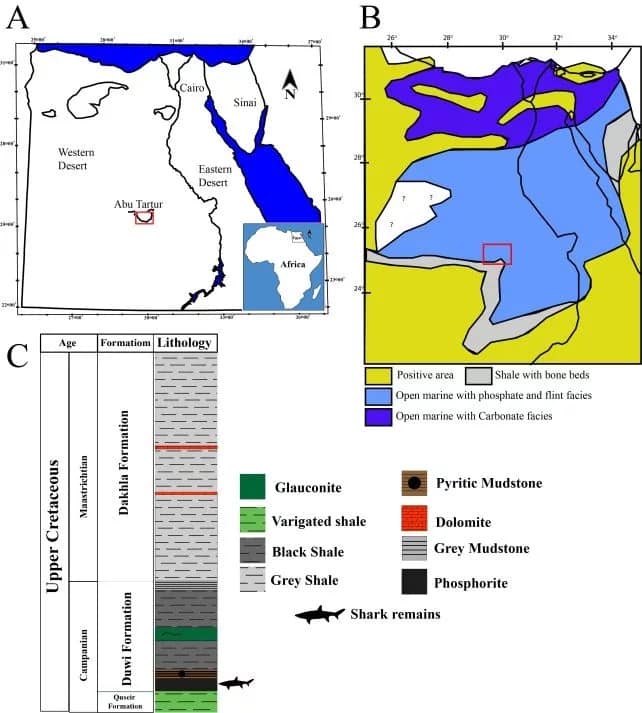
Палеонтологчид Египетийн баруун цөлийн Абу-Тартур тэгш өндөрлөгөөс далайн эртний долоон зүйл аварга загасны шүдний чулуужсан олдворыг илрүүлсэн байна.
Каирын их сургуулийн палеонтологч Тарек Яссинаар ахлуулсан судалгааны баг 2020-2022 оны хооронд явуулсан хээрийн судалгаагаар 14 ширхэг шүдний олдвор цуглуулжээ. Эдгээр олдворын дотор Африк тивд анх удаа бүртгэгдсэн “Scapanorhynchus raphiodon” зүйлийн аварга загас байгаа бөгөөд “Serratolamna serrata” болон “Squalicorax bassanii” зүйлүүдийг Египетийн нутаг дэвсгэрээс анх удаа олсон нь энэ юм. Судалгааны үр дүнг “Cretaceous Research” сэтгүүлд наймдугаар сарын 18-нд нийтэлжээ.
Цэрдийн галавын үед буюу 145-66 сая жилийн тэртээ одоогийн хуурай цөлийн бүс нутаг нь далайн гүехэн, амьдралаар дүүрэн бүс байсныг уг олдворууд баталж байна. Фосфоритын агууламж өндөртэй тус бүс нутаг нь далайн амьтад амьдрахад таатай температур, нарны гэрэл, хүчилтөрөгчийн хангамжтай байсныг эрдэмтэд онцолжээ.
Гэхдээ олон зүйлийн аварга загасны үлдэгдэл нэг дороос олдсон нь тэдгээр амьтан нэг цаг үед зэрэгцэн амьдарч байсныг шууд нотлохгүй гэдгийг судлаачид анхаарууллаа. Эдгээр үлдэгдэл нь урт хугацааны туршид хуримтлагдаж, нэг давхаргад холилдсон байх магадлалтай бөгөөд цаашид тус бүс нутагт нэмэлт малтлага хийхээр төлөвлөж байна.
Дэлгэрэнгүйг эх сурвалжаас харах
↓Эх сурвалжийг нээх ↓
Millions of years before it became one of the driest places on Earth, Egypt’s Western Desert was home to a thriving underwater world. Paleontologists have now uncovered fossilized teeth from at least seven shark species in the Abu-Tartur Plateau. The findings, gathered over several years of fieldwork, suggest the area once teemed with predators and prey alike.
The Abu-Tartur Plateau sits within the Duwi Formation, a Late Cretaceous rock layer that stretches across both the Eastern and Western deserts of Egypt. Researchers had already found traces of fish, sea turtles, and marine reptiles in this formation, hinting that a rich coastal sea once covered the region. Because the rocks there are unusually high in phosphorite, a sedimentary material that frequently forms from the remains of marine creatures, scientists suspected the plateau might be hiding more.
That hunch paid off. According to the study’s first author, Tarek Yassin, a paleontologist at Cairo University, the team already had reason to believe, before setting out, that phosphate-rich zones could contain fossils of vertebrate marine organisms. What they eventually found, however, exceeded expectations.
A Sea Where Desert Now Stands
During the Cretaceous period, roughly 145 million to 66 million years ago, the planet was considerably warmer than it is today, and sea levels stood as much as 558 feet higher. Shallow seas spread across regions that are bone-dry now, Egypt’s deserts among them. This flooded landscape, warm and sunlit, appears to have offered ideal conditions for marine life to flourish.
Yassin explained, in comments reported by Live Science, that the plateau’s location points to a sea that once supported abundant biodiversity.
“This study provides evidence that the area now occupied by the plateau was once a sea with flourished marine life, with environmental conditions suitable for its development and prosperity, including favourable temperatures, sunlight, and appropriate oxygen levels.”
Fourteen New Teeth, Five New Species
The discovery didn’t come all at once. Yassin and his colleagues had earlier identified fossilized teeth belonging to two species of mackerel shark in the area. But expeditions carried out between 2020 and 2022 turned up something more substantial: 14 additional teeth representing at least five more shark species, according to the study published in the journal Cretaceous Research on August 18.
Among them was Scapanorhynchus raphiodon, a relative of the modern goblin shark, which had never before been documented anywhere in Africa. Two other species, Serratolamna serrata and Squalicorax bassanii, were being recorded in Egypt for the first time. Yassin found it especially notable that all seven species turned up in a single location, on one plateau, rather than scattered across a wider area as might typically be expected.

Not Necessarily One Big Happy Ecosystem
The sheer number of species found together might suggest a nutrient-dense environment capable of supporting several apex predators at once, implying no shortage of smaller fish for them to hunt. That’s a reasonable inference, but the study authors are careful to note a caveat: the presence of multiple species in the same sediment doesn’t prove they all lived there simultaneously.
Instead, their remains could have accumulated over a longer stretch of time, gradually mixing together within the same rock layer rather than reflecting sharks that coexisted at any single moment. As Yassin put it:
“Finding teeth belonging to seven different shark species was particularly remarkable, especially because they were all discovered in the same location, in the middle of an entire plateau,” he explained. “This discovery is more than simply a large assemblage of shark fossils.”

This “graveyard” may not capture a single moment in a thriving sea, but rather reflect a long procession of species that passed through the region over time. The work is far from over, though. Yassin has suggested that the Abu-Tartur Plateau likely has more secrets still buried within it, and further expeditions in the surrounding area are already being planned.
Enjoyed this article? Subscribe to our free newsletter for engaging stories, exclusive content, and the latest news.

